Golden-cheeked Warbler, Friedrich Wilderness Park, San Antonio, March 18th 2017.
Golden-cheeked Warbler, the Lone Star State’s only endemic breeding bird, returns in early March to the forests of central Texas. With a tiny world range confined to the juniper-oak woodlands north of San Antonio and west of Austin, and being highly attractive and colorful to boot, it is a highly desirable target species for any resident or visiting birder in Texas.
Fortunately, the Golden-cheeked Warbler is easily found – even common – in suitable habitat within its breeding range. However, it is officially classified as “Endangered” due to continuing loss of habitat in Texas, as well as threats to tropical forests on its wintering grounds in Central America.
The first birds arrive back earlier than most wood-warblers, usually in early March (this year the first records were on March 5th). By the time I visited a classic site, Friedrich Wilderness Park, on March 18th, the warblers were back in force. In a relatively small area of the park we (Martin Reid, Sheridan Coffey, Christian Fernandez and I) counted at least 7 singing males. Hearing them is easy, but getting good views is far more difficult, and it took at least an hour before I was able to get photos of a male singing from the top of a tall tree.
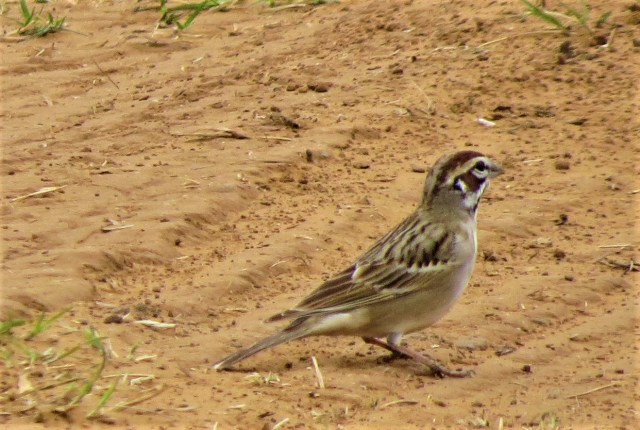
Lark Sparrow, Kinney Road Sod Farm, Bexar, March 18th 2017.
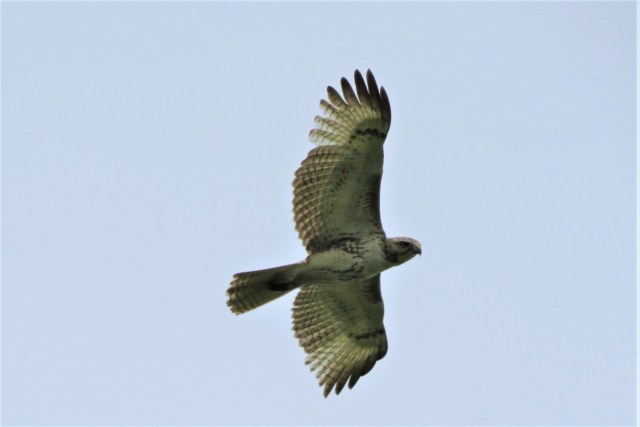
With my lifer target safely under the belt, we rounded out the morning touring a number of local birding spots on the hunt for early migrants, with the highlights being American Golden Plover, Pectoral Sandpiper, Lark Sparrow, and best of all several very pale “Krider’s” Red-tailed Hawks:
“Krider’s” Red-tailed Hawk, one of two birds seen during the morning in the San Antonio area, March 18th 2017.
Black and White Warbler, Holt Paradise Pond (Port Aransas), March 13th 2017.
It’s mid-March and we are right on the cusp of Texas’s most exciting time for birds – spring migration – so this weekend I decided I had better get down to the Lower Rio Grande Valley to grab some nice tropical year ticks (and perhaps a lifer or two) before I get too distracted by migration here on my doorstep in Houston.
It’s a long way to “the Valley”, about a 5.5 hour drive each way, and to avoid putting lots of miles on the elderly Jaguar I am currently borrowing, I instead opted to rent an economy car. With more than 900 miles driven over the three days, the money I saved in gas compared to running the Jaguar almost equaled the cost of renting a compact Hyundai. And as every birder knows, the great thing with a rental car is that you can rack up thousands of miles driving it non-stop for days, fill it with mud, take it down potholed unmade roads and onto beaches, then hand it back and let Enterprise take care of the wear and tear. It wouldn’t surprise me if before long some rental companies wised up and inserted a “no birding” clause in their rental agreement.
Louisiana Waterthrush, Falfurrias Rest Area, March 11th 2017.
An essential stop on every birding itinerary to south Texas is the Falfurrias Rest Area, a busy toilet block and picnic area sandwiched in between the north- and southbound carriageways of highway 281. Despite the unpromising-sounding description, the numerous mature trees here are alluring for migrants, and there is even a short nature trail through some very birdy-looking woods draped in Spanish moss. For some reason – perhaps because a lot of birders stop here – this place has a reputation for turning up lots of rarities.
My 30-minute stop here yielded a ton of great birds, including a lifer Yellow-throated Warbler, Louisiana Waterthrush, Blue-headed Vireo, Yellow-bellied Sapsucker, and the first signs of the tropical south: several noisy and colorful Green Jays.
Yellow-throated Warbler, Falfurrias Rest Area, March 11th 2017.
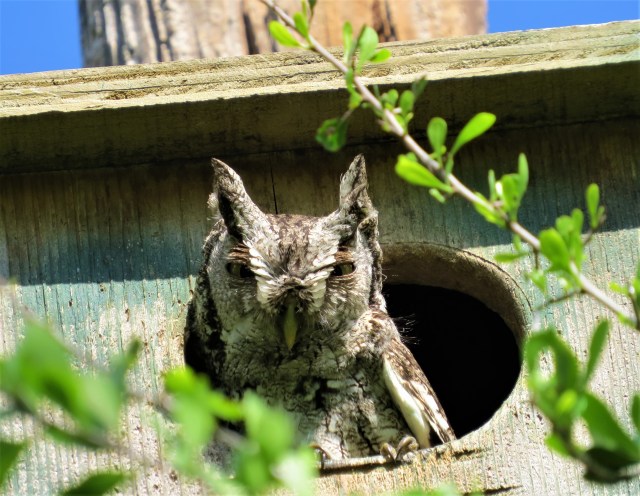
Once down in the LRGV, the cloudy morning gave way to a sunny and sweltering hot afternoon with high humidity and barely a breath of wind. I spent the whole afternoon at Estero Llano Grande State Park, mopping up year ticks at their usual stakeouts, including this Eastern (McCall’s) Screech Owl ……
Eastern (McCall’s) Screech Owl, Estero Llano Grande SP, March 11th 2017.
….. and this Common Pauraque, which most likely holds the honor of being Texas’s most photographed bird:
Common Pauraque, Estero Llano Grande SP, March 11th 2017.
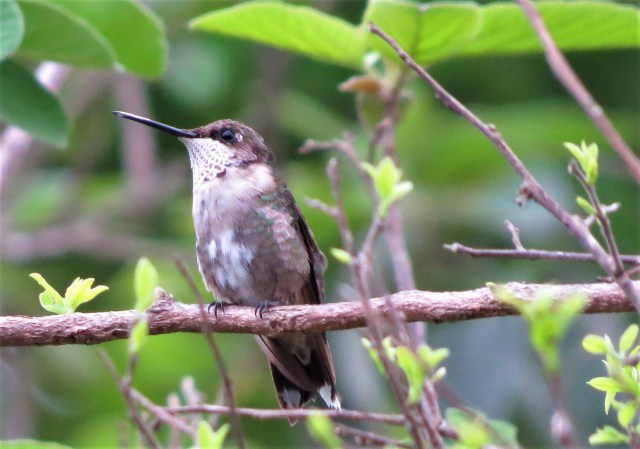
However, I unfortunately managed to miss the long-staying male Rose-throated Becard by less than half a minute. It also proved harder to connect with hummingbirds here than it did last winter, but I did eventually find both Buff-bellied Hummingbird and this Black-chinned Hummingbird in the Tropical Zone:
Black-chinned Hummingbird, Estero Llano Grande SP, March 11th 2017.
By dawn on Sunday morning the weather had changed dramatically, as is common in these parts, with temperatures dropping from the mid-80s to the mid-60s and a chilly wind blowing. I turned up at Santa Ana NWR and was immediately cheered by the news that no fewer than 8 Northern Beardless-Tyrannulets had been seen in various locations in the park yesterday, and I was directed to an area where a pair was in the process of nest-building close to the trail. Not only could I hear a male Northern Beardless-Tyrannulet singing there when I arrived, but another one was answering it not too far away. Only a matter of time before I saw one, right? Wrong. The birds stayed well hidden in the breezy conditions, and before long stopped singing entirely, making them impossible to locate.
Compensation of sorts came in the form of several wonderful Altamira Orioles, an LRGV specialty which is found nowhere else in the US:
Altamira Oriole, Santa Ana NWR, March 12th 2017.
…. and Olive Sparrows, which are abundant at this site, and once I became familiar with their call I began finding them everywhere, but they stubbornly refused to be photographed.
It was difficult to decide what to do with the afternoon. I opted for the Yturria Tract, an arid area of thorn scrub, which at lunchtime on a cool and breezy day was a gamble, but I got lucky and saw some good birds including my main target Black-throated Sparrow (seemingly common here), White-tailed Hawk, Harris’s Hawk, Greater Roadrunner, Pyrrhuloxia and Verdin.
Harris’s Hawk, Santa Ana NWR, March 12th 2017.
I rounded out the afternoon at Anzalduas Park, where I had no specific targets in mind and hoped to enjoy some “general birding”. My wish came true, as the park was bursting at the seams with common birds, including one amazing flock which contained perhaps 35 individual birds of 14 different species.
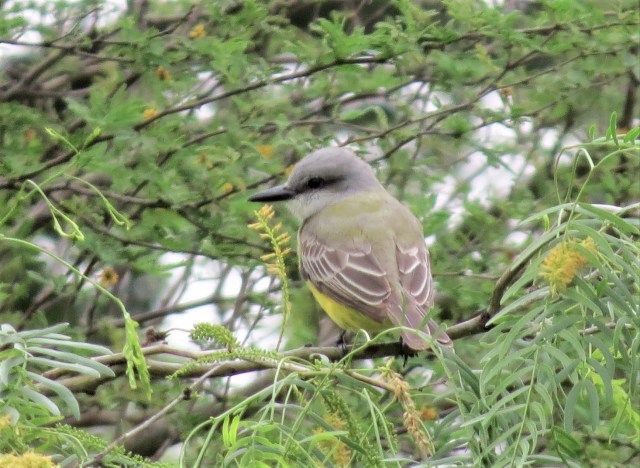
It was good to compare Couch’s and Tropical Kingbirds, both on voice and plumage:
Couch’s Kingbird. This individual was photographed at Santa Ana NWR but I saw them at most sites in the LGRV. Note the thick-based and relatively short bill, and overall green tone to the mantle.Tropical Kingbird, Anzalduas Park, March 12th 2017. Much scarcer than Couch’s Kingbird in the LRGV. Note the relatively long and thin-based bill, and grayer tone to the mantle compared to Couch’s Kingbird. The plumage differences are subtle, and voice is definitely the best way to distinguish the two species.
Border police booted me out of the park at 5.00pm sharp – Anzalduas Park is on the banks of the Rio Grande which forms the border with Mexico, and there is a huge police and border security presence in the area. I decided to start the long drive north in order to be ready for a dawn start on the coast in the Mustang Island/Port Aransas area.
Wilson’s Plover, Kennedy Causeway, Nueces County, March 13th 2017.
The day started with two fine Wilson’s Plovers, a shorebird I have seen only once before, in Honduras, then a flock of nine Pectoral Sandpipers – another USA tick, and another one struck off from the long list of Nearctic shorebirds I have seen as vagrants in the UK but not yet in their normal range in the Americas.
Two fantastic migrant hotspots on Mustang Island – “The Willows” and “Holt Paradise Pond” really raised the anticipation levels for the upcoming spring migration. Between the two sites, I saw two Louisiana Waterthrush, a total of 5 Black-and-White Warblers, Yellow-throated Warbler, White-eyed Vireo and Gray Catbird – a mere taster of the kind of range and quality that will be at these sites in a month’s time, I suspect!
I had to leave around lunchtime to make sure I got back to Houston in time for the rental car return deadline, but there was just enough time to grab Sandwich Tern for the year at the Port Aransas jetty, and this portrait of a Long-billed Dowitcher at the Port Aransas Nature Preserve:
Long-billed Dowitcher, Port Aransas Nature Preserve, March 13th 2017.
With the clocks having gone forward this weekend, lighter evenings present opportunities for after-work birding. On Wednesday, a late afternoon visit to the Edith L Moore Nature Sanctuary, less than a mile from where I am currently living, turned up my 7th Black-and White Warbler of the last seven days (and 8th of the year overall), a fine male Wilson’s Warbler, and a long overdue Northern Flicker for the year list.
I’ll be in a warbler frame of mind in San Antonio this weekend, with Golden-cheeked Warbler top of the agenda – watch this space!
Total species count, LRGV and coastal Texas, March 11th-13th: 136
Lifers this weekend: Yellow-throated Warbler, Black-throated Sparrow (total 2,155).
Hutton’s Vireo in song, Panther Springs Park, San Antonio, March 5th 2017.
Hutton’s Vireo is a bird that flies under the radar. It is unremarkable looking – resembling a super-chunky, thick-billed Ruby-crowned Kinglet – and it attracts very little attention to itself. In central Texas its status is described as “scarce and local, but increasing”, with a patchy distribution restricted to the Edwards Plateau. In the San Antonio area, despite numerous well-scattered records, there doesn’t seem to be any particular location where sightings can be guaranteed.
In other words, it’s not exactly the kind of bird that gets me enthusiastically leaping out of bed at 5.00am on a Sunday, hence why I haven’t gone out actively looking for one until now. But with my pipeline of potential lifers rapidly drying up, and the refreshing onslaught of spring arrivals still a few weeks away, I figured it was about time I tried to score. A quick eBird search soon revealed a few likely spots on the northern outskirts of San Antonio, including a location where my friend Sheridan Coffey had seen one just the day before.
My lack of urgency to see this bird is reflected in the fact that I didn’t even start the day at my selected Hutton’s Vireo site, instead choosing to mooch around nearby Stone Oak Park in the mist and drizzle of a mild, damp Sunday morning. I did have an ulterior motive here, with Rufous-crowned Sparrow (another unremarkable life bird) top of the agenda, plus Canyon Wren and the long-staying Say’s Phoebe, all of which made it onto my list with the minimum of fuss.
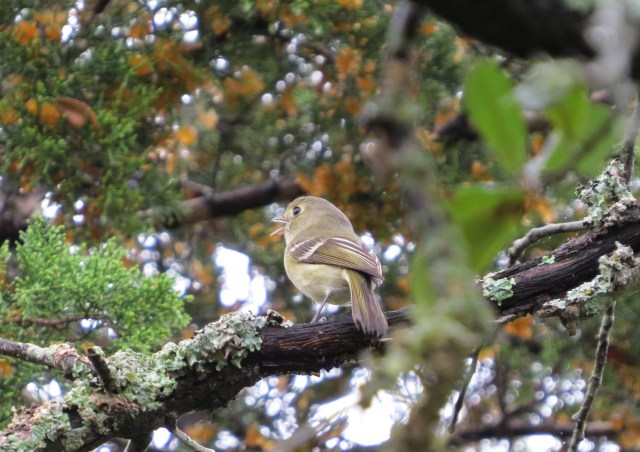
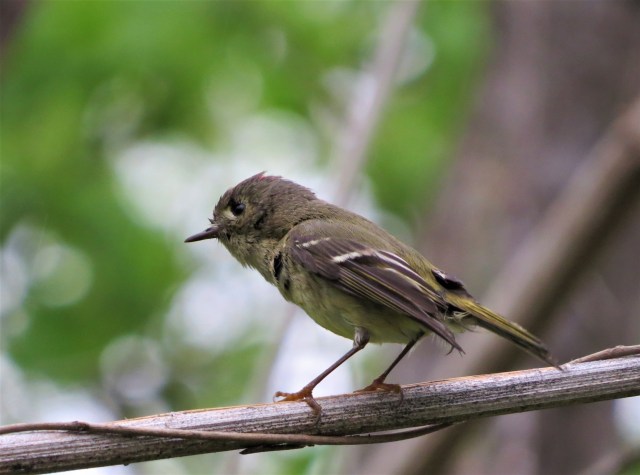
The drizzle had stopped by the time I got to Panther Springs Park, allowing at least some record shots of the single Hutton’s Vireo I found there, which I first located by song. This bird allowed a close approach but was constantly backlit against the sky or obscured by twigs. The photos below show a comparison with the superficially similar Ruby-crowned Kinglet:
Hutton’s Vireo, Panther Springs Park, March 5th 2017. Note the chunky build, thick bill, incomplete pale eyering (strongest behind the eye) and the lower wingbar connecting to the pale primary edges.Ruby-crowned Kinglet, Riverview Park, Seguin, March 4th 2017. Note the slim build, fine bill, and darker primaries with a distinct blackish bar below the second wingbar.
The day before had been a washout, with constant rain all day. I took my wife’s cousin’s kids (triplets!) on an early-morning jaunt to Riverview Park in Seguin, haunt of the long-staying White-breasted Nuthatch. It was a lot of fun but – perhaps predictably with steady rain falling and three ebullient 10-year-olds in tow – not productive for the nuthatch. The kids really enjoyed the birding, though, with the highlight for them being three woodpecker species in the same pecan tree (Ladder-backed, Downy, and Golden-fronted), and for me the Green Kingfisher that flashed past us twice when we were clowning around trying to cross a small stream.
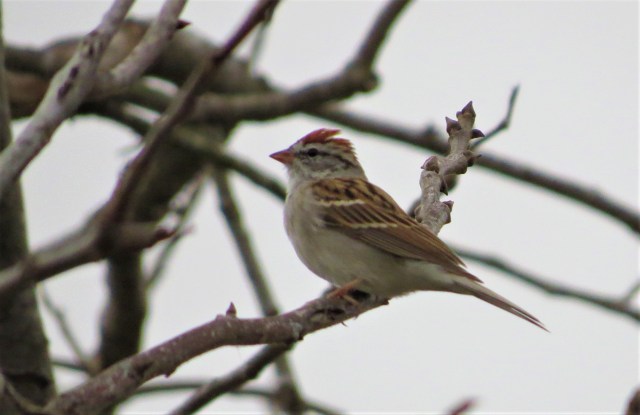
I spent Saturday afternoon trying to take photos of the birds coming to the yard feeders in New Braunfels, and getting almost no usable shots in the very poor light conditions. My best effort was this Chipping Sparrow:
Chipping Sparrow, New Braunfels, March 4th 2017.
Anyway, it was a satisfying weekend all told, especially considering the limitations imposed by the weather. In a few days I’ll be off on a long weekend down to the lower Rio Grande Valley, which should yield a bunch of year ticks, and hopefully the first stirrings of Texas’s all-important spring migration!
Seaside Sparrow, Bolivar Shorebird Reserve, February 25th 2017.
My seemingly eternal focus on sparrows continues, but in stark contrast to last weekend’s failures, this time I succeeded in seeing all four of my target species. This is no mean feat considering that they are all notorious skulkers, and their status is at best uncommon in Texas in winter.
The rarest of them all is Henslow’s Sparrow. This subtly attractive denizen of grasslands probably overwinters annually in Texas in small numbers. However, until this winter it has been a serious “blocker” for many leading Texas listers, with just a scattering of records annually and no reliable locations. That changed early in February when several individuals were discovered at Big Thicket National Park in East Texas, which have been showing intermittently to visiting birders ever since.
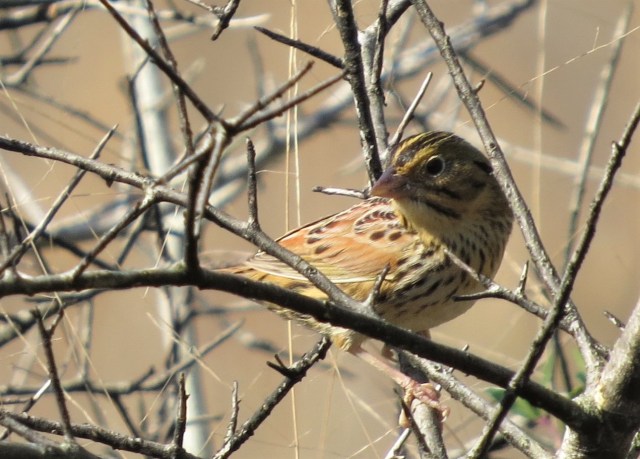
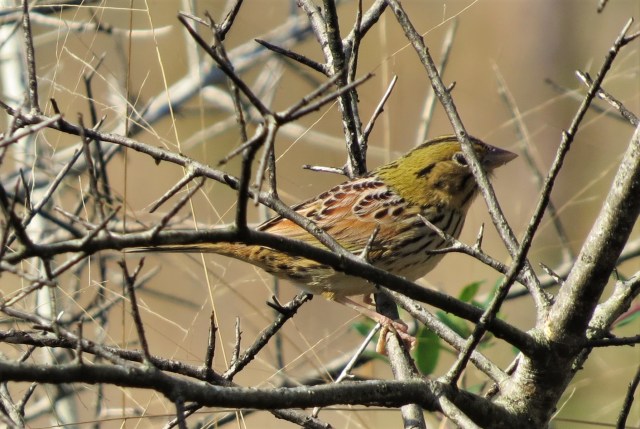
Henslow’s Sparrow, Big Thicket NP, February 26th 2017.
Finding these birds proved to be far from straightforward. They feed singly in long grass, and flush at close range, usually flying directly to the nearest patch of Yaupon Holly, into which they dive and completely disappear. For nearly three hours I tramped around in the grass, flushing three “probable” Henslow’s Sparrows, none of which gave me more than the briefest of flight views – enough to raise my suspicions but unfortunately not clinch the identification, let alone provide an opportunity for photos.
I persevered, knowing from photographic evidence on eBird that they do occasionally perch up on a Yaupon Holly for a few moments before diving in. And finally one did just that. It happened to be a very well-marked bird, and in great light, so apart from the unavoidable branches between camera and bird (for this one virtually never poses fully in the open), I got great views as well as some half-decent photos.
Henslow’s Sparrow, Big Thicket NP, February 26th 2017.
Other bird life was disappointingly scarce, but several Sedge Wrens skulked around in the damp grassland, one of which posed briefly for a photo opportunity:
Sedge Wren, Big Thicket NP, February 26th 2017.
The previous day, I had arrived early at Bolivar Flats Shorebird Reserve, a short ferry ride across from Galveston. The two main enemies to birding on the mid-Texas coast in winter are wind and fog – and if it’s not windy then it is usually foggy. Neither weather phenomenon is very conducive to finding small birds (ie. rare sparrows) in coastal saltmarshes. Today, it was windy. Shorebirds were everywhere, including plenty of the endangered and irresistibly attractive Piping Plover, and also Semipalmated, Snowy, and Black-bellied Plovers, Least and Western Sandpipers, Dunlins and Sanderlings . A handful of Barn Swallows and a Purple Martin, early harbingers of spring, battled the wind as they headed north.
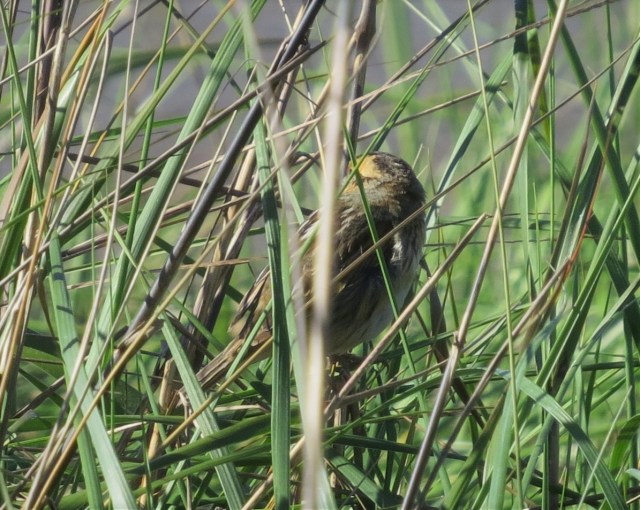
I didn’t rate my chances of finding any interesting small birds in the blustery conditions, but an area of saltmarsh grass adjoining a small beach seemed to be popular with Savannah Sparrows so I decided to take a closer look. After a while, I found a Horned Lark and some American Pipits, and then …. the briefest of views of two sparrows with orange faces, running on the ground, which briefly appeared at the edge of the grass before disappearing again.
I didn’t see these birds again for 15 minutes, until they suddenly popped up on some grass stems, showing quite well. Nelson’s Sparrows, for sure – but my luck deserted me with the camera, and I couldn’t get a single in-focus shot during the 10 seconds the birds were in view. Naturally, as soon as the sparrows dropped down into a partly obscured position, facing the wrong way, the camera decided to play ball.
Nelson’s Sparrow, Bolivar Shorebird Reserve, February 25th 2017. The face pattern as well as the unstreaked grey nape can just about be seen in this photo.
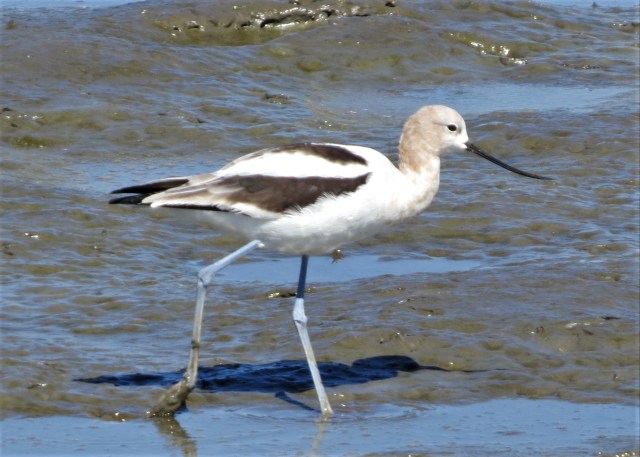
The nearby 17th Street Jetty is always a good bet for big flocks of American Avocet, as well as other shorebirds, and plenty of weekending fishermen. The jetty – which is made of huge, flat-topped boulders – extends a long way into the Gulf, clipping the corner of some extensive areas of saltmarsh habitat.
American Avocet, Bolivar 17th Street Jetty, February 25th 2017.
Some serious schlepping over the boulders is required to get to the end of the jetty, and I was more than halfway out when I realized I had left my brand new iPhone in full view on my car seat. Cursing my stupidity, I turned around and headed back, only to flush a very interesting-looking small bird from among the boulders, which almost immediately gave itself up for crippling views – Seaside Sparrow! If I had remembered to bring my phone, I wouldn’t have had to turn around, and wouldn’t have seen the bird.
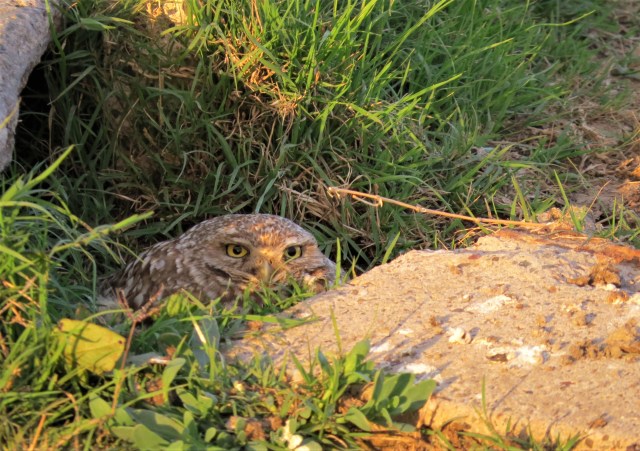
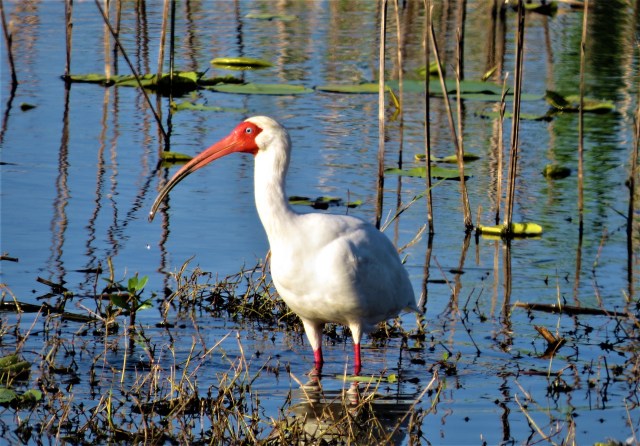
I spent the rest of Saturday at Anahuac NWR, which has to be one of the very best birding spots within easy reach of Houston. This site usually produces at least 60-70 species during a typical mid-winter visit. The best birds today included the long-staying Burrowing Owl, a Palm Warbler of the western race, the male Vermilion Flycatcher still present, and four Stilt Sandpipers with the Long-billed Dowitcher flock. It’s also a great place to get close to common birds, with the car-based birder having numerous opportunities for photography along the Shoveler Pond loop.
Burrowing Owl, Anahuac NWR, February 25th 2017.American White Ibis, Anahuac NWR, February 25th 2017.(Western) Palm Warbler, Anahuac NWR, February 25th 2017. This photo was taken at 100x magnification – in fact it was too distant to ID through binoculars – I just had a hunch that it was “interesting” so I reeled off a bunch of photos.Vermilion Flycatcher, Anahuac NWR, February 25th 2017.
I stayed overnight in the “Crystal Meth Motel” in Beaumont, the cheapest night halt available in town. Next time, I will fork out the extra $20 for something halfway acceptable. However, I survived the night, and with the Henslow’s Sparrows safely under the belt (and photographed) at nearby Big Thicket NP by late Sunday morning, I decided to push the envelope and hit up a Bachman’s Sparrow spot about an hour to the north at Sam Rayburn reservoir.
Bachman’s Sparrow, along with Red-cockaded Woodpecker and Brown-headed Nuthatch, is a range-restricted specialist of south-eastern pine forests. However, unlike the woodpecker and nuthatch, it no longer occurs close to Houston – although it is apparently still quite common nearer the Louisiana border.
From my eBird research, one of the closest reliable sites is the entrance road to Ebenezer Park, close to the reservoir spillway. The woods were deathly quiet when I arrived, with hardly a bird to be seen. Wandering up and down the road eventually produced a few Chipping Sparrows and Pine Warblers, a Field Sparrow, a Song Sparrow, and two Brown-headed Nuthatches – expected fare for this kind of habitat. It became clear I would have to enter the forest for a chance of getting my target bird. Expectations were raised when a Bachman’s Sparrow gave a short burst of song, and finally I flushed one out of the understorey which perched up long enough to be identified, but unfortunately wasn’t obliging enough to allow itself to be photographed.
So all in all, a highly successful weekend. I’m running out of “new” winter birds to see within reach of Houston, so I feel a longer-haul trip to the Rio Grande Valley coming on – not to mention the fast-approaching spring migration which is of course legendary in this part of the world!
American Alligator, Anahuac NWR, February 25th 2017.
I set myself an ambitious target of 5 lifers from this weekend, but despite plenty of effort managed to see none of them at all. However, in between the numerous moments of frustration there was still lots to enjoy, notably the first field outing for my new camera. Last week, I finally took the plunge and invested a small amount of money in a used Canon SX50HS “superzoom”, which has been receiving glowing reports from birders since it came onto the market in 2012. My first weekend with it was somewhat experimental, but resulted in a few pleasing photos – and of course a lot of out-of-focus dross!
Ladder-backed Woodpecker, Balcones Canyonlands, February 18th 2017.
Saturday was one of those picture-perfect days that seem to be happening a lot during this non-winter we’ve been experiencing in Texas: crystal clear air, mostly blue skies with a little high cloud, and a cool start to the day but warming up to an afternoon high of 84F (29C).
By first light I was already at the edge of the Balcones Canyonlands reserve in the “hill country” outside Austin, with my target lifers in this area being Black-throated Sparrow, Rufous-crowned Sparrow, and Canyon Towhee – all of which are no doubt fairly common further west, but are at the far eastern edge of their range here. It seemed from my reading that these kinds of species prefer arid, rocky slopes and canyons, and my main problem – as often seems to be the case in Texas – was actually getting to this habitat in an area where so little of the land is accessible to the public.
Field Sparrow, Balcones Canyonlands, February 18th 2017.
Nonetheless, I had a most enjoyable start at the Doeskin Ranch, one spot to which the public have been granted access. I didn’t see any obvious habitat for my target birds, but a couple of hours here did produce 10 sparrow species within just a 300-yard radius of the parking lot (Grasshopper, Le Conte’s, Lark, Fox, Song, Lincoln’s, White-throated, Vesper, Field, and Savannah). I even managed record shots of both of the Ammodramus sparrow species on this list – surely it is a good omen to get these tricky skulkers on my “photographed” list on my very first morning with my new camera!
Grasshopper Sparrow, Balcones Canyonlands, February 18th 2017. My photo of its relative Le Conte’s Sparrow was even less impressive, but nonetheless getting two Ammodramus species on camera in one day is not to be sniffed at!
If getting the sparrows on camera is a good omen, the karma must be coming at a later date because my luck deserted me for the remainder of the weekend. Several more hours in different areas of the canyonlands turned up just two Dark-eyed Juncos, a flock of eight Lark Sparrows, and a pair of Woodhouse’s Scrub-Jays of note – and they wouldn’t even do me the courtesy of getting in front of my camera lens.
With the temperature rising but the winds still nice and light, I drove an hour east to try yet again for the elusive flock of McCown’s Longspurs near Granger Lake. Finding these birds is becoming something of an obsession. A flock of over 100 McCown’s Longspurs – plus another 100 unidentified longspurs, probably all McCown’s but conceivably also including Lapland and Chestnut-collared – had been seen the previous day along road 378, and with such good viewing conditions today I really did fancy my chances.
A distant flock of small birds disappointingly turned out to be American Pipits on closer inspection, but otherwise there was little of interest to be seen, with a faraway and very un-birdlike Coyote loping across a bare earth field being the highlight. Another birder gently informed me that I was probably a bit too hung up on these McCown’s Longspurs, and that I should consider quitting – but I reckon I have one more Granger Lake session in me before the winter is over. Satisfaction is doubled when one finally finds a bird one has looked for so hard.
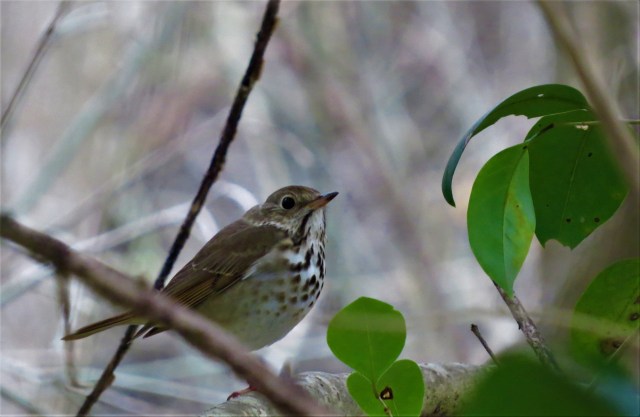
Hermit Thrush, Southside/Lions Park, San Antonio, February 19th 2017 – getting this one on camera was the high point of rather a birdless visit.
Dip number 5 was perhaps even harder to take than my ongoing failure with the longspurs. I spent (wasted?) most of a perfectly decent Sunday hanging around in the woods beside a small creek in a San Antonio park, the favored location of the male Black-throated Blue Warbler which had been showing to all-comers literally every single day since the last time I dipped it here two weeks ago. But it seems it chose Saturday night to disappear, with no sightings since then. Whether it departed of its own volition or was murdered, we will never know …. although my suspicions were raised when this guy turned up at the exact spot favored by the warbler:
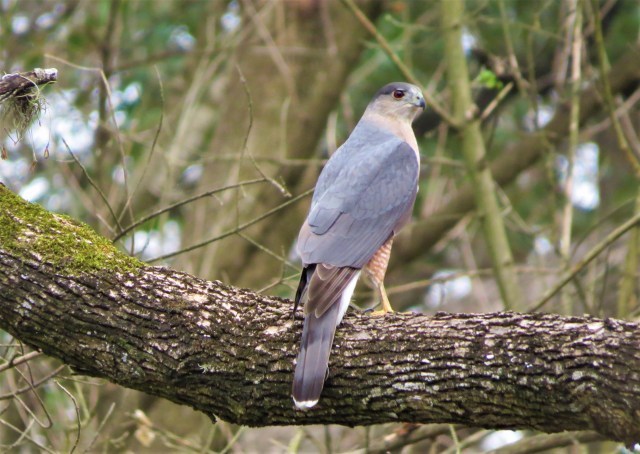
Cooper’s Hawk, Southside/Lions Park, San Antonio, February 19th – a prime suspect in the unsolved case of the missing Black-throated Blue Warbler.
Around lunchtime I took a half-time break from Lions Park and headed to nearby Mitchell Lake for some light relief, which came in the form of lots of photographic opportunities for common birds around the visitor center:
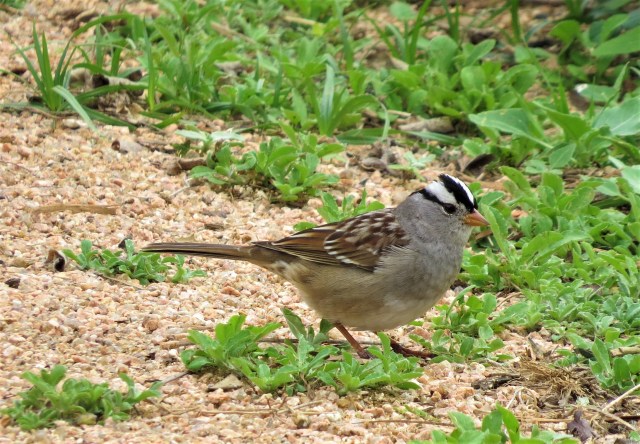
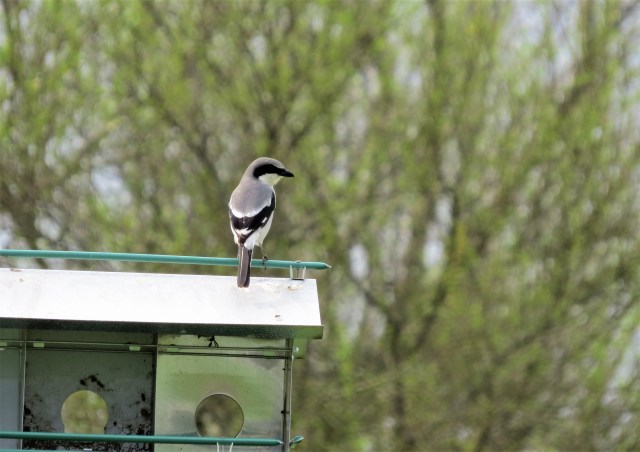
White-crowned Sparrow, Mitchell Lake, San Antonio, February 19th 2017.Loggerhead Shrike, Mitchell Lake, San Antonio, February 19th 2017.Northern Cardinal, Mitchell Lake, San Antonio, February 19th 2017.
It’s hard to know what to make of last weekend. I got some satisfying photos but all I know at this point is that I’m getting fed up with long drives “out west” and coming back with little in the way of new birds to show for it. So where to go on Saturday? The previous weekend yielded Palm Warbler and Clapper Rail in Galveston, so maybe I’ll stay relatively local. On the other hand, there is also a Henslow’s Sparrow to go for at Big Thicket National Park, towards the Louisiana border. I guess I will decide how I feel on Friday!
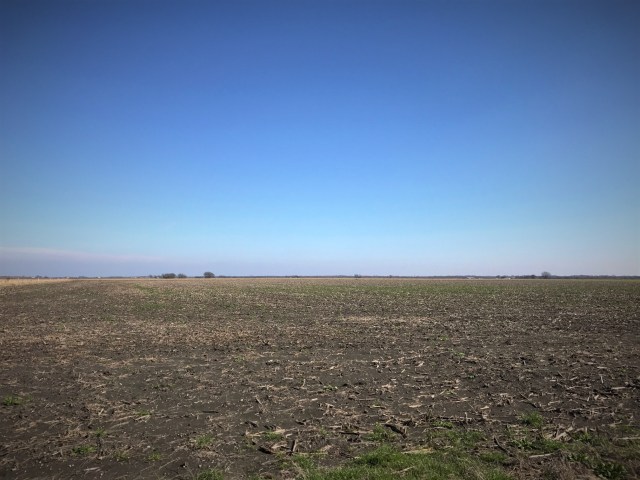
Wide open spaces west of Granger Lake, near Austin, Texas, January 21st 2017. This area hosts several sought-after but hard to find specialties in winter.
One of the joys of birding is that you never quite know what to expect. In May 2015, a trip to Hungary gave me 8 species of woodpecker including the sought-after White-backed, Grey-headed, and Middle Spotted – but inexplicably we failed to find a Green Woodpecker, normally one of the commonest and certainly the most conspicuous of them all. Meanwhile, I have yet to see Yellow-bellied Flowerpecker at the summit of Doi Inthanon in Thailand after more than 15 visits – this is a bird that literally everyone else seems to connect with on their first or second try, and they all post nice close-up photos on Facebook to prove it.
On Saturday, I started early from Houston and headed over to Granger Lake to try for two regional wintering specialties – McCown’s Longspur and Mountain Plover. I missed them both, but instead came away with two completely different and relatively unexpected lifers. Such is birding.
Granger Lake lies to the north-east of Austin, and like almost all large bodies of water in Texas, was artificially created – in this case by damming the San Gabriel river. The area is of interest not so much for the lake itself, but for the open fields and prairies lying to the west. McCown’s Longspur and Mountain Plover both have fairly small breeding and wintering ranges restricted to the central U.S. They are found in flocks in winter, and range over large areas of wide-open habitat – meaning that birders are likely to find either a lot of them, or none at all.
Having driven around minor roads staring at empty earth fields for a while, I happened to stop by the San Gabriel unit, a wildlife protection area near the shores of the lake. An overgrown field here seemed potentially “sparrow-y”, and being keen to add some birds to the rather slow day list, I decided to thrash around in the field and neighboring scrubby woodland for a while. This turned out to be an excellent plan, with a nice range of sparrows popping up including Field, Swamp, Song, and – lifer number one – a Grasshopper Sparrow which responded to my “pishing” and gave prolonged views on a low bush. This is supposed to be a fairly common resident in Texas, but has a reputation for being rather secretive, so I counted myself lucky to get such good views.
Emboldened by my sparrow success, I continued a few miles to Willis Creek park, where a scrubby area near the boat ramp produced another good flock, this time including a Harris’s Sparrow – surely one of the handsomest of sparrows – and a second lifer, a smart red-and-grey Fox Sparrow.
I left the area feeling very satisfied with my haul, until later in the evening when I read another eBird report by a birder who had found both Mountain Plover and McCown’s Longspur, along some of the same roads I had driven down. It’s always a little galling when that happens – maybe this weekend I’ll get a chance to go back.
Lifers: Grasshopper Sparrow, Fox Sparrow (total 2,140).
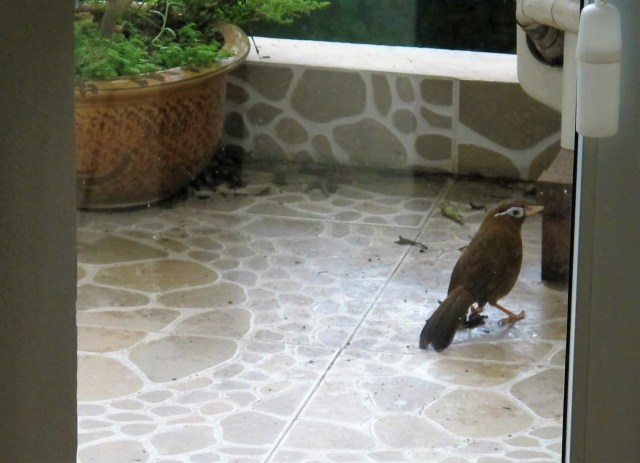
Chinese Hwamei, a bird that has been hunted to near-extinction in Vietnam, but which turns up occasionally in Hanoi. This bird was singing loudly on my balcony one morning, within earshot of the Red River Island, and I saw another later the same morning in the North Wood. We must assume the origins of these two to be dubious at best!
I visited the Red River Island on eight mornings between April 20th and May 1st, spending almost all of my time in the North Wood and surrounding areas of grassland and farmland. Happily no one seemed to be bird-hunting in the area during the period, and the destruction of the North Wood has been temporarily suspended. In fact, one good strip of habitat in the wood is still completely untouched – I was told that the family who own this strip haven’t got around to cutting it down yet. The felling of the remaining trees seems inevitable but I am crossing my fingers that they wait just a couple more weeks until spring migration is over ….
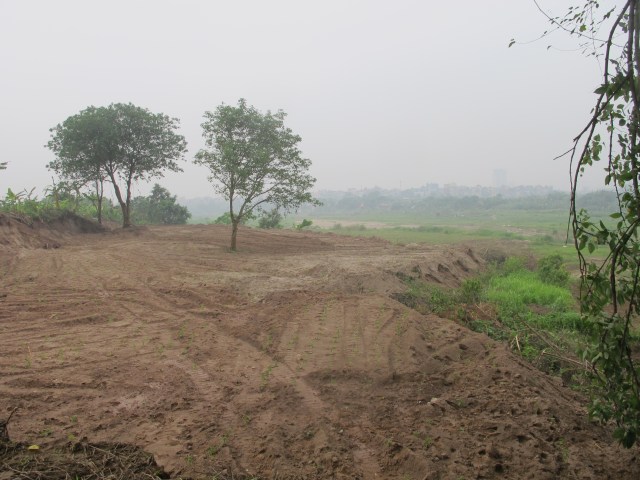
On the negative side, the overgrown field immediately to the west of the North Wood – a favorite recent haunt of Japanese Quail – has now been destroyed and planted with crops, and a decent patch of trees and scrub to the south – which hosted a male Siberian Thrush early in the period – was bulldozed overnight to become just another bare earth field.
Yet more habitat destruction on the Red River Island. Until a week ago, this was an interesting patch of trees and scrub which hosted a male Siberian Thrush on April 21st.
Full sightings list from my visits on April 20th, 21st, 22nd, 23rd, 25th, 27th, 29th, and May 1st:
Japanese Quail – one flushed on 20th and 23rd in the now-destroyed overgrown field next to the North Wood. Asian Openbill – a flock of 42 soaring over the Red River on 23rd. Striated Heron – one in the North Wood on 27th. Cattle Egret – single bird on 21st and 23rd. Chinese Pond Heron – peak count of 10 on 21st. Black-shouldered Kite – resident, 1-2 birds seen most visits. Japanese Sparrowhawk – male hunting in North Wood on 23rd. Chinese Sparrowhawk – male over on 27th. Eurasian Hobby – one over the North Wood on 1st. White-breasted Waterhen – single bird around the edges of the North Wood on two dates. Ruddy-breasted Crake – heard singing near the North Wood on 20th but not seen. Grey-headed Lapwing – one poorly photographed on 29th in farmland south-east of the North Wood. Little Ringed Plover – 1-2 seen most visits. Common Sandpiper – occasional singles. Common Greenshank – flock of 11 on the Red River sandbar on 20th, single still present on 22nd and 23rd. Barred Buttonquail – scarce resident, one south-east of the North Wood on 1st. Oriental Turtle Dove – four on 21st and one on 22nd. Red Collared Dove – seen on most visits with a peak count of 8 on 27th. Wedge-tailed Green Pigeon – single male on 21st and 23rd. Now four records in the North Wood this spring. All the birds have appeared very uniform yellow-green below with no hint of a white or whitish belly. Spotted Dove – one on 29th. Chestnut-winged Cuckoo – one on 1st. Large Hawk Cuckoo – one in the North Wood on 21st and 22nd. Hodgson’s Hawk Cuckoo – one showed very well in the North Wood on 25th. Oriental Cuckoo – singles on 21st and 23rd. Indian Cuckoo – one singing on 1st, 0.4km south of the North Wood, but not seen. Plaintive Cuckoo – commonly heard, occasionally seen. Greater Coucal – common resident, more often heard than seen. Lesser Coucal – singles seen on two dates during the period. Grey Nightjar – one in North Wood on 27th, my personal third record of the spring here. Germain’s Swiftlet – five over on 29th. Black-capped Kingfisher – single on three dates. Pied Kingfisher – common resident, peak count of 5 on 29th. Black-winged Cuckooshrike – 1-2 on three dates. Tiger Shrike – male on 25th. Burmese Shrike – common migrant throughout April but not seen since 27th. Peak count of 4 on 25th. Brown Shrike – becoming more numerous as Burmese Shrike declines, peak count of 6 on 1st. Black-naped Oriole – seen on most dates with a peak count of 10 on 23rd. Black Drongo – 12 passing through on 23rd during a morning of heavy drongo passage. Ashy Drongo – common migrant with a peak count of 10 on 23rd. Hair-crested Drongo – common on most dates during the period with a peak count of 65 during very heavy rain on 22nd. Crow-billed Drongo – at least two on 27th, and some distant drongos flying through on this date may also have been this species. White-throated Fantail – resident in the Hanoi area, 1-2 occasionally seen in North Wood. Black-naped Monarch – 1-2 on most dates. Blyth’s Paradise-Flycatcher – male on 25th. Amur Paradise-Flycatcher – two females on 27th, told from Blyth’s by sharp demarcation between black throat and grey breast. Red-billed Blue Magpie – resident in the area, up to four seen on most dates. Grey-throated Martin – just one bird recorded during the period. Barn Swallow – small numbers on passage with a high count of 6 on 21st. Red-rumped Swallow – small numbers on passage with a high count of 5 on 23rd. Japanese Tit – one on several dates in patch of trees south of the North Wood. Sooty-headed Bulbul – up to five on several dates. Red-whiskered Bulbul – three on 21st was the only record during the period. Light-vented Bulbul – just one record of one bird on 1st. Dusky Warbler – common migrant with a high count of 15 on 22nd. Radde’s Warbler – less common than Dusky. Up to three on most dates. Yellow-browed Warbler – sharp decline during the period, from 7 on 21st to none at all on 1st. Arctic Warbler – three on 29th and five on 1st, with several birds in song. Pale-legged Leaf Warbler – single(s) on five dates. This species prefers more enclosed forest and is usually 4-6 feet off the ground. Eastern Crowned Warbler – one on 20th and three on 25th. Claudia’s Leaf Warbler – regular migrant throughout April but not seen since 22nd. Grey-crowned Warbler – on 22nd, one seen and a second individual heard, distinctive soft double-note call. Bianchi’s Warbler – one on 20th. Distinctive call, a soft, slightly cracked-sounding “heu”. Other seicercus warblers seen during the period didn’t call, so ID not certain, but they resembled Bianchi’s in plumage with greenish forehead and crown-stripes not extending to bill base. Thick-billed Warbler – one on 22nd, then a noticeable increase late in the period with two on 29th and four on 1st. Black-browed Reed Warbler – a common migrant throughout the period, often heard singing, with a high count of 12 on 29th. Oriental Reed Warbler – singles on 20th and 22nd. Zitting Cisticola – common resident. Common Tailorbird – common resident, pair observed nest-building along edge of North Wood. Yellow-bellied Prinia – abundant resident. Plain Prinia – abundant resident, generally preferring more open/grassy areas than Yellow-bellied. Japanese White-eye – 1-6 on all dates, much reduced in number compared to earlier in the spring. Masked Laughingthrush – single very vocal bird, heard on every visit and seen on several dates, apparently now the only survivor of the flock of up to 5 that were formerly resident in the area. White-crested Laughingthrush – one, almost certainly an escapee, on 1st, accompanied by a second bird that resembled a White-crested Laughingthrush but had apparently been dyed yellow. Chinese Hwamei – one in the North Wood on 22nd. There is also a long-staying bird just outside the area, singing regularly in gardens near my house off Phan Lan Street, and photographed on my balcony on the same date as the North Wood bird. Presumably both birds are of dubious origin! Dark-sided Flycatcher – singles in the North Wood on four dates. Asian Brown Flycatcher – common migrant with high count of 5 on 21st. Hainan Blue Flycatcher – one on 20th was the last record of the spring – this species was commonly observed in late March/early April. Blue Whistling Thrush – one on 23rd. Siberian Rubythroat – sharp decline since early April, with only one individual remaining by 1st. Siberian Blue Robin – male on 27th and two on 29th. Yellow-rumped Flycatcher – seen on three dates with a high count of three on 1st. Mugimaki Flyatcher – seen on five dates with a high count of four on 20th. Taiga Flycatcher – common migrant, seen on every visit with a high count of 5 on two dates. White-throated Rock Thrush – male seen in the small patch of trees south of the North Wood on 20th, 21st and 23rd. Siberian Stonechat – very common migrant with a high count of 15 on 21st, noticeable decline late in the month. Siberian Thrush – adult male in the now-bulldozed patch of trees south of the North Wood on 21st. Eyebrowed Thrush – two on 20th were the last records of the spring. Crested Myna – two flying over on 22nd, and three unidentified mynas that were perhaps this species distantly on 1st. Citrine Wagtail – one on 21st and a flock of 12, the majority apparently adult males, flying north on 25th. White Wagtail – just one seen during the period, on 20th. Forest Wagtail – one in the North Wood on 29th. Richard’s Pipit – 2-4 birds on most dates, usually in farmland south-east of the North Wood. Paddyfield Pipit – fairly common resident seen or heard on most dates. Olive-backed Pipit – late singles over on 22nd and 25th, this was a common bird earlier in the spring. Red-throated Pipit – single over on 22nd. Oriental Greenfinch – four on 23rd. Eurasian Tree Sparrow – occasional individuals recorded, this species is much more common in urban areas. White-rumped Munia – singles on two dates. Scaly-breasted Munia – erratically recorded, with a peak count of 20 on 25th.
Total species observed during the period: 98
Total species I have observed at Red River Island since March 5th: 171
Male Green-backed Flycatcher, Red River Island, April 13th (photo by Hung Le).Almost daily coverage of the island this week resulted in a total of 115 bird species seen. I was often joined in the field by Joy Ghosh and Hung Le, and between us we managed to find an excellent array of migrants during one of the very best weeks of the year.
At the same time as the birds pour through, local people have been doubling their efforts to destroy all remaining fragments of “natural” woodland on the island. The north wood has been decimated, with virtually all of the best trees now gone (although the non-native eucalyptus trees – which are fairly useless for birds – have been left standing). Much of the grassy understorey has also been cleared. It seems likely that the north wood will barely be worth visiting in another week’s time. A sad end to what was until very recently a splendid habitat and refuge for birds.
Simultaneously, a strip of good habitat at the far south of the island is currently being bulldozed, and its imminent disappearance seems inevitable. The “middle wood” is now the largest expanse of remaining forest, but for some inexplicable reason it doesn’t seem to be very popular with the birds, perhaps because of its location in the center of the island away from the river.
On a more positive note, hunting pressures seemed lower than usual, with no mist-netters encountered and just a few munia traps here and there (I released any birds I found in them). Hopefully most of the migrants using the small patches of remaining forest this week were able to pass through this dangerous area unscathed.
Notable sightings on Red River island from my seven visits between April 8th-15th included the following:
Japanese Quail – one flushed from the overgrown field next to the north wood on 12/4.
Jerdon’s Baza – three over on 11/4 and two on 15/4, corresponding with peak passage of this species at Tam Dao.
Pied Harrier – an adult male flew north on 13/4.
Japanese Sparrowhawk – two sightings of single birds.
Ruddy-breasted Crake – one flushed in the overgrown field north of Bai Da on 8/4.
Oriental Pratincole – one flew north on 11/4.
Wedge-tailed Green Pigeon – one in the north wood on 12/4, in exactly the same place as two birds on 22/3.
Chestnut-winged Cuckoo – one glimpsed in the north wood on 12/4, followed by excellent views of another along the western edge of the island on 14/4.
Large Hawk Cuckoo – one seen and photographed near the north wood on 12/4.
Hodgson’s Hawk Cuckoo – one seen very well at the middle wood on 11/4.
Oriental Cuckoo – one at the far south of the island on 14/4.
Northern Boobook – one in the north wood on 9/4.
Grey Nightjar – one in the north wood on 11/4, and perhaps the same individual seen and photographed by Hung Le on 13/4.
Black-capped Kingfisher – up to two seen on three dates.
Dollarbird – one at the southern tip of the island on 11/4, and another north of Bai Da on 15/4.
Eurasian Wryneck – one on 13/4.
Black-winged Cuckooshrike – two on 11/4.
Black-naped Oriole – one at the north wood on 13/4 and 14/4.
Hair-crested Drongo – at least 17 on 11/4, with smaller numbers on other dates.
Racket-tailed Treepie – one along the western edge on 14/4.
Pale-footed Bush-Warbler – three on 8/4 and two the following day, located by distinctive song and also seen on several occasions.
Radde’s Warbler – one in the north wood on 14/4.
Pale-legged Leaf Warbler – one in the wood north of Bai Da on 15/4.
Eastern Crowned Warbler – one seen daily in the north wood from 11/4-13/4.
Grey-crowned Warbler – easily recognisable call heard in the north wood on 9/4, but not seen. Other seicercus warblers seen on several dates during the week didn’t call and therefore could not be reliably identified.
Masked Laughingthrush – sadly only one bird apparently remains from the 4-5 individuals present last month.
Black-throated Laughingthrush – one in the middle wood on 11/4 may have been an escapee.
Yellow-rumped Flycatcher – up to three on four dates during the week, mainly gorgeous males.
Green-backed Flycatcher – adult male photographed in the north wood on 13/4, the first record of an adult male for Vietnam.
Orange-headed Thrush – one in the north wood on 14/4 was probably the same bird photographed by Hung Le the previous day.
Eyebrowed Thrush – small flock of up to 7 present daily around the north wood from 8/4 to 11/4.
Grey-backed Thrush – one at the far south of the island on 14/4.
Yellow-breasted Bunting – long-staying adult male still at cornfield along western edge on 9/4 but not since.
Chestnut Bunting – female-type with above bird on 9/4.
In addition, a selective list of regular migrants and resident birds seen during the week included the following: Oriental Honey-Buzzard, Grey-faced Buzzard, Barred Buttonquail, Oriental Turtle Dove, Asian Koel, Lesser Coucal, Germain’s Swiftlet, White-throated Kingfisher, Burmese Shrike, Ashy Drongo, White-throated Fantail, Black-naped Monarch, Red-billed Blue Magpie, Grey-headed Canary Flycatcher, Claudia’s Leaf Warbler, Thick-billed Warbler, Black-browed Reed Warbler, Asian Brown Flycatcher, Hainan Blue Flycatcher, Hill Blue Flycatcher, Blue-and-White Flycatcher, Mugimaki Flycatcher, Bluethroat, Siberian Rubythroat, Citrine Wagtail, Red-throated Pipit, Olive-backed Pipit, Richard’s Pipit, Oriental Greenfinch and Little Bunting.
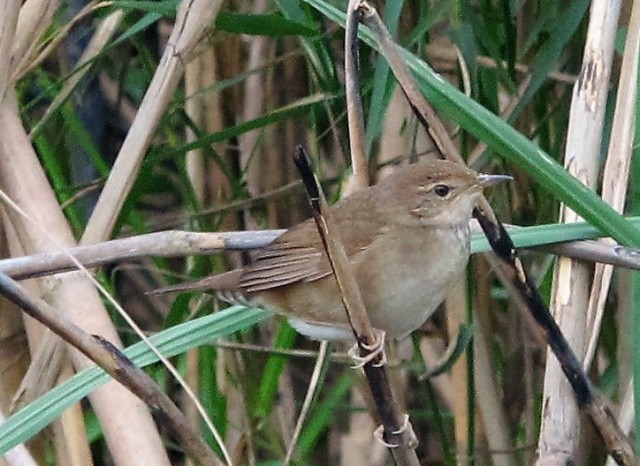
Baikal Bush Warbler at Red River Island, Hanoi, March 2016.
If you’d told me when I moved to Hanoi at the end of February that I would find myself living just a 10-minute cycle ride away from one of the best birding spots I have ever experienced, I wouldn’t have believed you.
The Red River is a major migratory flyway which passes through the heart of this noisy, polluted, crowded city. There isn’t much space for birds here – urban development is rife, and most of the land that hasn’t yet been built upon has been given over to high-intensity agricultural fields and banana plantations, neither of which are very good for birds.
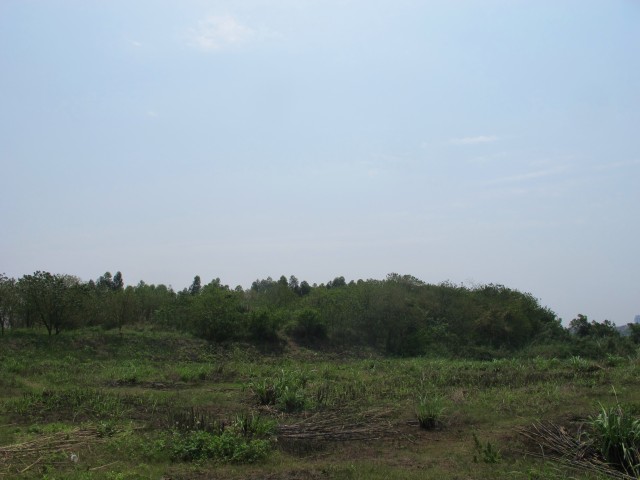
However, on the “Red River Island” (which is actually only an island in the wet season), a few small pockets of undisturbed habitat remain. Foremost among these is a small wood, only about two hectares in size, which offers practically the only decent cover for migrant birds for many miles around. Combined with nearby patches of remnant tall grassland, this area is an oasis in the urban sprawl for tired migrants as they follow the course of the river.
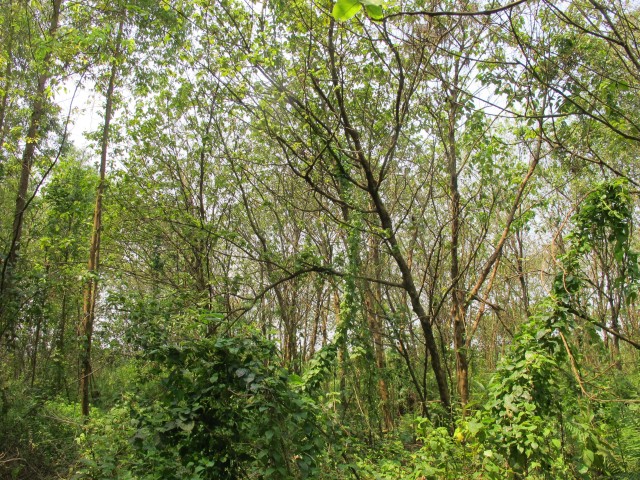
The small wood on Red River Island – it may not look like much, but it’s the only decent patch of cover for birds for miles around.
I’ve been visiting the area since early March, with a running total of 11 visits spread over 20 days, and have so far recorded an impressive 104 bird species. The best area by far is the small wood, but I’ve visited other parts of the island too, and depending on time I quite often check out an area of swampy ponds halfway along the western edge as well as the wood.
I’ll start with some of the “silly” birds I’ve seen in the wood. The other day, there were two Wedge-tailed Green Pigeons in there – quite what they were doing so far away from their preferred habitat of montane forest is anyone’s guess. This morning, I flushed a Grey Nightjar on two occasions, even managing to get a very poor photo of it perched in a bush. A small flock of Red-billed Blue Magpies is resident, they usually fly in from the north-west and pass through the wood before disappearing – where do they go? – it seems remarkable that they can survive here. Equally baffling, a small flock of Masked Laughingthrushes have been regularly seen for at least a year, and have reportedly even bred – given the amount of bird poaching and trapping that occurs in Vietnam, it’s amazing that they are still alive. The local Red-breasted Parakeet could have hopped out of a cage, but the fairly frequent Blue Whistling Thrushes – of both the yellow-billed and dark-billed races – may well be genuine wanderers.
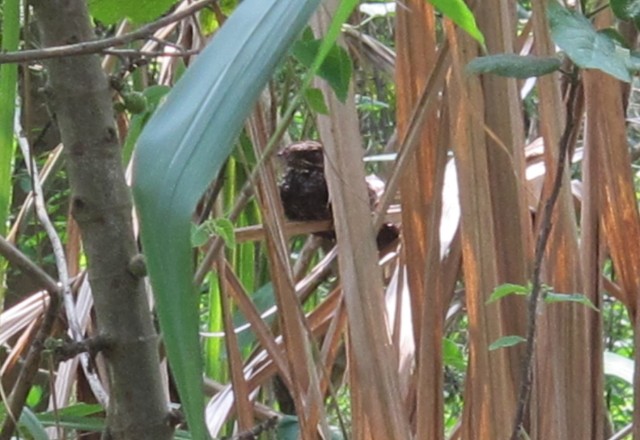
A Grey Nightjar lurking in the bushes – a most unexpected find.
The birds here can make you feel like you’re in some remote montane forest a long way from the city. Bianchi’s Warbler, Claudia’s Leaf Warbler, Sulphur-breasted Warbler, White-throated Fantail, Black-naped Monarch, Grey-headed Canary-Flycatcher, Rosy Minivet, Greater Racket-tailed Drongo and Chestnut-flanked White-eye are just some of the forest birds that I’ve encountered in the wood so far.
Other species are perhaps a little more expected as migrants here. I hear thrushes on every visit, but they are invariably very wary, and masters of melting away into the treetops. The majority of those I have seen have turned out to be Japanese Thrushes, but I have also notched up several very smart Grey-backed Thrushes and one Black-breasted Thrush. Judging by past reports, flycatchers are something of a specialty here – these start to appear in mid-March, with several beautiful Blue-and-White Flycatchers during my last couple of visits as well as long-staying male Hainan Blue and Hill Blue Flycatchers. I’m looking forward to the prospect of encountering a wide variety of spring-plumaged flycatchers during the peak month of April.
No trip to the wood would be complete without spending a while trying to track down some skulkers. You get the feeling that almost anything could be lurking in the quite dense undergrowth under the trees, with “tick”, “tack”, “tseep” and “churr” calls often heard deep within the thickets. Some of the easier birds to find – with patience! – include Dusky Warbler, Asian Stubtail and Siberian Rubythroat, while others I have been lucky enough to catch a glimpse of include Rufous-tailed Robin, Manchurian Bush-Warbler, Brownish-Flanked Bush Warbler, and fairly regular Tristram’s Bunting.
Yellow-bellied Prinias and Common Tailorbirds are annoyingly common in the undergrowth – the usual rule of thumb seems to be that if you can actually see it, it’s probably going to turn out to be one of these two!
Habitat in the wood is not the best, but it’s amazing what the birds will put up with when there’s nowhere else to hide!
Outside the wood, towards the northern end of the island, a few patches of tall grassland remain, although this is being rapidly encroached by agricultural land. A few days ago, I saw two Chinese Penduline Tits here – this species has overwintered in the Red River area in previous years, but its official status is rare vagrant to the south-east Asia region. I’ve also seen Crested Bunting in this area twice in the past week, apparently two different individuals. There is a small pond here which occasionally has a lingering Pied Kingfisher or Green Sandpiper. On one occasion, I was very surprised when a Baikal Bush Warbler popped out of the grass right at my feet, even allowing me to take a photo – a rare opportunity indeed, as this locustella is known to be a master skulker!
I have marked the location of the wood on this Google Maps link .
Another worthwhile spot for those with the time is an area of grassland and ponds along the western edge of the island. Citrine Wagtail, Red-throated Pipit and Bluethroat always seem to be hanging around, and I’ve also had crippling views of Lanceolated Warbler, Common Rosefinch, and Little Bunting among other goodies. The general area on Google Maps is here.
One fly in the ointment of the Red River Island is – predictably in Vietnam – the activities of bird poachers here. Bird traps and mist nets are commonly encountered, especially near the ponds along the western edge, and I’ve also come across poachers mist-netting in the small wood. Their main targets appear to be munias (in the traps) and white-eyes (in the nets), but surprisingly there are still plenty of Scaly-breasted Munias and Japanese White-eyes on the island despite the extensive trapping.
I hope this short account of the wonders of the Red River Island will encourage other birders to visit this spring. If you come, do let me know what you see! (and submit your sightings on eBird).
Full List of Birds Seen at Red River Island, Hanoi, March 5th-25th 2016:
Slaty-legged Crake at Lung Sin waterhole, Kaeng Krachan, Thailand, February 25th 2016.
Following a very productive trip to Vietnam in January, I was able to swing a full three weeks in Thailand in February before a return to the world of work and study eventually had to prevail later in the month.
I birded alone for two full weeks in the north, chasing some of the specialities that up until now had eluded me, with visits to familiar locations as well as a handful of new sites.
The third week was spent in the company of my good friend Tim Harrop, who although a very experienced birder, had not visited Asia before. With just five and a half days to play with, and with Tim’s number one target bird being Spoon-billed Sandpiper, we focused on the coastal Laem Pak Bia/Pak Thale area followed by three full days in Kaeng Krachan National Park.
Male Siberian Blue Robin, Lung Sin, February 25th.
Main sites visited:
Doi Inthanon: Thailand’s highest mountain is a staple fixture on the North Thailand birding circuit, with several species found here that can be seen nowhere else in the country. My two main “gaps” from here are Black-tailed Crake and Yellow-bellied Flowerpecker, both of which I failed to see yet again. As usual, the crake was heard calling at the campsite marsh in the late afternoon, but stayed resolutely hidden in the vegetation, while the flowerpecker was widely reported by other birders but failed to show for me. However, the summit marsh delivered ample compensation in the form of a fine Chestnut Thrush.
Spot-breasted Parrotbill at Doi Lang (Fang side), February 8th 2016.
Doi Lo rice paddies: This lowland area between Doi Inthanon and Chiang Mai has only recently been “discovered” by birders. It’s just a few minutes from Highway 108, making a convenient stop on the way between Chiang Mai and Doi Inthanon. Like many similar sites in Thailand, Doi Lo is absolutely bursting at the seams with lowland birds, making for some easy and enjoyable birding. The best birds during my two visits were the wintering Eastern Imperial Eagle and an Asian Golden Weaver, which although in non-breeding plumage was quite distinctive with its thick, heavy bill, quite bright yellow plumage tones, and prominent supercilium.
Lifer: Asian Golden Weaver. Thailand ticks: Eastern Imperial Eagle, Black-eared Kite, Pied Harrier, Common Kestrel, Chestnut-tailed Starling, Green Sandpiper. Other highlights: Ruddy-breasted Crake, Rufous-winged Buzzard.
Male White-bellied Redstart, Doi Lang (Fang side), February 10th 2016.
Mae Ping: The dry deciduous forest here contains several specialities, including White-bellied Woodpecker and Neglected Nuthatch, although curiously it lacks some of the birds found in similar habitat in Cambodia (eg. White-browed Fantail and Brown Prinia). Much less visited than other sites in the north, this large national park is well worth an early morning, although it can become rather hot and birdless by late morning.
Thailand ticks: Yellow-footed Green Pigeon, Black Baza, White-bellied Woodpecker, Neglected Nuthatch, Two-barred Warbler. Other highlights: Grey-headed Parakeet, Black-headed Woodpecker, Red-billed Blue Magpie.
Yellow-throated Martens on the road at Doi Lang (Fang side), February 8th 2016.
Doi Angkhang: This has for a long time been my favorite mountain site in the north. Nowadays, it is sometimes overlooked by birders in favor of neighboring Doi Lang. However, this winter, Angkhang has really been producing the birds, with high daily species counts and good levels of bird activity virtually all day. The draw for many is the regular and confiding Rusty-naped Pitta at the Royal Project, but my personal highlight was a superb male Grey-winged Blackbird.
Crimson-breasted Woodpecker, Doi Lang (Fang side), February 8th 2016.
Doi Lang: I spent two days on the west side (approached from Fang), and one day on the more difficult east side (approached from Tha Ton). The Fang side is easily accessible in any kind of vehicle, but the road up the east side of the mountain is in very poor condition, and not accessible by ordinary saloon car or minivan (you must either have a 4×4, or do as I did and rent a motorcycle for the day in Tha Ton). It is currently forbidden to complete the full loop in a vehicle, although I was allowed to proceed on foot past the top checkpoints on both the east and west sides of the mountain – birders with plenty of time and energy could presumably walk all the way around the loop.
Male Ultramarine Flycatcher at Doi Lang – the same bird I saw here last winter. It is so used to being fed by photographers that it flies down from the trees and lands nearby, with an expectant look on its face, as soon as you get out of your car.
Chiang Saen Lake: This is Thailand’s most famous site for wintering ducks, and a number of rarities get found here every year. I was very fortunate to relocate the wintering male Baer’s Pochard after it had been absent for several weeks – this bird was subsequently seen by a number of observers and could fairly reliably be found in the company of around 40 Ferruginous Ducks on the south side of the lake. I found a pale-phase Booted Eagle in the same area, while a male Western Marsh Harrier in the roost at Wat Pa Mak No was also a very noteworthy Thai rarity.
Siberian Rubythroat at Nam Kham Nature Reserve, February 13th 2016.
Nam Kham Nature Reserve: This small reserve near Chiang Saen is famous for hosting Thailand’s first Firethroat, a male which is currently in residence for its second winter. The bird occasionally appears in front of the Cettia hide to bathe at a small pool – 9.00am seems to be a good time, but equally it is possible for it to fail to make an appearance all day. I was lucky, and the Firethroat emerged on cue for a 10-second showing at 8.55am. Nam Kham reserve contains a maze of paths through the reedbeds, and it is easy to get lost or disorientated – best arrive at the site very early to make sure you locate the correct hide by 9.00am!
There are plenty of other birds to see here in the early morning, and with luck and patience a number of secretive reedbed specialists may be seen.
Lifers: Firethroat, Baikal Bush Warbler. Thailand tick: Paddyfield Warbler. Other highlights: Red Avadavat, Spotted Redshank.
Record shot of the male Firethroat, during its brief appearance in front of the Cettia hide at Nam Kham Nature Reserve, February 13th 2016.
Doi Phu Ka: This is a seldom-visited mountain in Nan province, famous for a small population of Beautiful Nuthatch, and several other species that cannot usually be found elsewhere in Thailand. I found birding here to be hard going, and only late on my second morning did I finally discover a trail leading into good high altitude forest, but I ended up seeing virtually none of the site’s specialities.
The traditional route up the mountain, a trail starting behind the shrine opposite the star-gazing area, seems to be completely overgrown, with a high risk of getting lost for birders without a GPS. A better option seems to be the trail starting on the roadside at Km 29.7, which climbs up into some good forest where Beautiful Nuthatch should be a possibility.
The roadside itself from Km 28-33 could also turn up some good species, although bird activity generally seemed rather low during my visit. I also spent some time on the trail leading into the forest from the top of the pass, at the high point of the road – this forest contains plenty of huge, old trees, seemingly suitable habitat for Beautiful Nuthatch and other forest species such as Green and Purple Cochoas. However, birding here was extremely difficult, with loud, crunchy leaves underfoot making quiet walking impossible, and the sheer size of the trees making it very hard to locate birds.
In general, Doi Phu Ka didn’t repay my investment in time and effort to get there – I got the feeling that a lot of time would be needed to get the most from this site.
Lifer: Indochinese Yuhina. Other highlights: White-browed Piculet, Crested Finchbill, Bianchi’s Warbler, Sulphur-breasted Warbler, White-gorgeted Flycatcher, Small Niltava.
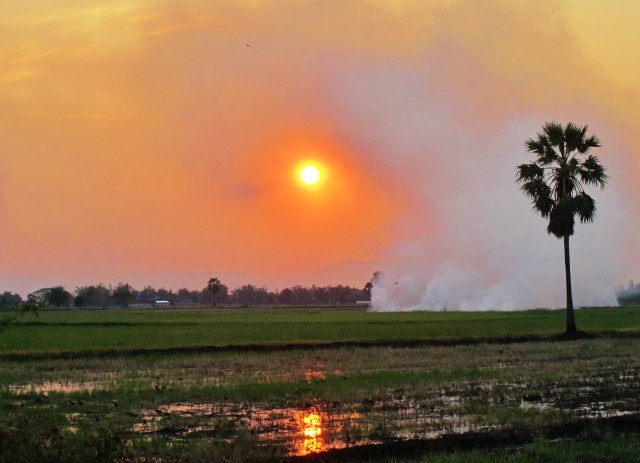
Burning the rice stubbles in the late afternoon at Nong Pla Lai, near Phetchaburi, February 25th 2016.
Pak Thale/Laem Pak Bia area: The whole coastal strip from Wat Khao Takrao in the north to Laem Pak Bia in the south contains a fantastic range of wetland, farmland, and coastal habitats – the area scarcely needs any introduction as it is world famous for being the favored wintering location for a small number of Spoon-billed Sandpipers, as well as upwards of 40 other shorebird species.
As well as focusing on the well-known locations of Pak Thale, the King’s Project, the “abandoned building” wetlands, and the Laem Pak Bia sandspit, we also visited farmland and grassland inland from Pak Thale, Wat Khao Takrao, and the Nong Pla Lai rice paddies, seeing a total of 132 bird species in the area in two days.
Lifer: Slaty-breasted Rail. Thailand ticks: Far Eastern Curlew, Heuglin’s Gull, Oriental Darter, Black-headed Ibis, Greater Spotted Eagle. Other highlights: Chinese Egret, Booted Eagle, White-faced Plover, Malaysian Plover, Nordmann’s Greenshank, Great Knot, Spoon-billed Sandpiper, Asian Dowitcher, Red-necked Phalarope, Brown Hawk Owl, Indian Nightjar, Asian Golden Weaver, Chestnut Munia.
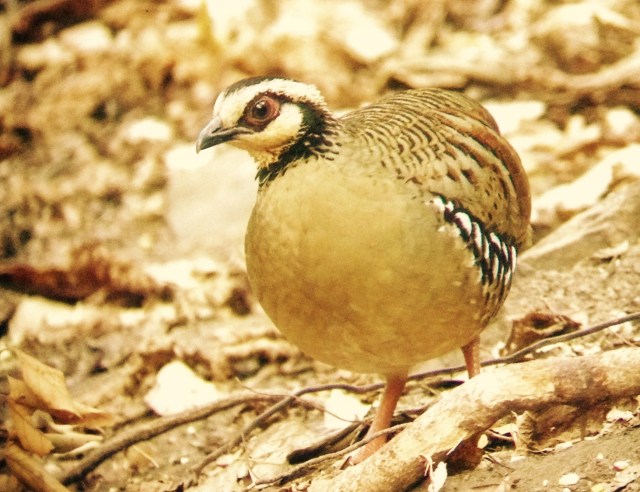
Bar-backed Partridge, Lung Sin waterhole, February 25th 2016.
Kaeng Krachan National Park: Probably Thailand’s best overall birding location, this huge national park forms part of one of south-east Asia’s largest continuous forested areas. Its strategic location in the middle of Thailand means that birds from both north and south Thailand can be found here, meaning a very high species total is possible.
In addition to the birds, mammals are a feature of the park, with White-handed Gibbon, Dusky Langur, Asian Elephant, Serow, Crab-eating Mongoose, Black Giant Squirrel, Asian Porcupine, Yellow-throated Marten, and even Leopard among the species regularly seen. During our visit, a Malayan Sun Bear was occasionally visiting the back of the Ban Krang restaurant for food scraps, but unfortunately we weren’t lucky enough to see it despite spending several hours waiting for it on consecutive evenings.
In three full days we recorded 155 species of birds inside the park gates, with another 10 or so recorded outside the gates at our accommodation at Ban Maka, and at the Lung Sin waterhole. Booking a spot in the hide at the latter site can be done through Ban Maka, and is highly recommended for close views of some normally tricky customers such as Bar-backed and Scaly-breasted Partridges, Lesser and Greater Necklaced Laughingthrushes, and for the lucky few – including us! – perhaps a visit from a Slaty-legged or Red-legged Crake. It’s also a great spot to observe and photograph mammals, for example Mouse Deer and Muntjac.
Lifers: Asian Emerald Cuckoo, Moustached Hawk Cuckoo. Thailand ticks: Blue Pitta, Black Bittern, Mountain Hawk Eagle, Pacific Swift, Rufous-browed Flycatcher, Blue-and-White Flycatcher, Chinese Blue Flycatcher, Hainan Blue Flycatcher, Slaty-legged Crake. Other highlights: Violet Cuckoo, Crested Jay, Black-and-Yellow Broadbill, Black-and-Red Broadbill, Silver-breasted Broadbill, Long-tailed Broadbill, Common Green Magpie, Kalij Pheasant, Bar-backed Partridge, Besra, Black-thighed Falconet, Little Cuckoo-Dove, Red-billed Malkoha, Brown-backed Needletail, Red-headed Trogon, Orange-breasted Trogon, Bamboo Woodpecker, Grey-and-Buff Woodpecker, Collared Babbler, Great Hornbill, Red-bearded Bee-eater, Alstrom’s Warbler, Orange-headed Thrush, Black-throated Laughingthrush, Golden-crested Myna.
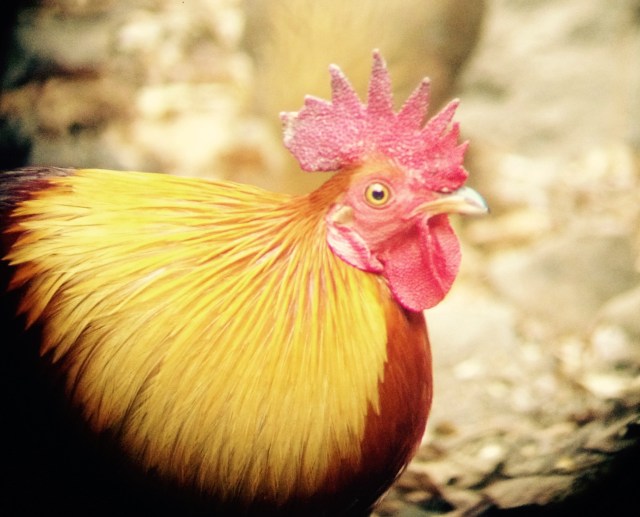
Red Junglefowl at Lung Sin waterhole, February 25th 2016.
Notable records from other sites:Spot-winged Starling – five at a flowering tree in Mae Rim, near Chiang Mai. Chestnut-eared Bunting – two at Fang rice paddies. River Lapwing, Small Pratincole – on the Mekong River near Chiang Khong. Bluethroat, Citrine Wagtail – Tha Ton rice paddies.
Trip Total: 444. World Life List: 2,115. Thailand Life List: 625. 2016 World Year List: 713.
White-rumped Shama at Lung Sin waterhole, February 25th 2016.Rufous-bellied Niltava at Doi Lang (Fang side), February 10th 2016.















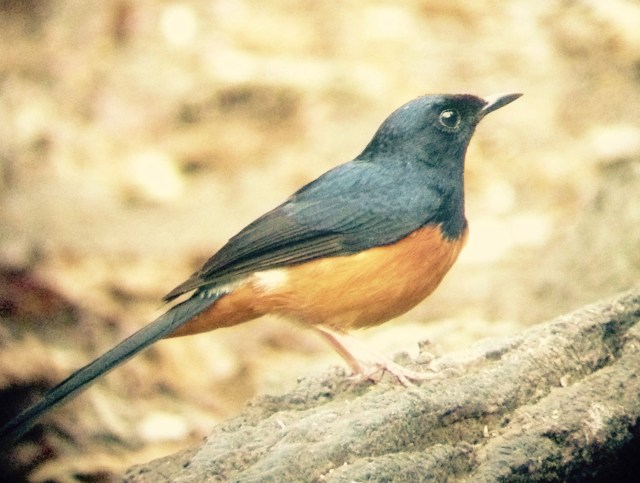
![Green-backed_Flycatcher_Adult_male_RR_13_4_16_2[2]](https://domthebirder.com/wp-content/uploads/2016/04/green-backed_flycatcher_adult_male_rr_13_4_16_22.jpg?w=640)






 Dom the Birder