Doi Angkhang summit (photo taken in February 2015).
Every birder has them – those supposedly “common” species that you have somehow never seen. My list of such birds in Thailand includes the infuriatingly regularly heard – but not yet seen – Collared Owlet and Mountain Scops Owl. the possibly overlooked Barred Cuckoo-Dove, and the enigmatic Blue Pitta.
I didn’t want to leave anything to chance for my one-day visit to Doi Angkhang, for a concerted effort to finally get White-browed Laughingthrush on my list. I’ve visited this remote corner of northwest Thailand on a number of occasions over the years and it’s one of my all-time favorite birding sites. White-browed Laughingthrush is common in montane scrub in the area, and is apparently seen by most visiting birdwatchers – except me, that is.
After careful research on the excellent websites North Thailand Birding and Thai Birding, I reckoned I should probably concentrate on the Ban Khoom Valley trail for my best chance. This happened to be an area I have seldom visited, so I was cautiously optimistic. I started at the Ban Luang end of the trail, where the orchards were heavy with orange fruits and teeming with birds. I saw over 40 Crested Finchbills here, alongside numerous bulbuls of several species including the local speciality Brown-breasted Bulbul. To my surprise I kept hearing the thin “tsee” call of turdus thrushes, birds which I would not expect here outside the November to February winter season. Unlike the bulbuls, the thrushes remained low down in the orchards or on the ground, and it was hard to get the chance of views due to surrounding vegetation. Eventually I had brief views of what looked to be an adult female Black-breasted Thrush, a regular winterer here which breeds in neighboring countries and is the most likely of the three possibilities. I couldn’t absolutely exclude Grey-backed Thrush and Japanese Thrush on the views I obtained, but either of the latter two species would be very rare indeed.
In any case, judging from the calls there were at least three, probably four, turdus thrushes present here – in all likelihood post-breeders from the nearby breeding ranges attracted to the area by a bumper fruit crop.
A little further along the trail, areas of scrub and rocks on the left quickly produced the day’s target bird, White-browed Laughingthrush – and not just one, but about fifteen birds seen in various small parties. It never rains, but it pours. I had been expecting a skulker, but these birds perched up on rocks and bushtops and showed very well indeed. A quite unexpectedly easy tick.
Other noteworthy birds in the general Ban Khoom Valley trail area included a Mountain Bamboo-Partridge, two Maroon Orioles and a Rufous-backed Sibia.
With my target bird under the belt and the pressure off, I drove down to Km 24 and walked the Mae Per forest trail as far as the dam and back. This trail passes through excellent habitat and has a long list of mouthwatering but seldom-seen birds such as Red-tailed Laughingthrush and Pale-billed Parrotbill. It was quite “birdy” along here today, with several feeding flocks encountered, but nothing spectacular was seen although Ashy Bulbul was a year tick, and a pair of White-gorgeted Flycatchers showed well.
After a spot of lunch in Ban Khoom, I went up to the trails at Km 21.5. Surprisingly, it hadn’t started raining yet although the afternoon was becoming increasingly cloudy and misty. Outside of the dry season, the trails here become increasingly overgrown or even impassable although I could just about get to the base of the summit trail. Generally hanging around for a couple of hours in the area produced some nice birds including Scarlet-faced Liocichla, a singing Lesser Shortwing in the dark forest that showed nicely for a few seconds, several groups of Silver-eared Mesias, and another White-gorgeted Flycatcher that approached me to within six feet as I sat motionless on the forest floor. Following this morning’s thrush sightings, another seemingly unseasonal bird was a male Mrs Gould’s Sunbird, which the literature suggests is only a winter visitor here – perhaps they also breed in small numbers?
Opportunistic and rather blurry shot of a Red-crowned Barbet, Trang Botanical Gardens, July 22nd.
From Malaysia, we flew into Hat Yai on an incredibly cheap Air Asia flight ($22 per ticket), and continued by local bus to the small town of Trang. The nearby botanical gardens with their canopy walkway provided an opportunity for me to add some more “southern” birds to the year list, and I spent a few enjoyable hours here one afternoon and again the following morning.
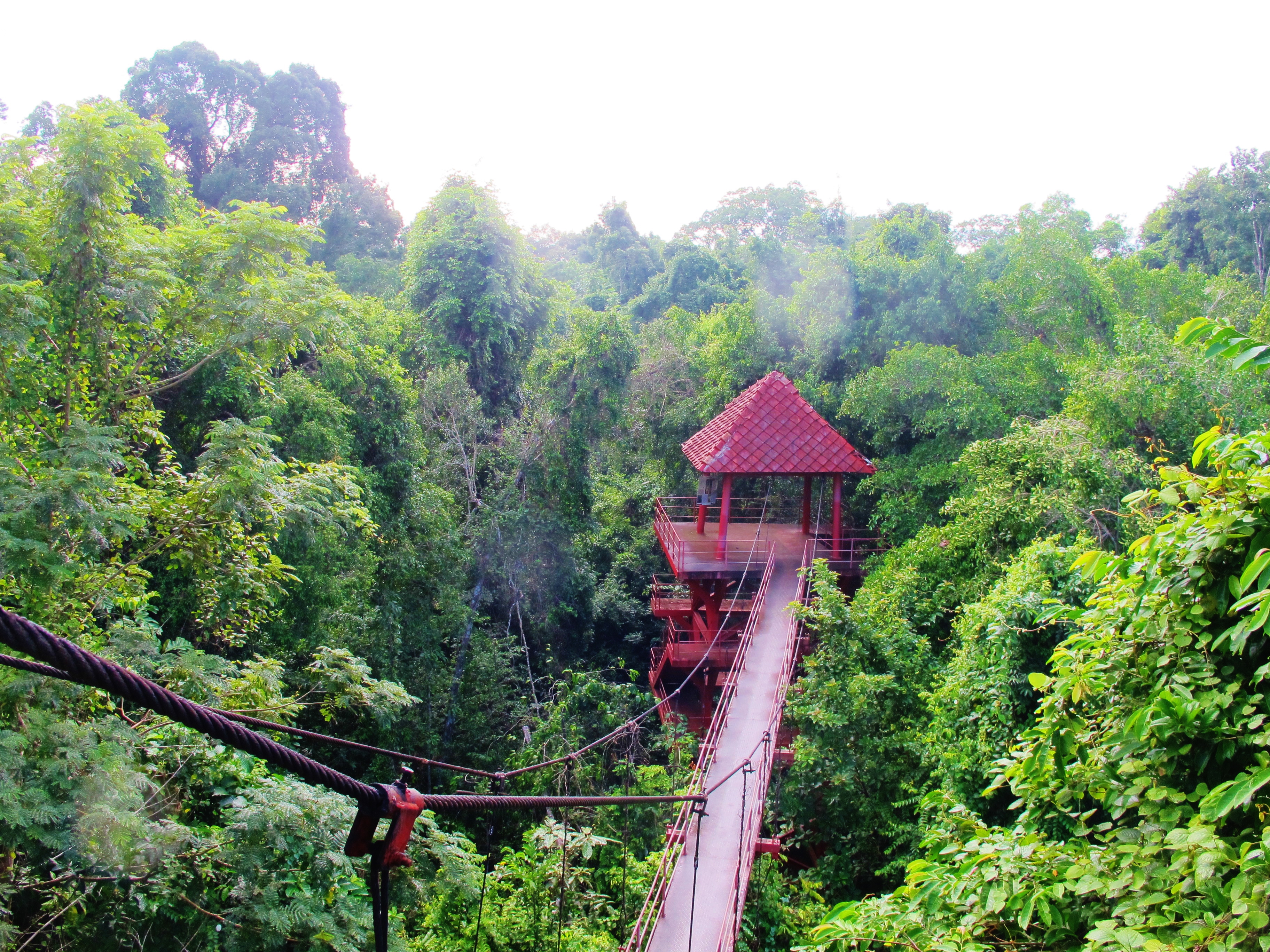
The Trang botanical gardens make an excellent day trip for birders and non-birders alike. About 10km south of the town, they form a small remnant area of tropical lowland rainforest and swamp forest, and some more open park-like areas with planted trees. Most interestingly, there is a multi-towered canopy walkway, with metal bridges of various heights between the towers allowing for good views of different levels of forest vegetation. Access to the botanical gardens is free of charge, and when I visited there was virtually no one else there.
Despite the botanical gardens’ many attributes, birding was fairly slow, but over the course of my visits I did pick up several lifers including the quite magnificent Red-crowned Barbet. From the highest walkway tower, I had great views of a Square-tailed Drongo Cuckoo, which was also calling throughout my visit. This bird has been recently split from the more northerly Fork-tailed Drongo Cuckoo. I also flushed a day-roosting small owl, but unfortunately couldn’t relocate it.
The canopy walkway at Trang botanical gardens.
From Trang, we moved north to Krabi town for a three-night stay. About 50km south-east of the town is the infamous Khao Nor Chu Chi (KNC) reserve, until recently known as the only remaining site in the world for Gurney’s Pitta (fortunately a fairly large population has recently been discovered in southern Myanmar). These colorful and very elusive birds sadly became functionally extinct at KNC in 2014, when the last two remaining females and lone male finally disappeared. I’ve been to KNC on a number of occasions since 2006, and always tried to find a Gurney’s Pitta for myself, being reluctant to pay the quite extortionate 9,000 baht that well-known guide Yothin charged for his services. With hindsight, having never managed to self-find a Gurney’s, I should have paid the money.
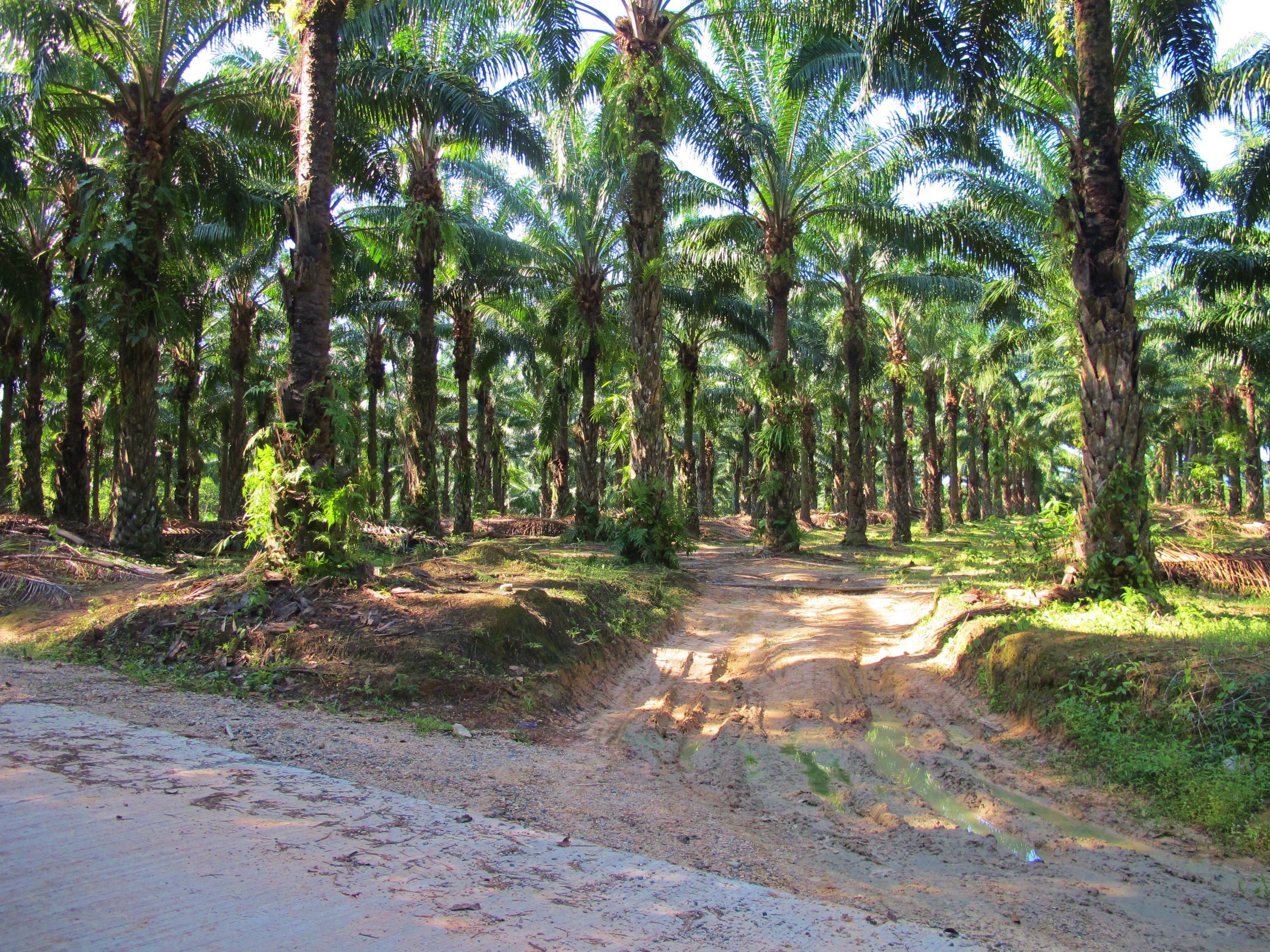
Anyway, no visit to Krabi would be complete for me without a nostalgic visit to KNC. I set off early on a rented motorcycle while it was still dark. On arrival at the site, it was clear that things continue to change. The Emerald Pool entrance area is now an ever-growing mess of food stalls, coffee stands and an enormous coach park, while the main trail past the entrance gate (“A” trail), where Gurney’s and Malayan Banded Pittas were formerly regular in the early mornings, is now lined with trash cans. On all sides of the reserve, the inevitable oil palm plantations continue to encroach on the fragments of remaining primary forest. It’s all rather depressing. Some pockets of nice habitat still exist, but birding is a frustrating experience here at the best of times, as even in the good old days the site was notorious for producing very few birds at all on a typical visit. True to form, I saw very little for the first three hours. After exploring the trails near the Emerald Pool, I wandered over to “U” Trail and lingered in the first gully for an hour, a former Gurney’s Pitta hotspot. Here I saw just two individual birds, an Emerald Dove which landed on a low branch just five feet from where I stood motionless, and a Rufous Piculet which lingered nearby for quite some time.
So my visit to KNC was predictably a bit of a waste of time, but luckily my main target for this visit to Krabi can be found much closer to town: Mangrove Pitta. I had heard they are easier to find here in the rainy season, whereas most birders visit in the dry. The mangrove boardwalk beside the river, just north of the tourist area of Krabi town, is a well-known spot for them. Starting at first light, I spent three hours walking slowly up and down the boardwalk, with no sight nor sound of a pitta. Returning in the afternoon, I did something I almost never do, and played the tape of Mangrove Pitta song from my laptop. Again nothing until very near the far end of the boardwalk, when a pitta finally responded. I had brief flight views as it swooped past me, then I fortunately located it in a tree where I had good views for some 10-15 seconds. Finally, one of Thailand’s “easier” (relatively speaking) pittas was safely on my list after quite a few previous attempts.
Aside from the Mangrove Pitta, I was kept entertained in the mangroves by several magnificent Brown-winged Kingfishers, while over the river at the end of the walkway some Rufous-bellied Swallows were flying about. These distinctive birds have been recently split from Striated Swallow, and are therefore another bona fide addition to my list.
South Thailand 2015 Year Ticks: Red-throated Barbet, Yellow-breasted Flowerpecker, Rufous Piculet, Chestnut-winged Babbler, Yellow-bellied Bulbul, Brown-winged Kingfisher (total 824).
Oil palms, an ever-increasing sight at Khao Nor Chu Chi. Now that Gurney’s Pitta has been extirpated from the site, the future for the remaining lowland tropical rainforest here looks bleak.
Asian Fairy Bluebird at the FRIM botanical gardens, July 18th.
After our month in Indonesia, we spent several days in extremely civilised (and expensive!) Singapore. Luckily we were staying with friends, which kept the costs down somewhat. With just one free morning for birding, I elected to head to Rifle Range Road in the central catchment area, which on the map appeared to be within walking distance of our accommodation. It turned out to be over an hour’s brisk walk away, but with great views of Blue-crowned Hanging Parrot and Pied Imperial Pigeon along the way, I wasn’t complaining.
Alongside Rifle Range Road is some excellent, intact tropical rainforest, in which the birds seemed more active and conspicuous than is usual for this kind of habitat. Highlights of a couple of hours wandering along the road included a stunning pair of Banded Woodpeckers, a Chestnut-bellied Malkoha, and a showy male Crimson Sunbird.
Our next stop was Kuala Lumpur in Malaysia for a couple of nights. Our Singaporean friend had warned us of the potential for civil unrest and even a terrorist attack in central KL that weekend, and seeing as Jenna and I have both visited KL before, it was an easy decision for us to stay outside the center of the city. We visited the Batu Caves, which have to be one of the least impressive tourist attractions I have seen in Asia – horribly crowded, stiflingly hot, filthy dirty, infested with monkeys, and home to lots of shabby food stands where I contracted a healthy dose of food poisoning.
The upside of the Batu Caves district is the Forest Research Institute of Malaysia (FRIM), a mere 25 minute walk from our hotel. I arrived at 7am and was very surprised to find runners, cyclists and even picnicking families already active in the park. It’s an impressive place, with open parkland and patches of mature forest providing easy birding opportunities, and it wasn’t too hard to escape the crowds. I lucked upon a fruiting tree beside the road, which produced some excellent sightings over a one-hour period including both Sooty and Gold-whiskered Barbets, Greater Green Leafbird and a beautiful male Asian Fairy Bluebird. Nearby, a Blue-eared Kingfisher at a small pool was a useful year list addition, a bird I’ve seldom seen in SE Asia despite it being very widespread.
Singapore and Malaysia Lifers: Banded Woodpecker, Blue-crowned Hanging Parrot, Olive-winged Bulbul, Gold-whiskered Barbet, Sooty Barbet, Spectacled Spiderhunter, Spectacled Bulbul.
Singapore and Malaysia 2015 Year Ticks: Pied Imperial Pigeon, Chestnut-bellied Malkoha, Red-eyed Bulbul, Grey-breasted Spiderhunter, Blue-eared Kingfisher, Greater Green Leafbird, Orange-bellied Flowerpecker (total 814).
Everyone has heard of the mighty Komodo Dragon, yet relatively very few people make the long trip to see them in eastern Indonesia. Komodo island is about four hours by boat from Labuan Bajo on Flores; it is possible to visit on a day trip, but many opt for a two day, one night cruise for a more relaxed experience.
In Labuan Bajo, we spent a few hours shopping around the travel agencies and eventually settled on Komodo Expedition, who weren’t the cheapest operator in town but we were swayed by their professional attitude and glowing online reviews.
Our fairly large, comfortable boat came fully equipped with three crew (the driver, his assistant, and a cook), and a choice of two cosy cabins. Hiring the boat as a private charter including all meals (lunch and dinner on day one, breakfast and lunch on day two), came to about $220. A bit of a splurge for the average backpacker budget, but in terms of value it was unbeatable. The food was plentiful and excellent, and included freshly caught fish for lunch on the second day.
We set sail at 8am, heading south-west towards Rinca island. The two-hour voyage revealed few birds of note apart from a small mixed group of Greater Crested and Lesser Crested Terns near Labuan Bajo, several Black-naped Terns at their nesting islets, and an occasional Brahminy Kite or White-bellied Sea Eagle passing over.
Docking at Rinca island, we walked the short distance to the park headquarters. Straight away, it was noticeable how arid the island was, with open sunbaked mud, savanna-type dry forest, and no natural fresh water to be seen. We later learned that the few sources of fresh water on the island are a magnet for the local animals and therefore a favorite hunting ground for Komodo Dragons.
We opted for one of the “medium” length treks, in the company of a compulsory guide. Permits for Komodo National Park totaled 600,000 rupiah (= $46 or £30) for one day for two people, including entry fee, government taxes, guide fees for Rinca and Komodo, and snorkeling permits. It’s quite expensive by Indonesian standards – one hopes that the money is being efficiently used to protect the park and its wildlife.
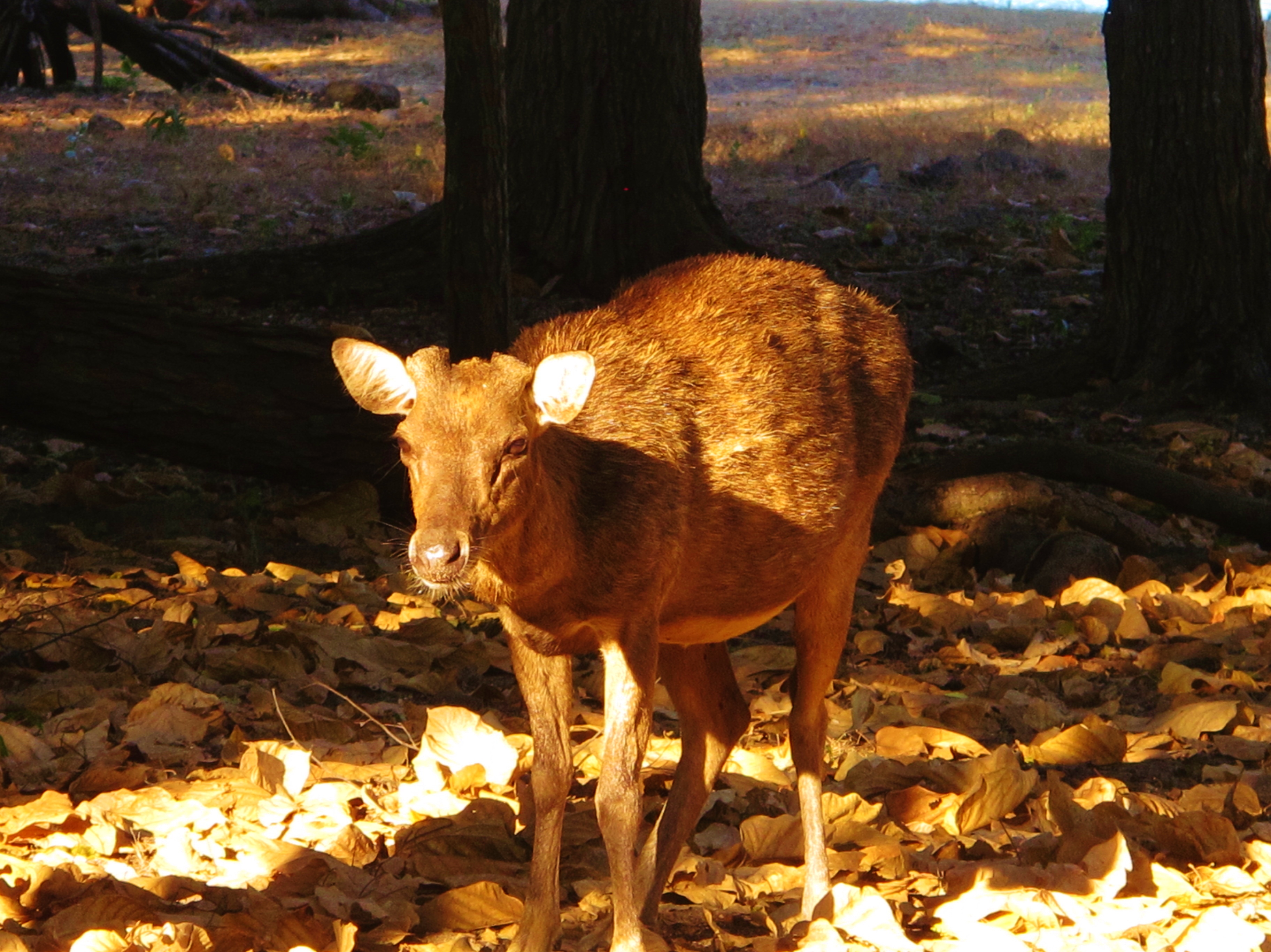
Something we noticed straight away was the abundance and fearlessness of large mammals. Deer are everywhere, even close to the park buildings, and macaques are common. The monkeys have been introduced to Rinca – this is one reason why small birds are scarce on the island, as the macaques eat their eggs. Komodo, which has no monkeys, is by far the better of the two islands for birding.
Komodo island deer …. dragon food!
Rinca is currently the best bet for guaranteed dragon sightings. Behind the rangers’ kitchen, just a short distance from the park HQ, we quickly saw three of these great beasts, two of which were quite large and around 18 years of age. Our guide told us that they continue growing throughout their lives, and reach a maximum age of about 35 years; they have no natural predators and their demise usually comes when they lose their teeth and can no longer hunt.
Komodo Dragons usually prey on deer, wild pigs, buffaloes and monkeys, and can also be dangerous to humans. They seem quite sedate most of the time, but are capable of sudden bursts of speed when an unwary animal strays too close. We were able to observe the resting dragons safely at a range of about 4 meters; any closer than this and we would have risked a bite, which can lead to serious infection and even death. In the wild, after having bitten an animal, the Komodo Dragon follows it around until the animal eventually dies of the poisonous bite. These predators have an extraordinarily powerful sense of smell, and other dragons from as far as 2km away quickly descend on a fresh kill. They only need to eat a couple of times a month – my feeling was that life is quite easy for a Komodo Dragon, as their prey species are so abundant on the islands.
Apart from the dragons hanging out behind the kitchen, we had two more sightings of these fearsome reptiles during our hour-long trek: a big one lying right next to the path, and another slightly smaller one walking along a forest trail. Komodo Dragons are cannibalistic, so small ones less than about 4 years of age live exclusively in the trees in order to avoid the big dragons on the ground below.
Birding on Rinca wasn’t very impressive, but this was probably partly due to being there in the heat of the day. Orange-footed Scrubfowl is supposedly quite common, but much easier in the early morning and we didn’t see one – our hike yielded only low numbers of very common species, such as Black-naped Monarch and Pied Bushchat.
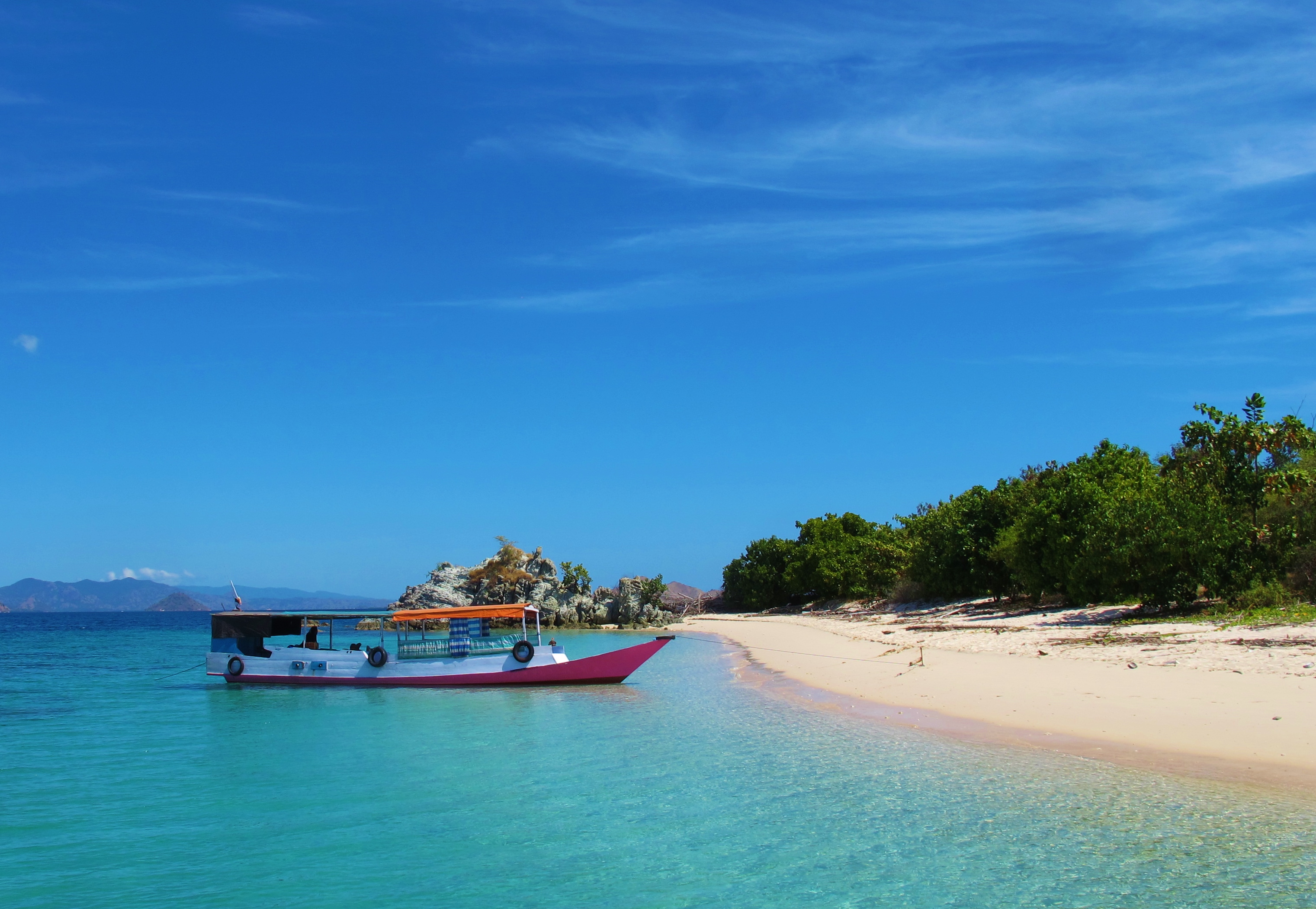
Bidadari Island, offshore from Labuan Bajo on Flores; Komodo national park has many similar small islands with clear water, white sand beaches, unspoiled coral and no one else around to share it with.
At about lunchtime we set sail again for the two-hour boat ride to Komodo, seeing almost no birds along the way but enjoying the sunshine and splendidly rugged island scenery. Komodo island has a huge concrete pier, presumably to make it easier for large numbers of tourist boats to dock; but there was only one other boat docked there and we saw only two other tourists on the island. Local people sell handicrafts such as carved wooden dragons from a small warehouse on the island; they seemed desperate for our business and it was quite painful to have to turn them down, but we have no space for heavy souvenirs in our backpacks. We bought two fresh coconuts from one man, but he didn’t have a machete to cut them open for us, and nor did anyone else in the area it seemed, so this deal fell through much to the man’s disappointment (and ours, since we were thirsty). I don’t know how he expected us to drink the coconut water if we couldn’t get the coconuts open …. hopefully the vendor will come better prepared with a knife next time.
Amid this almost ghostly lack of tourists, we recruited a guide to take us on an island walk. Komodo is very hot and very dry, and the guide was pessimistic about our chances of connecting with Yellow-crested Cockatoo at this time of day – but we lucked out with superb views of one in a tree right above the path. This was my main target bird on Komodo, it’s a critically endangered parrot that is now extinct in the wild almost everywhere else but maintains a final stronghold here. I was elated with this sighting, but couldn’t continue my lucky streak with Orange-footed Scrubfowl, which again eluded us. Green Junglefowls were, however, plentiful, and there were a handful of other birds to be seen despite the mid-afternoon heat including abundant Green Imperial Pigeons, White-shouldered Triller, Sunda Pygmy Woodpecker, Blue-tailed Bee-eater, an Asian Koel, and brief views of a flushed buttonquail that had to remain unidentified.
Among the other animals, Wild Boar are noticeably abundant here, providing a key prey species for Komodo Dragons. However, we didn’t actually see a dragon on Komodo, much to the disappointment of our guide, although having already seen the dragons on Rinca I was more bothered about having missed Orange-footed Scrubfowl.
A final excellent bird sighting on Komodo was a species I’ve been wanting to see for some time, in fact one of the few East Asian shorebirds I had been missing from my list – Beach Thick-Knee. Three of these magnificent birds flew past as we walked along the concrete pier. This is yet another bird that is declining in the region due to human pressures, because they depend on undisturbed beaches and mudflats for feeding. However, I imagine they must hopefully maintain a fairly healthy population among the uninhabited islets of Komodo National Park.
After leaving Komodo pier, we headed south along the coast, spotting a soaring Lesser Frigatebird en route, and moored offshore of some mangroves for the night. Nearby, hundreds of enormous fruit bats appeared at dusk and flew over the boat; the sunset and full moon added to the eerie spectacle. Upon awakening to a fiery sunrise and freshly cooked banana fritters, I spotted several Yellow-crested Cockatoos perched distantly on tree tops on the island, but unfortunately we were a little far from the mangroves to have a chance at spotting any rails or crakes.
We spent most of the second day visiting various snorkelling sites on our way back to Labuan Bajo. The coral here is almost pristine, especially near Komodo Island and off Kanawa Island, and aquatic highlights included a turtle, a huge Manta Ray, and a pod of dolphins, as well as thousands of tropical fish. While it was tempting to revisit Komodo Island for Orange-footed Scrubfowl, we decided against it as this would have involved paying another round of hefty entrance fees, and Jenna wasn’t too keen on the idea of another baking hot hike around the island.
While on the subject of islands, I should mention a day trip we made from Labuan Bajo to an inshore island called Bidadari (or Angel Island). It offers pristine white sand and good coral and is just 30 minutes by boat from the town. It was the only place I saw Lemon-bellied White-eye, an Indonesian endemic that specialises in small islands – it was abundant on Bidadari but seemed entirely absent on the Flores mainland just a short distance away.
Komodo National Park lifers: Yellow-crested Cockatoo, Beach Thick-Knee, White-shouldered Triller.
A “small” Komodo Dragon emerging from the bushes on Rinca Island.
Sunset at Labuan Bajo, west Flores’ port town and the ideal dropping-off point for Komodo boat trips …. the area around the town also offers some good birding.
Just east of Bali is the famous – or at least, famous among birders – “Wallace’s Line”. Bird species on islands to the east of this line have more in common with those in Australasia, whereas many of the birds on islands to the west (Bali and Java) are shared with south-east Asia.
The distance between Bali and Lombok is only about 35km, but for more than 50 million years this deep water channel between the Asian and Australasian continental plates formed a daunting barrier that few species of birds – and even fewer mammals – were able to cross. It is remarkable how many bird species’ ranges extend as far east as Bali, or as far west as Lombok, but do not cross the gap.
Flores lies well to the east of Wallace’s Line, and as this was my first visit to this faunal region, it presented an opportunity to see quite a few new birds for my list.
For the first couple of nights, we stayed in the small, dusty and friendly port town of Labuan Bajo. This is the epicenter of the developing tourist industry on Flores. The town has a shiny new airport and several new midrange hotels, and tourism will no doubt take off here in the next few years. For now, the town is at that perfect point where fairly decent infrastructure exists, but it still receives only a tiny fraction of the number of visitors of better-known Indonesian holiday locations. Labuan Bajo is an ideal springboard for diving and snorkeling trips to offshore islands and reefs, as well as boat trips to the Komodo National Park.
I birded on several early mornings on the outskirts of Labuan Bajo, ranging as far south as the river mouth, which was probably a splendid complex of impenetrable mangroves until recently but has now been heavily degraded, with dirt roads deep into the area and some kind of mining going on. A welcome sight in the mangroves was a Stork-billed Kingfisher, and hopefully some other interesting species also hang on here despite the disturbance and habitat loss.
Common species throughout the coastal strip included Flame-breasted Sunbird, Wallacean Drongo, Yellow-spectacled White-eye, Black-faced Munia, Zebra Finch, Sunda Pygmy Woodpecker, Sacred Kingfisher, Barred Dove and Black-fronted Flowerpecker – almost none of these birds can be found to the west of Wallace’s Line so most of them were new for my list.
Truck trail through degraded mangroves south of Labuan Bajo.
The local birding highlight was a splendid Elegant Pitta, which I spent some time stalking in a wooded gully on the edge of Labuan Bajo, before it finally gave itself up for good views. Many species of pitta are maddeningly elusive, able to disappear almost into thin air; they tend to frequent dark areas of the forest floor and can slip away undetected even when you think you’ve got their location pinned down. So the satisfaction levels are high when you finally connect with one.
I also had an unexpected Australian Pelican soaring offshore one evening. This is an uncommon visitor to eastern Indonesia during the southern hemisphere winter, and as with all pelicans is a spectacular sight.
There are two well-known birding locations near Labuan Bajo that can be reached by scooter or even public transport. The first is the forested hill around the Puarlolo communications tower, about 50 minutes scooter ride east of Labuan Bajo. The site is easy to find as there is basically only one main road out of Labuan Bajo which passes right below the tower after about 38km …. but be wary of the smaller but similar tower a few kilometers before it. The “real” tower is on the right hand side of the road, and there is a billboard with pictures of endemic birds shortly before it.
This is one of only a handful of known sites for Flores Monarch, which can be elusive although it is probably fairly common in the area. I had a very frustrating morning at this site. First of all, I walked the short approach road up to the tower, which produced Crested Dark-eye, and several singing Russet-capped Tesias which unfortunately I could not get a visual on. Next, I returned to the main road and walked a few hundred meters back towards Labuan Bajo. Behind a newish building on the left, a narrow trail leads into the forest. This trail proved to be a singularly frustrating experience as I saw almost nothing in there. The habitat looks good but the vegetation is very dense, and although I heard many birds I didn’t get tickable views of anything much at all, apart from an Asian Paradise-Flycatcher that approached me so closely that it almost seemed to be mocking my lack of success.
I had much better success at the “other” famous Labuan Bajo birding site, although my expectations for this place were somewhat lower. This is the road to Rareng, also known as the Potowangka Road. I had to check Google Maps carefully for its exact location, as it’s not signposted – look for a surfaced road on the left, in a village about 10km from Labuan Bajo, shortly before the main river crossing. This minor road winds its way slowly uphill through degraded lowland forest, and continues for many kilometers for those with the inclination to explore, although most birders seem to focus their efforts on the area between 3 and 7km from the main road. Recent trip reports indicated that this road is now quite busy with traffic, making birding difficult. It is also clear that the quality of the habitat has been much reduced in recent years – there are piles of trash here and there, and I saw several hunters with guns entering the forest, although thankfully much of it still remains inaccessible because of the lack of trails.
I arrived at the site at first light on a Sunday morning. At first I was pleasantly surprised at how little traffic there was along the road, at least for the first couple of hours. One annoying factor in this part of Indonesia is the “friendliness” of the people – in other words, every passing truck or motorcycle will sound their horn, and the driver will invariably shout or wave when they see you. So much for quiet undisturbed birding. At one point I tried to hide in the bushes when I heard a bus loudly approaching, but I was spotted and the bus even reversed so its occupants could have a close look at me and shout out their greetings as I slunk shamefully out of my hiding place.
I walked about 3km along the road, and although birds were fairly scarce it was definitely a case of quality over quantity here. My favorite bird here was a beautiful White-rumped Kingfisher, perched in full view not much higher than eye level among the trees. This is an unusual kingfisher, an endemic to Flores, and sometimes it can be a tough bird to find. I also had good looks at a pair of Flores Crows, a shy jungle crow with rather odd vocalisations that is now endangered due to loss of habitat. I was also lucky to connect with Wallace’s Hanging Parrot, arguably THE speciality of this site, but as is typical with hanging parrots my views were of the in-flight-overhead-calling-loudly variety. I had much better views of several pairs of Flores Minivets, a singularly attractive member of a very attractive bird family, made all the more satisfying because it is a Flores endemic.
Labuan Bajo Area Lifers: Flame-breasted Sunbird, Rusty-breasted Whistler, Spotted Kestrel, Wallacean Drongo, Black-faced Munia, Yellow-spectacled White-eye, Sunda Pygmy Woodpecker, Zebra Finch, Barred Dove, Indonesian Honeyeater, Elegant Pitta, Black-fronted Flowerpecker, Crested Dark-eye, Australian Pelican, Arafura Fantail, Flores Crow, Flores Minivet, White-rumped Kingfisher, Wallace’s Hanging Parrot.
Labuan Bajo Area 2015 Year Ticks: Sacred Kingfisher, Brown-throated Sunbird, Little Black Cormorant.
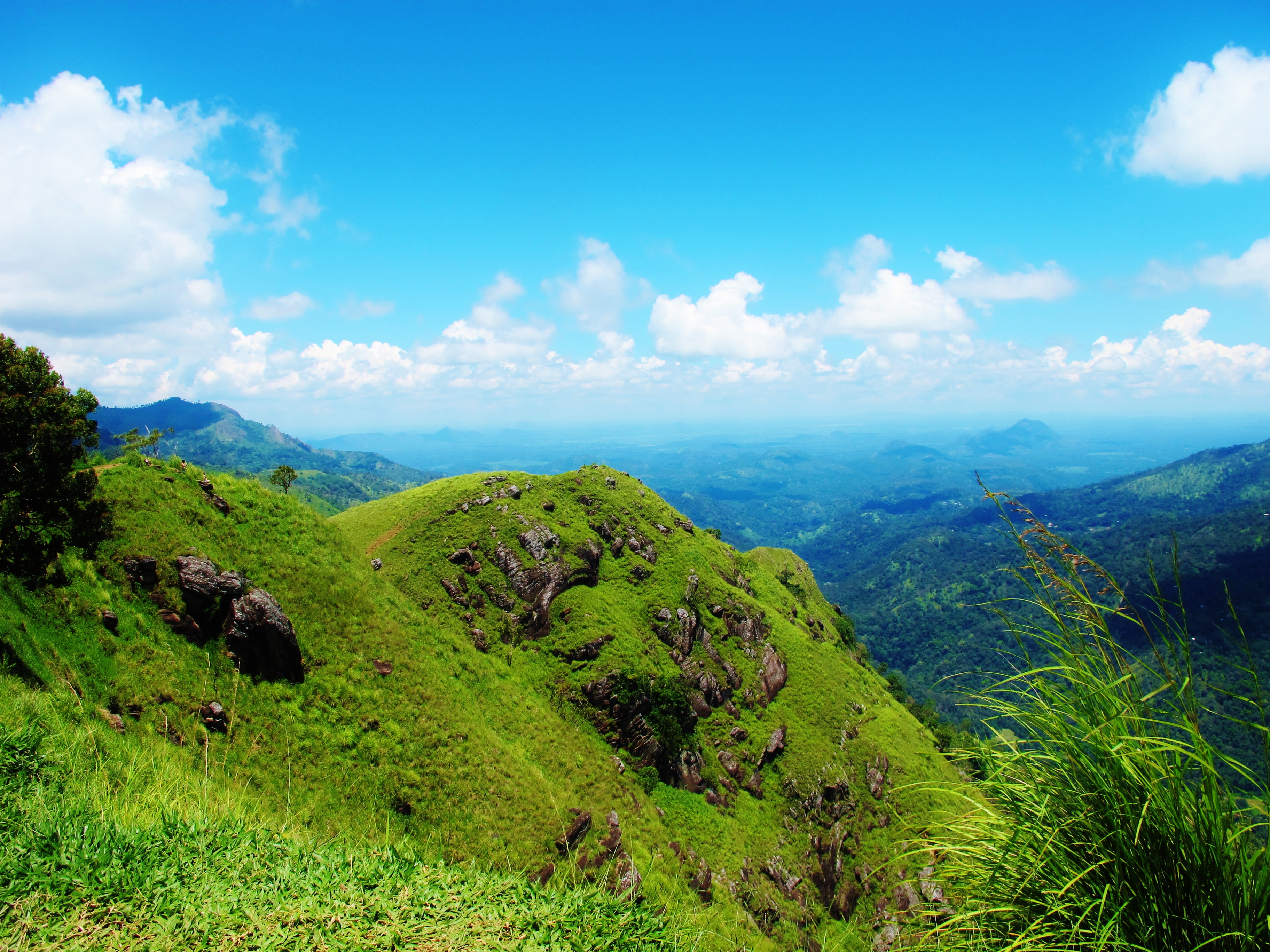
Little Adam’s Peak, near Ella, Sri Lankan highlands. Extensively deforested and replanted with tea and non-native tree species, the area is nonetheless fairly rich in bird life.
We rounded off our three-week Sri Lanka trip with a couple of days in the highlands, based in the small town of Ella, where I was hoping to add a few of the higher-altitude endemics to my list. On arrival, the landscape initially looked rather unpromising, with no original forest to be seen, extensive tea plantations, and non-native trees including the dreaded Eucalyptus much in evidence.
However, as it turned out I was pleasantly surprised by the number and variety of birds – including several endemic species – that were in the area. In just two days I recorded 61 bird species, most of them within a short walk of our guesthouse, Ella Nature View Lodge.
Chestnut-headed Bee-eater near its nest site along the Ella railway line.
Highlights:
Layard’s Parakeet – two pairs seen.
Sri Lanka Hanging Parrot – excellent views of a pair.
Yellow-crowned Barbet – common.
Crimson-fronted Barbet – fairly common.
Coppersmith Barbet – several.
Brown-headed Barbet – common.
Sri Lanka Junglefowl – commonly heard, seen once.
Common Hawk-cuckoo – heard only.
Black Eagle – two.
Booted Eagle – one, presumably late passage bird.
Crested Serpent Eagle – common.
Oriental Honey Buzzard – common.
Yellow-crowned Woodpecker – pair near our hotel.
Lesser Yellownape – one in trees along railway.
Black-rumped Flameback – fairly common.
Black-headed Cuckooshrike – one.
Asian Paradise-Flycatcher – several including a long-tailed male.
Indian Robin – several pairs in rocky areas.
Hill Myna – one.
Ashy Prinia – several on territory near hotel.
Sri Lanka White-eye – fairly common.
Small Minivet – fairly common.
White-browed Fantail – fairly common.
Bar-winged Flycatcher-shrike – several.
Sri Lanka Swallow – common.
Indian Scimitar-Babbler – several along railway.
Tawny-bellied Babbler – fairly common.
Yellow-eyed Babbler – several at margins of tea plantations.
Jerdon’s Leafbird – one.
Golden-fronted Leafbird – several.
Loten’s Sunbird – common.
Purple-rumped Sunbird – common.
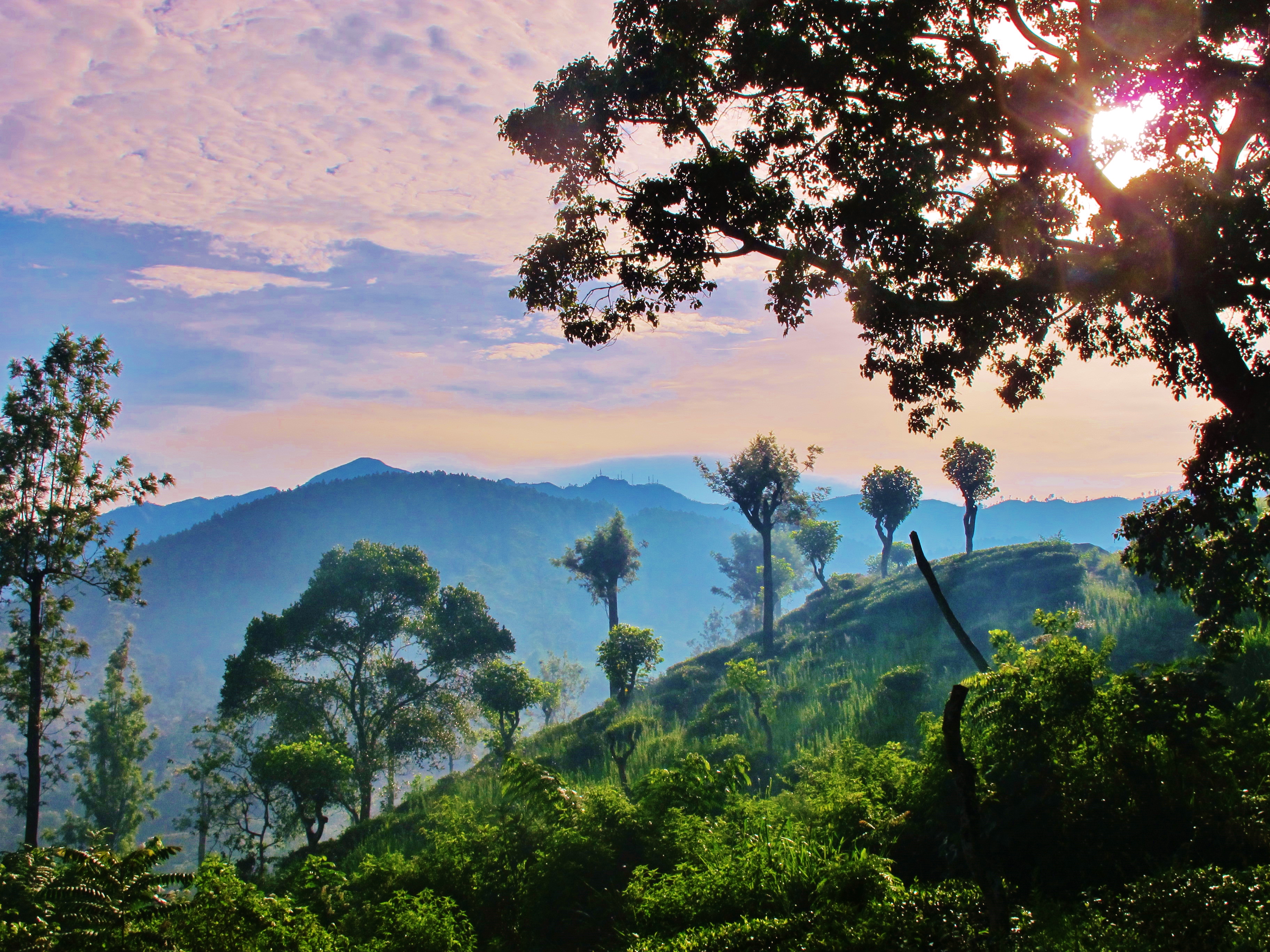
Tea plantations in the early morning sunlight.
Lifers: Yellow-crowned Woodpecker, Black-headed Cuckooshrike, Sri Lanka White-eye, Yellow-crowned Barbet, Ashy Prinia, Layard’s Parakeet, Jerdon’s Leafbird, Indian Scimitar-babbler (total 1,903).
Year ticks: Yellow-eyed Babbler, White-browed Fantail, Small Minivet (total 601).
The very first bird of the morning at Sinharaja was …. the spectacular endemic Sri Lanka Blue Magpie, actually inside the restaurant at Martin’s Simple Lodge.
After quite a few very enjoyable but hardly bird-filled days on the beach or beside the pool, I felt ready for an adventure to try and grab a few more Sri Lankan endemics. We had moved along the coast to Tangalle, from where a scooter trip to the northern part of Sinharaja and the famous Martin’s Simple Lodge seemed within the realms of possibility. I borrowed a scooter from one of the hotel staff, and armed with a rather basic map, set off on what turned out to be a 5-hour drive to the Kudawa entrance of the famous Sinharaja rainforest.
Despite the excruciatingly slow mode of transport, and less-than-ideal roads, the ride was actually fairly enjoyable. Close to Tangalle I picked up several Black-headed Ibis feeding in damp rice paddies, a long overdue lifer, while a hilly area of tea plantations produced a pair of Indian Robins.
Martin’s Simple Lodge is famous for being accessible only via the world’s rockiest, bumpiest track. Most people get there by 4WD jeep. I wanted to walk the 3km track instead, in order to save money as well as perhaps see some birds, but according to the park staff this wasn’t an option. After making a nuisance of myself for a while around the ticket office at the park headquarters, I was finally informed that it would be OK for me to drive myself to Martin’s on my scooter. It was quite an incredible road to attempt on such a vehicle, but thanks to plenty of experience riding scooters on bad roads in Thailand and Taiwan, I finally made it to Martin’s with only minimal damage to my borrowed transport.
A terrible road to attempt on a 100cc scooter, but we made it in the end.
Unfortunately, my precious afternoon at Sinharaja was a complete washout owing to continuous torrential rain that continued well into the night. Fortunately, when I awoke at 5.45am the next morning, the rain had temporarily stopped, and I was able to enjoy about four hours birding in the vicinity of the lodge before embarking on my epic return scooter ride to Tangalle.
I decided against entering the park proper. I figured there was plenty of good rainforest habitat around Martin’s lodge, and I was just as likely to connect with the target birds there as deeper in the forest. Also, prior to entering the rainforest, I would have had to retrace my steps back to park headquarters to buy an entry ticket and arrange for a compulsory guide, which would have cost a fair amount of money and a lot of my very limited time.
The very first bird I saw, as it was getting light, was a beautiful Sri Lanka Blue Magpie …. actually inside the restaurant at Martin’s Simple Lodge. Lifers don’t get any easier, or more spectacular, than that. Leaving the lodge, I quickly racked up some good birds including the sometimes tough-to-find White-faced Starling, and Sri Lanka Hanging Parrot. In Martin’s back garden, a fruiting tree attracted a nice range of birds including a Sri Lanka Grey Hornbill, Black-capped Bulbul, Yellow-browed Bulbul, and both Dark-fronted and Tawny-bellied Babblers. Nearby I was able to enjoy prolonged views of a calling male Sri Lanka Junglefowl, that most superior of jungle chickens:
A splendid male Sri Lanka Junglefowl, a beautiful endemic chicken found only in forested areas of Sri Lanka and nowhere else in the world.
I left Sinharaja as the rain threatened to return at about 10.00am, stopping to enjoy great views of several Legge’s Flowerpeckers as I carefully negotiated the track down the mountain.
One of Sinharaja’s most notorious native species is the humble leech. Having flicked several from my shoes and trousers during the morning, I thought I had successfully fended them off – until I got home and found several inside my clothes, along with a lot of blood. When visiting Sinharaja, bring your leech socks – especially after heavy rain.
It was a little frustrating to have so little time at Sri Lanka’s foremost birding site, but seeing some of the special birds has whetted the appetite and I will be sure to return.
Lifers (inside Sinharaja rainforest): Sri Lanka Blue Magpie, White-faced Starling, Sri Lanka Hanging Parrot, Black-capped Bulbul, Yellow-browed Bulbul, Sri Lanka Grey Hornbill, Sri Lanka Junglefowl, Tawny-bellied Babbler, Legge’s Flowerpecker (total 1,895).
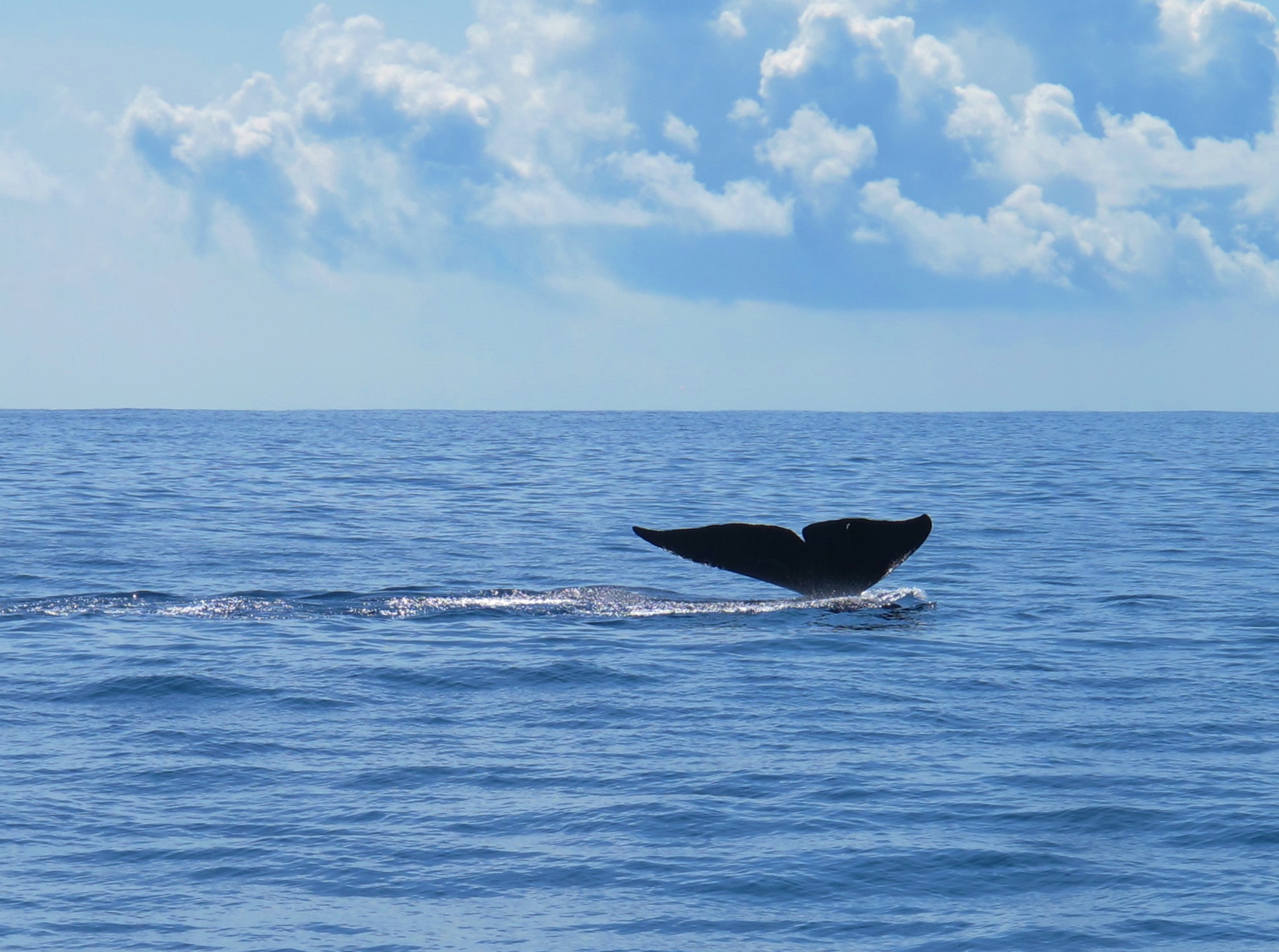
Blue Whale at sea off Mirissa, Sri Lanka, April 12th.
The southern Sri Lankan coast is one of the few places in the world where Blue Whale is reliably seen, and April one of the very best months for sightings. We joined a fleet of tourist boats setting off from Mirissa early in the morning, to the prime whale area about an hour’s boat ride from shore.
Over a 90-minute period, we saw a Blue Whale surface three times – a truly magnificent animal and definitely one for the “bucket list”.
In terms of the birds, tropical seas – away from breeding islets – can often be rather quiet for seabirds, and that was the case today. The only notable sightings were two large and fairly distant tern flocks, containing many summer-plumaged White-winged Terns and a handful of Bridled Terns, as well as many that remained unidentified due to distance. Also out here were at least three Flesh-footed Shearwaters passing fairly close to the boat.
We stayed in the town of Unawatuna, near Galle, which although a touristy beach resort did have the saving grace of a wooded hill close by. Our hotel – the Nooit Gedacht – also had extensive gardens including a lotus pond where many birds were seen. Loten’s and Purple-rumped Sunbirds were common and easily seen, and White-browed Bulbul, Green Imperial Pigeon, Brown-headed Barbet and Black-rumped Flameback were among the many birds nesting in the gardens or nearby. Other birds regularly seen around the hotel included the endemic Sri Lanka Green Pigeon and Sri Lanka Swallow, with Crimson-fronted Barbets common on the hill behind the hotel and Dark-fronted Babbler also seen there.
Finally, an early morning trip to Koggala Lake produced few birds at the lake itself, but the nearby airfield had a pair of Indian Stone-Curlews and several Ashy-crowned Sparrow-larks.
Lifers: Sri Lanka Swallow, Purple-rumped Sunbird, Loten’s Sunbird, Yellow-billed Babbler, White-browed Bulbul, White-bellied Drongo, Brown-headed Barbet, Crimson-fronted Barbet, Sri Lanka Green Pigeon, Black-rumped Flameback, Dark-fronted Babbler, Pale-billed Flowerpecker, Indian Swiftlet, Indian Stone-Curlew, Ashy-crowned Sparrow-lark (total 1,884).
Year ticks: Green Imperial Pigeon, Flesh-footed Shearwater, Bridled Tern, White-bellied Sea Eagle, Tickell’s Blue Flycatcher (total 578).
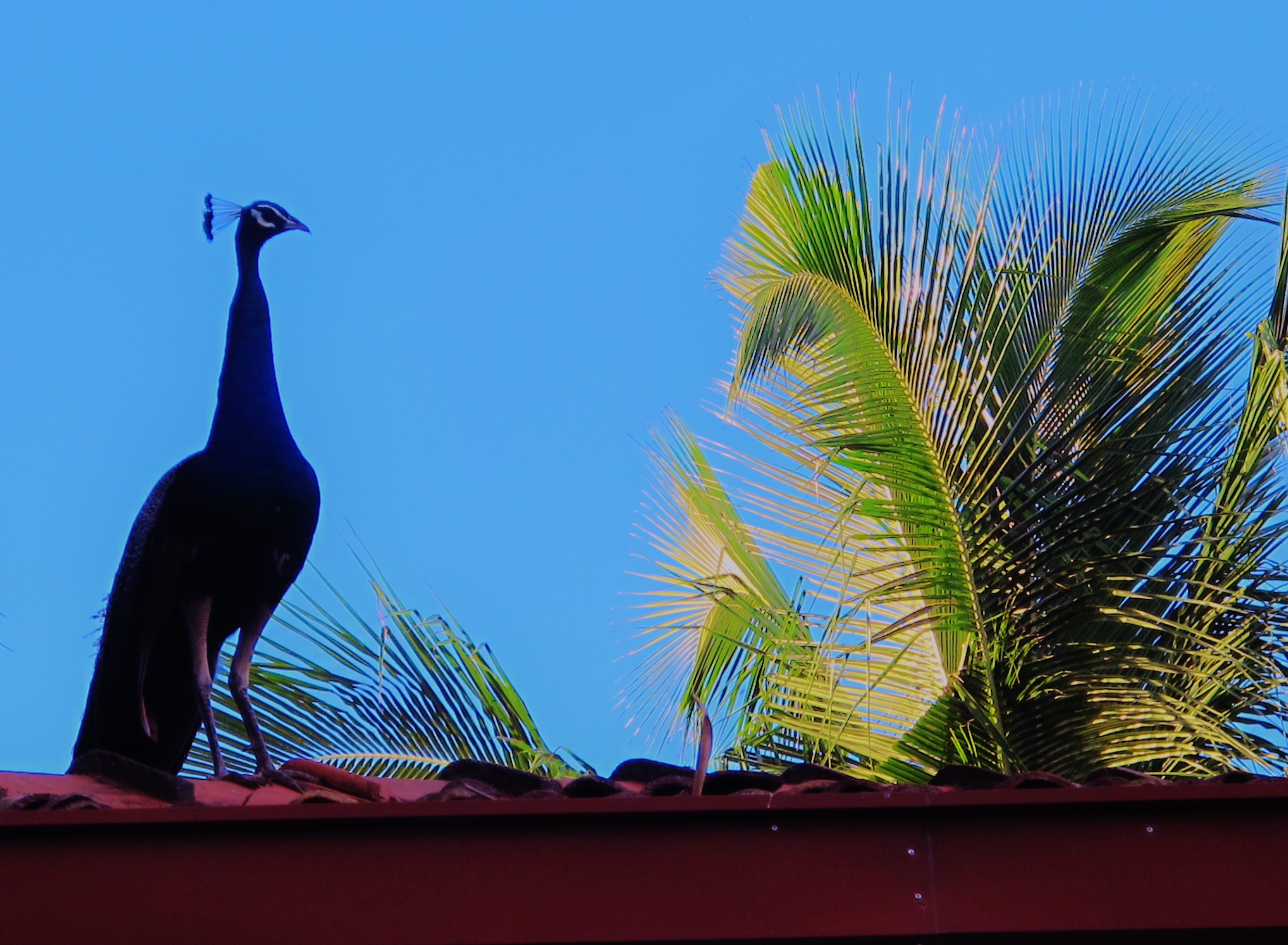
Indian Peafowl on the roof of our Unawatuna hotel.
The Taj Mahal. There were a lot of birds around the buildings here and on the river behind.
Birding took a back seat during my week in India. I was reunited with my fiancee Jenna after more than two months apart, and we had a busy schedule with visits to Agra and Varanasi – neither one a particularly famous location for birding! In addition, getting immersed in the chaos of India was really tough after the relative ease of Nepal, and I found that I had little inclination to get out there and try and make my way to any birding sites.
I did add a few new birds to the list. Bank Mynas were common throughout the places I visited. I had been looking forward to seeing this myna for some time, and it didn’t disappoint. They really are very handsome, clean-cut birds and a refreshing change from the legions of drab Common and Jungle Mynas I had been seeing in Nepal.
Having missed them in Cambodia on a dedicated birding trip there in 2012, it was good to catch up with the magnificent Sarus Crane –a pair showed well at a pool close to the main Delhi-Agra road.
Finally, the Taj Mahal proved surprisingly good for birds. Indian Grey Hornbills were easy to see around the buildings and gardens, while the river behind held some Bar-headed Geese, a flock of Greater Flamingo flying upstream, and lots of very distant birds of which only Painted Stork and Eurasian Spoonbill were identifiable through binoculars.
India lifers: Bank Myna, Sarus Crane, Bar-headed Goose, Indian Grey Hornbill (total 1,870).
India year ticks: Greater Flamingo, Laughing Dove (total 558).
The Annapurna mountain range at first light (altitude just over 4,000 meters).
No trip to Nepal would be complete without a trip to the high mountains of the Himalayas, where many sought-after bird species live. Getting to the best habitat entails quite a bit of effort, with several days walking needed. I opted for the Annapura Base Camp trek, a 6-8 day hike which starts near Nayapul and reaches a maximum altitude of 4,130 meters above sea level, passing through some excellent rhododendron and bamboo forest habitat along the way.
I had originally intended to go alone, but in the end teamed up with three non-birding trekkers, which made the long afternoons and evenings in the lodges much more enjoyable and social. We didn’t hire guides or porters – we took a map, the trails are well-marked, and we traveled light so were easily able to carry our own bags.
View to the Annapurna range from Landruk, our stop on the first night of the trek. Blue-fronted Redstart was a colorful addition to the trip list in the gardens around here.
Himalayan trekking presents many challenges for the birder. Seemingly endless flights of stone steps leave you breathless, especially at high altitudes. The steps and paths are uneven, so you have to spend lots of time looking at the ground and not at the birds. The main trekking routes can be busy with other hikers, porters carrying goods, and mule trains, meaning birding is quite disturbed. It was noticeable that bird activity declined very sharply after the first three hours of daylight, when many of the shyer species seemed to melt back into the forest away from the disturbance of the trails – during the afternoons, even in prime forest habitat, I usually saw and heard very little.
High altitude habitat near Macchapuchre Base Camp, at around 3,600 meters above sea level. Birds were scarce up here in the snow but did include a scattering of interesting species including Himalayan Monal.
A breakdown of each day of the trek:
Day one: Lumle to Landruk, around 1,600 meters altitude. Habitat mainly secondary forest, villages and agricultural land. New birds added included Grey-sided Bush-Warbler, the first of many Grey-hooded Warblers, and my first Russet Sparrows of the trip.
Day two: Landruk to Chhomrong, from 1,600 to 2,100 meters above sea level. The early morning produced several colorful Blue-fronted Redstarts around Landruk village. Also today, the first Rufous Sibias and Himalayan Griffons of the trip.
Day three: Chhomrong (altitude 2,100 meters). An enforced stay in Chhomrong due to an acute attack of food poisoning. The immediate vicinity of our guesthouse was excellent, with the following new species seen in the scrub and rhododendron shrubberies: Pink-browed, Spot-winged and Dark-breasted Rosefinches, Striated and Streaked Laughingthrushes, Red-headed Bullfinch, Fire-tailed Sunbird, and Whiskered Yuhina.
Day four: Chhomrong to Himalaya, from 2,100 to 2,900 meters altitude. Excellent habitat after Sinuwa, with rhododendron and oak forest and large areas of bamboo. However, birding was very slow, with just a handful of notable species added including Black-faced Laughingthrush, White-tailed Nuthatch and a surprise pair of Slaty-headed Parakeet.
Day five: Himalaya to Macchapuchre Base Camp (2,900 to 3,700 meters above sea level). Increasingly alpine environment, with deep snow on the ground past Deurali. Several big flocks of Snow Pigeon, and single Rufous-vented Tit and Grey-crested Tit, along with lots of Green-tailed and Fire-tailed Sunbirds.
Day six: Macchapuchre Base Camp to Annapurna Base Camp (3,700 to 4,130 meters). A pre-dawn hike up to Annapurna Base Camp, and a mid-morning return to MBC where we spent the rest of the day (the high risk of avalanches made it unwise to descend from MBC after mid-morning). Alpine Accentor, Robin Accentor and Grandala around lodges and snow-melt patches, a pair of Himalayan Monals on a crag, Lammergeier, Steppe Eagle, and abundant Alpine Choughs.
Day seven: MBC to Sinuwa (3,700 to 2,300 meters). The bamboo and rhododendron forests produced a few more birds on the way down, notably Green Shrike-Babbler, Black-eared Shrike Babbler, Yellow-browed Tit, White-throated Laughingthrush, and best of all, superb views of a Hill Partridge.
Day eight: Sinuwa to Landruk (2,300 to 1,600 meters). Many of the same birds as on the way up, with the addition of Speckled Woodpigeon.
Day nine: Landruk to Nayapul (1,600 to 1,070 meters). We took a bus for the last few kilometers. Birding was unremarkable except for a male Crested Bunting, several Black-lored Tits and a pair of Grey-headed Woodpeckers.











 Dom the Birder