The clocks went back today, buying me just enough time to make a short visit to this well-known local birding location while on a family visit to Dallas. I arrived, keen as mustard, as soon as it got light at 6.50am, only to find the gates aren’t unlocked on Sundays until 7.30am. I filled in the time at the neighboring park, where a Brown Creeper was a useful year list addition.
Arlington Village Creek Drying Beds is a fairly small area of small settling ponds, scrubby woodland and fallow fields, which according to eBird has played host to at least 295 bird species – an impressive total for an inland location of its size. A small hill near the parking area gives good views over the area, and I was soon enjoying the spectacle of large flocks of wintering ducks on the first lake on the right – mainly Gadwall and American Wigeon, with smaller numbers of Northern Shoveler, Northern Pintail, Blue-winged Teal, Mallard and Ruddy Duck. Some Aythya ducks lurked on a deeper adjacent pond – mainly Ring-necked Ducks but also several Redheads including two drakes. This was only my second personal record of the latter species, the first one being in the Western Palearctic – the long-staying wintering drake at Kenfig Pool in Wales in 2005. It was good to finally see this bird in its natural range.
I’m still getting to grips with the multitude of New World sparrows, and with my field guide at the ready I clinched the ID of several Lincoln’s Sparrows in the grassland, and a lone Song Sparrow in scrub along the lakeshore. American sparrows are an appealing bird family, strongly reminiscent of the Old World buntings, which I spent many enjoyable hours tracking down in winter in South Korea.
Another nice surprise today was a flock of 15-20 Western Meadowlarks. Having seen Eastern Meadowlark at Anahuac recently, it was interesting to compare these birds, which appeared much paler and more “washed out”. This species is regularly recorded at this site, which from the field guide appears to be at the edge of its usual range. I’m still at the stage of North American birding where I can reasonably expect a lifer on every outing, so it was good to get on the score sheet with this one today.
Lifer:Western Meadowlark (total 2,020).
2015 Year Ticks: Redhead, American Wigeon, Song Sparrow, Lincoln’s Sparrow, Eastern Bluebird, House Finch, Brown Creeper (total 1,013).
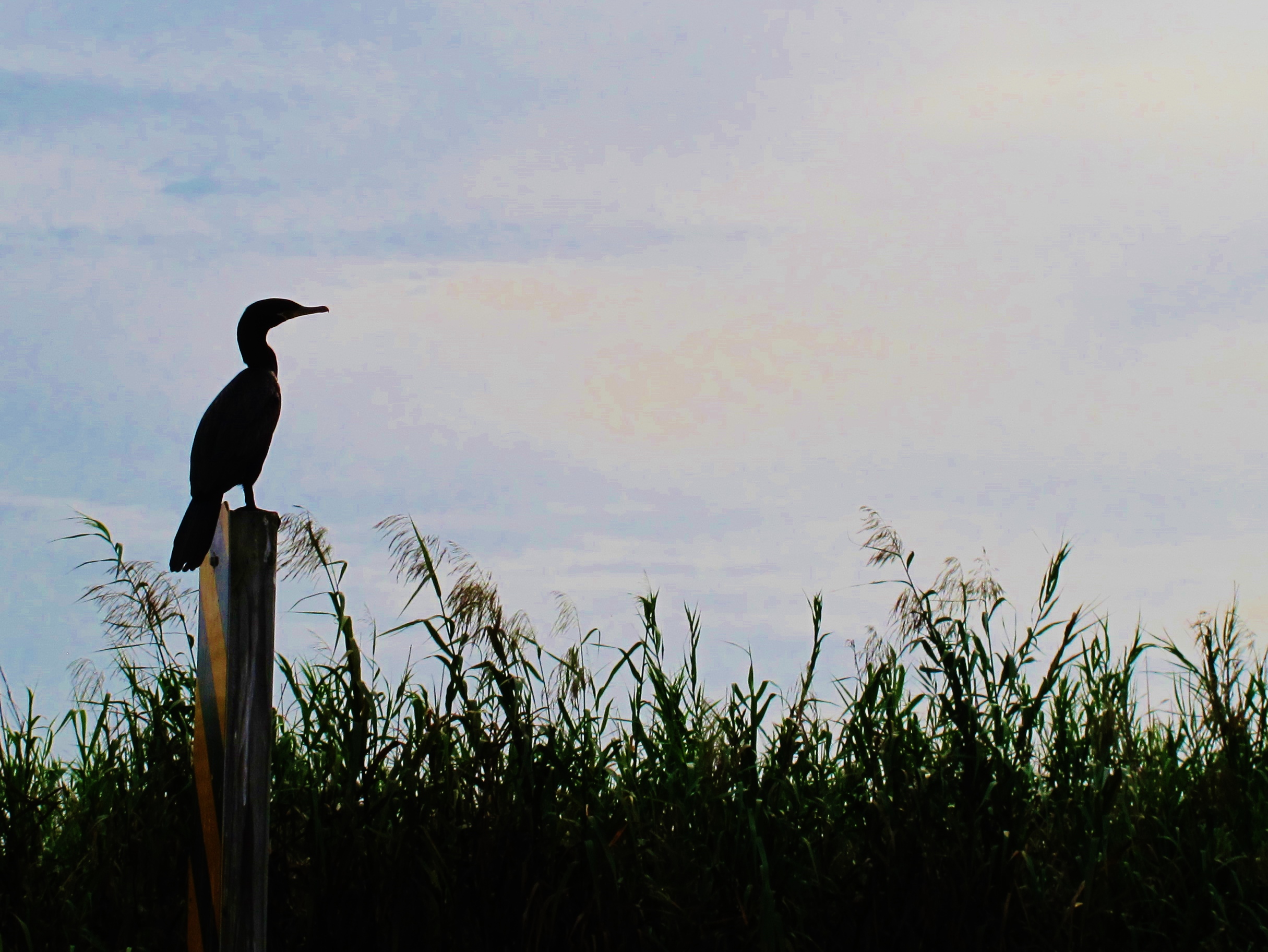
Neotropic Cormorant, Anahuac Wildlife Refuge, October 23rd.
After spending most of 2015 in Oriental Asia, what better way could there be to round off an excellent birding year than to spend late autumn and early winter in the USA? I got pretty much straight back into “normal life” on my return from Vietnam, but today I made the most of an opportunity to get out of Houston. It gets light quite late here at this time of the year, not until 7.30am, and I made sure I was on the I-10 heading east shortly after 6.00am in order to try and beat the rush hour traffic.
On the gulf coast of north-east Texas, a little more than an hour from Houston, Anahuac Wildlife Refuge is a flagship bird sanctuary. It is well known for hosting large numbers of wintering ducks, with up to 27 species possible on a midwinter day. In late October, the ducks have yet to arrive in force, but the area holds huge numbers of other birds including herons, ibises, raptors, and passerines. With this being late October, almost anything could turn up, and I was in a state of high anticipation as I made the early morning drive out from Houston.
Marshes at “Shoveler Pond”.
The good birding started before I even got into the reserve, when I spotted a couple of interesting-looking birds on a roadside wire. These turned out to be a Scissor-tailed Flycatcher and a late Eastern Kingbird. As I drove slowly along the road into the reserve, I saw several more of the former species on the wires, alongside large flocks of Brown-headed Cowbird and Red-winged Blackbird.
On arrival at the reserve visitor center, the nearby boardwalk seemed a good place to start. I didn’t linger for long, as the local mosquitoes are particularly aggressive at that time of day, but before I retreated I saw several year ticks including a male Vermilion Flycatcher, Loggerhead Shrike, White-tailed Kite, a flyover Royal Tern, and a magnificent Boat-tailed Grackle.
Probably the best area for birding is Shoveler Pond, around which a single-lane, one way road allows for great viewing of the marshes from the comfort of your car. At 7.45am I was the first person to drive along here for the day, which paid dividends in the form of an American Bittern flushed from beside the road and seen well in flight, and a Sora which lingered to eyeball me for a few moments before disappearing into the reeds.
Shoveler Pond was literally teeming with birds, and the year ticks were coming thick and fast, with further highlights in the form of small numbers of Mottled Duck, Roseate Spoonbill, various herons including a single Tricolored Heron, a pair of Fulvous Whistling Ducks, and plenty of both White Ibis and White-faced Ibis in nearby marshland.
Next, I drove slowly south on the main road through the reserve, stopping where marshes became visible to the east. Here, there were two Bald Eagles (an adult and an immature), a fly-through Green Heron, and vast numbers of American Coot and other wildfowl – although unfortunately most of the birds were very distant and the viewing conditions looking into the sun weren’t ideal.
At the end of the road, a small pool held some shorebirds including a Ruddy Turnstone, a Greater Yellowlegs, several Willets and a flock of Least Sandpipers. Offshore, Brown Pelicans, Laughing Gulls, and a few Forster’s Terns fished. Nearby, a juvenile Yellow-crowned Night Heron walked around on the edge of the road, and several Eastern Meadowlarks were seen in flight. Plenty of sparrows of various species inhabit the marshes and prairies at Anahuac, but every sparrow I got a look at turned out to be a Savannah Sparrow, which is abundant here. By late morning it was quite windy, so conditions for viewing passerines weren’t ideal.
Boat-tailed Grackle in display mode.
In the early afternoon, I took a drive out of the reserve to the Skillern Tract, which lies about 7 miles east of the main entrance road. Perhaps notable here was another male Vermilion Flycatcher, and a Common Yellowthroat. Along the way, I spotted a number of raptors in the air, so I stopped the car for a better look. They were mostly the two common vultures, but among them I found a Swainson’s Hawk (presumably on migration), and a Crested Caracara made an appearance too. Northern Harriers also seem to be very common in the area, with a minimum of 15 individuals seen today.
I ended the day with 52 year ticks, including 7 lifers, which pushed my 2015 year list through the 1,000 mark, the first time I have seen this many bird species in a single calendar year. With more than two months left in Texas, Anahuac is one place I’ll be sure to return to – especially once the winter wildfowl have returned in force in a month or so.
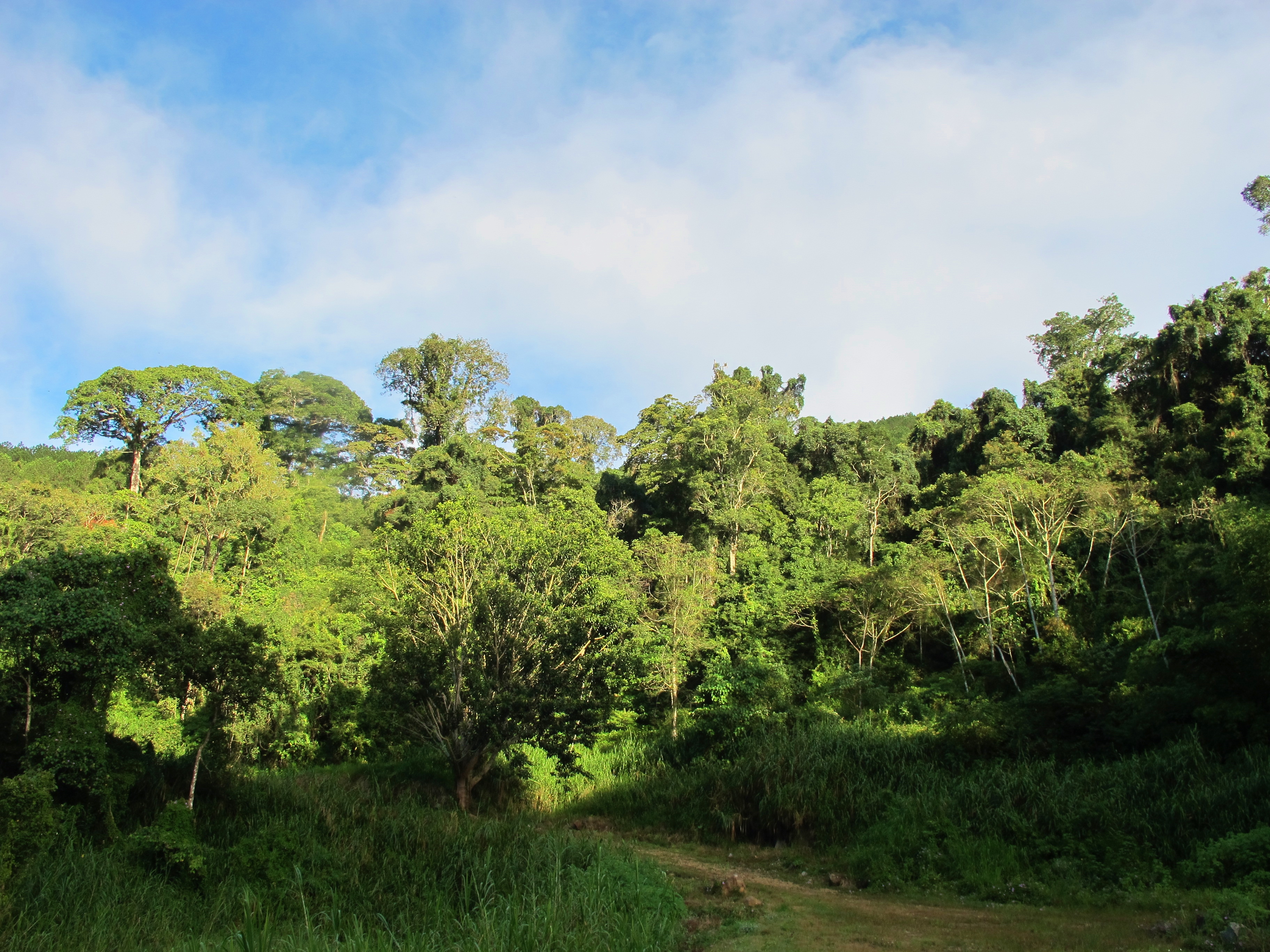
Early morning view from the road through Phong Nha-Ke Bang National Park.
The limestone karsts in north-central Vietnam, and neighboring central Laos, are home to several species found nowhere else: Sooty Babbler, the recently split Limestone Leaf Warbler, and the newly discovered Bare-faced Bulbul (so far only confirmed in Laos).
The Phong Nha-Ke Bang national park on the Vietnamese side of the border is renowned more for its caves than its birds, although the dramatic increase in tourist infrastructure in the area over the last five years means that several bird tour companies now visit. Nonetheless, most of the national park remains inaccessible to casual visitors, and further ornithological discoveries are no doubt waiting to be made here.
The fairly new airport in nearby Dong Hoi makes the area easily accessible from Ho Chi Minh City or Hanoi, with our last-minute midweek flights from the latter city costing only around US$35 each. The excellent Phong Nha Farmstay can arrange a private transfer from the airport for 500,000VND (US$23); their accommodation is comfortable and nestled in a beautiful rural setting among the rice fields with views to the national park. Other accommodation options, from hostels to basic hotels, exist in Phong Nha village. Traffic in the area is light, and renting a motorcycle is a good way to get around – these cost around 150,000VND (US$7) per day from several outlets in Phong Nha village.
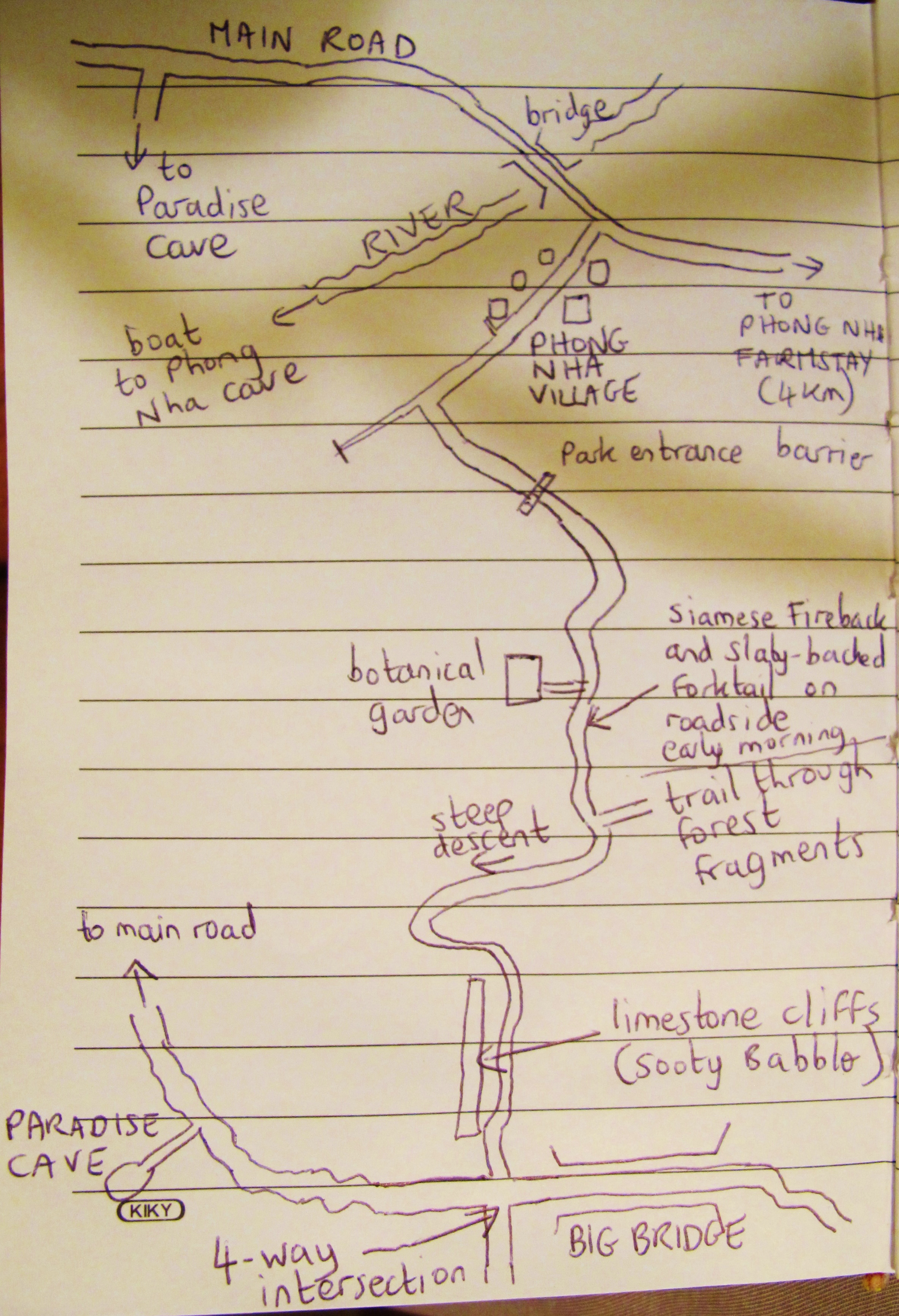
The loop road through the national park is about 50km long, starting and finishing in Phong Nha village. I found the eastern section of the road to be the best, especially the last 3km before the four-way intersection at the southern end of the park. Another spot to try is further north on the same road, where there is a wide track shortly before the steep descent. This track passes through several forest fragments – I had a group of three Siamese Firebacks along here in the early morning and a party of Wreathed Hornbills passing overhead, and it would probably be a good spot to try for a Blue-rumped or Bar-bellied Pitta.
Very basic sketch map of the area, which may be useful to some!
Opportunities to get deep into good habitat are very limited, but fortunately the road passes through some nice spots where some of the key species can be observed. The big bridge next to the four-way intersection is also worth a bit of time, as views from here are good. I didn’t manage to get very close to any limestone outcrops, where the two main target species reside, but I was lucky with Sooty Babbler: 3-4 birds showed fairly well but distantly on an outcrop about 2km north of the four-way intersection. Another possibility for this species would be the trail to Paradise Cave, which passes through some good forest, but the downside is having to pay a 250,000VND fee to access the trail.
Birding was generally fairly slow, with moderate levels of activity from first light until about 9.00am, then it became much quieter, with long periods in the afternoon when I saw and heard almost nothing. I saw 57 species in total during two early mornings and one afternoon birding in the park. I was told that the birds were formerly much hunted for food in this poor region, but rapidly increasing prosperity has led to a decline in hunting – one can only hope that this assessment from a local resident is indeed true.
Green-eared Barbet.
List of birds seen:
(not counting species seen outside the park gates, no heard-only birds included)
Red Junglefowl
Siamese Fireback
Rufous-bellied Eagle
Black Eagle
Thick-billed Pigeon
Himalayan/Oriental Cuckoo
Green-billed Malkoha
Greater Coucal
Asian Palm Swift
Red-headed Trogon
Oriental Pied Hornbill
Wreathed Hornbill
Green-eared Barbet
Grey-capped Woodpecker
Large Woodshrike
Bar-winged Flycatcher-shrike
Great Iora
Scarlet Minivet
Indochinese Cuckooshrike
Brown Shrike
White-bellied Erpornis
Black-naped Oriole
Ashy Drongo
Bronzed Drongo
Greater Racket-tailed Drongo
Black-naped Monarch
Racket-tailed Treepie
Ratchet-tailed Treepie
Dusky Crag Martin
Sultan Tit
Black-crested Bulbul
Red-whiskered Bulbul
Stripe-throated Bulbul
Puff-throated Bulbul
Yellow-browed Warbler
Arctic Warbler
Dark-necked Tailorbird
Pin-striped Tit-Babbler
Sooty Babbler
Puff-throated Babbler
Black-browed Fulvetta
White-crested Laughingthrush
Lesser Necklaced Laughingthrush
Asian Fairy Bluebird
Asian Brown Flycatcher
Oriental Magpie Robin
White-rumped Shama
Pale Blue Flycatcher
Blue Whistling Thrush
Blue Rock Thrush
Slaty-backed Forktail
Siberian Stonechat
Hill Myna
Blue-winged Leafbird
Crimson Sunbird
Streaked Spiderhunter
Grey Wagtail
Key species missed: Limestone Leaf Warbler, Red-collared Woodpecker.
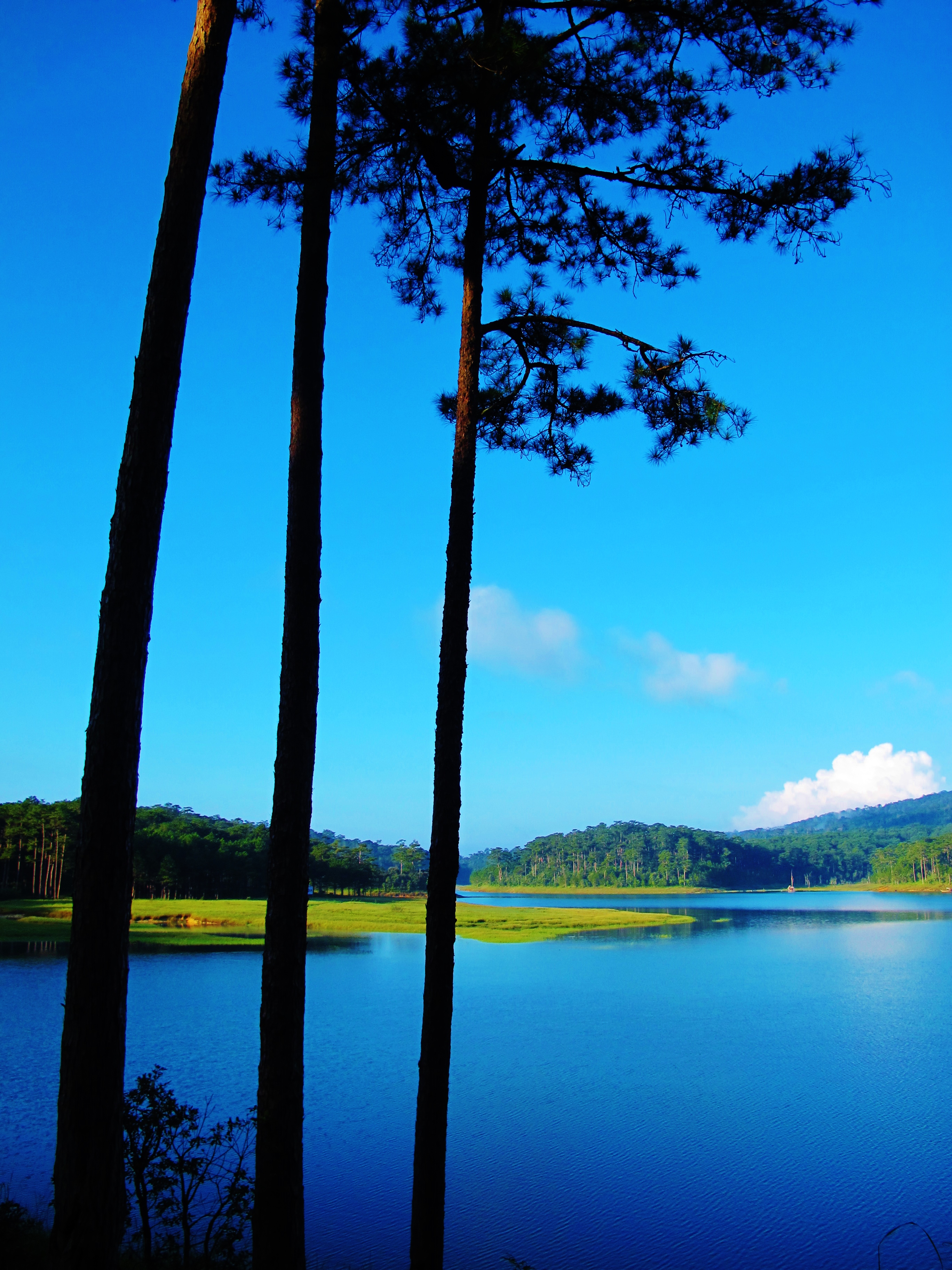
Tuyen Lam Lake – a very picturesque birding location.
The endemic-rich Dalat Plateau is a great place for a few days birding, with the three key sites all within 20 minutes drive of the town center. I first visited in 2006, when I was new to south-east Asian birding, and made only a single outing to Lang Bian mountain – predictably seeing only a small selection of the available birds. Nine years later, a bit more time, more skill and experience, and a more targeted approach produced sightings of the majority of the area’s endemics and special birds among a healthy total of 106 species.
The taxonomic status of many of the key local species has changed greatly in recent years, with Vietnamese Cutia, Black-crowned Fulvetta, Dalat Shrike-Babbler, and Grey-crowned Tit among the birds generally elevated to full species status since my previous visit. It seems likely that the distinctive local forms of Black-headed Sibia, Black-throated Sunbird and Blue-winged Minla will shortly join them on the rapidly lengthening list of Dalat endemics.
Online Resources: I found the following two websites to be indispensable for planning my trip:
The Google maps page clearly shows how to reach each of the sites, while Hendrik’s report is very comprehensive. In particular his excellent map of the trails to the south-east of Tuyen Lam lake is essential viewing – it is still completely accurate despite it being nine years since his report.
Transportation: I rented a small scooter from my hotel for 120,000VND per day. Getting involved in Vietnam’s chaotic traffic takes nerves of steel, although the situation in Dalat is nowhere near as intimidating as in Ho Chi Minh or Hanoi, and a scooter is the most flexible mode of transport for birders. Alternatively, meter taxis are available everywhere and are very reasonably priced.
Timing: Few birders visit the central Highlands in September, as it is reckoned to be one of the wettest months. During my visit, it rained hard most days from lunchtime onwards, but every morning was dry and sunny. It got light very early, around 5.35am, allowing for at least six hours birding time each day before the rains. The trails were predictably quite muddy, and I had several leech bites at Ta Nung valley and Tuyen Lam lake. Overall, the weather didn’t hamper birding in the slightest. Bird activity was quite high at all sites, although many birds weren’t singing which was probably a factor in my failure to find Orange-breasted Laughingthrush.
Trees at Ta Nung valley become alive with bird activity in the early morning as soon as the sun hits.
Birding sites: Although there are undoubtedly discoveries to be made on the Dalat Plateau for those with sufficient time and determination, I played it safe and stuck to the three main sites which between them hold nearly all of the area’s special birds.
Ta Nung Valley: Head west out of Dalat on road 725. After several kilometers of brand new road, the entrance to the site is marked by a wide track on the left, just over 6km from the last roundabout in Dalat town. The track should be easy to find as it seems to be the only one on the left hand side of this road. Follow this dirt road downhill for about one hundred meters to the locked iron gate, which the resident caretaker will open for you (I gave him 20,000VND for his trouble). Even very early in the morning (5.50am) he was up and about, so access shouldn’t be a problem. Follow the trail down to the valley bottom. This is undoubtedly the best birding site in the area in the early morning – as soon as the sun hits the treetops it becomes absolutely alive with birds here, and I found the main speciality Grey-crowned Crocias to be fairly easy to find. Other good birds I saw here included Pin-tailed Pigeon, Indochinese Cuckooshrike, Dalat Shrike-Babbler, Black-crowned Parrotbill and Vietnamese Greenfinch. Apart from birding along the wide track, it is possible to follow the river bed upstream through good broadleaved forest for several hundred meters, but the other forest trails along the stream marked in older trip reports were completely overgrown and impossible to find. Halfway down the track into the valley, a short loop trail through a patch of broadleaved forest was quite productive (follow the man-made terraces into the forest). It is worth noting that after 9am it seemed to suddenly become very quiet on both my visits to this site.
Tuyen Lam Lake: From Dalat, follow the eastern shore of the lake, past the dam and several high end resorts including Sacom and Edensee. Park just above the Da Tien resort, step over the logs and follow the concrete road to the end (there is no need to descend to the resort). The trail is somewhat indistinct as far as the second resort (fifteen minutes walk around the lakeshore from Da Tien), but afterwards the trail is clear and Hendrik’s map is most useful. The speciality of this site is Yellow-billed Nuthatch, which I found on my second visit in the “degraded forest” marked on Hendrik’s map. Other good birds I saw in this area included Silver Pheasant, Brown Fish Owl, Grey-crowned Tit and Red-billed Scimitar-Babbler.
Lang Bian mountain: A well-known tourist attraction about 10km north of Dalat. You must leave your vehicle at the base of the mountain, and either walk or take an expensive jeep 2.2km uphill to the start of the summit trail. From the trailhead, follow the path a further 2km to the summit. The trail is steep in places and passes through some excellent broadleaved montane forest. This is the site for Collared Laughingthrush, which can be hard to find as it is apparently becoming less responsive to call playback here. I was lucky, as one spontaneously emerged from the forest to investigate me, about 400m below the summit, not requiring any call playback at all. Other good birds I saw here included Black-crowned Fulvetta (a recent split from Rufous-winged Fulvetta), Clicking Shrike-Babbler of the distinctive local form with reduced chestnut on its breast, Snowy-browed Flycatcher, Lesser Shortwing, Scaly Thrush and Grey-bellied Tesia.
Other sites around Dalat: On one non-rainy late afternoon, I ventured south along Mimosa Road, where an opportune stop produced both White-crested and Lesser Necklaced Laughingthrushes, as well as a large flock of the rather common local speciality White-cheeked Laughingthrush. I also saw a Rufous-bellied Eagle soaring overhead from our hotel on Khe Sanh Road just south of Dalat.
Record shot of Collared Laughingthrush at Lang Bian mountain,.
List of birds seen:
1 = Ta Nung Valley, 2 = Tuyen Lam Lake, 3 = Mount Lang Bian, 4 = Elsewhere in Dalat
Chinese Francolin 2
Red Junglefowl 2
Silver Pheasant 2
Little Grebe 2
Little Egret 2
White-bellied Sea Eagle 2
Rufous-bellied Eagle 4
Black-shouldered Kite 4
White-breasted Waterhen 2
Spotted Dove 2
Barred Cuckoo-Dove 1,4
Emerald Dove 2
Thick-billed Pigeon 1
Pin-tailed Pigeon 1
Mountain Imperial Pigeon 1,2,3
Banded Bay Cuckoo 1
Green-billed Malkoha 1
Brown Fish Owl 2
House Swift 1,4
Red-headed Trogon 1,2
Common Kingfisher 2
Blue-bearded Bee-Eater 1
Indochinese Barbet 1,2
Greater Yellownape 2
Greater Flameback 2
Grey-headed Woodpecker 2
Bay Woodpecker 1,2
Bar-winged Flycatcher-Shrike 1
Grey-chinned Minivet 3
Long-tailed Minivet 2,3
Scarlet Minivet 1
Indochinese Cuckooshrike 1
Burmese Shrike 1,2,3
Dalat Shrike-Babbler 1
Clicking Shrike-Babbler 1,3
White-bellied Erpornis 2
Slender-billed Oriole 2,3
Maroon Oriole 2
Ashy Drongo 1,2,3
Bronzed Drongo 1,2
Hair-crested Drongo 1
Lesser Racket-tailed Drongo 1,2
White-throated Fantail 1,2,3
Eurasian Jay 1,2,3
Barn Swallow 1,3
Grey-headed Canary-Flycatcher 1,3
Green-backed Tit 1,2,3
Grey-crowned Tit 2
Chestnut-vented Nuthatch 2,3
Yellow-billed Nuthatch 2
Black-crested Bulbul 1
Sooty-headed Bulbul 2,3
Flavescent Bulbul 1,2,3
Ochraceous Bulbul 1
Black Bulbul 1,2,3
Ashy Bulbul 1,2
Mountain Bulbul 2,3
Ashy-throated Warbler 3
Yellow-browed Warbler 1,3
Arctic Warbler 1
Kloss’s Leaf Warbler 1,2,3
Grey-cheeked Warbler 1,3
Chestnut-crowned Warbler 1,2
Hill Prinia 1,2
Black-crowned Parrotbill 1
Rufous-capped Babbler 1,3
Red-billed Scimitar-Babbler 2
White-browed Scimitar-Babbler 2
Grey-throated Babbler 1,2
Spot-throated Babbler 1,2
Black-crowned Fulvetta 3
Mountain Fulvetta 1,2,3
White-cheeked Laughingthrush 1,2,3,4
Collared Laughingthrush 3
White-crested Laughingthrush 4
Lesser Necklaced Laughingthrush 4
Black-headed Sibia 1,2,3
Rufous-backed Sibia 1,2
Silver-eared Mesia 2
Grey-crowned Crocias 1
Blue-winged Minla 1
Asian Fairy Bluebird 1
Asian Brown Flycatcher 2,3
Large Niltava 2,3
Verditer Flycatcher 1,2
Snowy-browed Flycatcher 3
Little Pied Flycatcher 2
Lesser Shortwing 2,3
Siberian Blue Robin 2
White-tailed Robin 2,3
Grey Bushchat 2,3
Scaly Thrush 3
Hill Myna 2
Black-collared Starling 2
Yellow-vented Flowerpecker 1
Fire-breasted Flowerpecker 1
Black-throated Sunbird 1,2
Mrs Gould’s Sunbird 3
Streaked Spiderhunter 1,2,3
Grey Wagtail 1,2,3
Oriental Pipit 3
Vietnamese Greenfinch 1,2
Plain-backed Sparrow 3
Tree Sparrow 3,4
White-rumped Munia 1
Scaly-breasted Munia 3,4
Additional heard-only birds not counted on this list included Collared Owlet and Red-vented and Golden-throated Barbet. Notable misses included Orange-breasted and Black-hooded Laughingthrushes, Indochinese Green Magpie, Red-vented Barbet, Vietnamese Cutia and the potential endemic Vietnamese Crossbill.
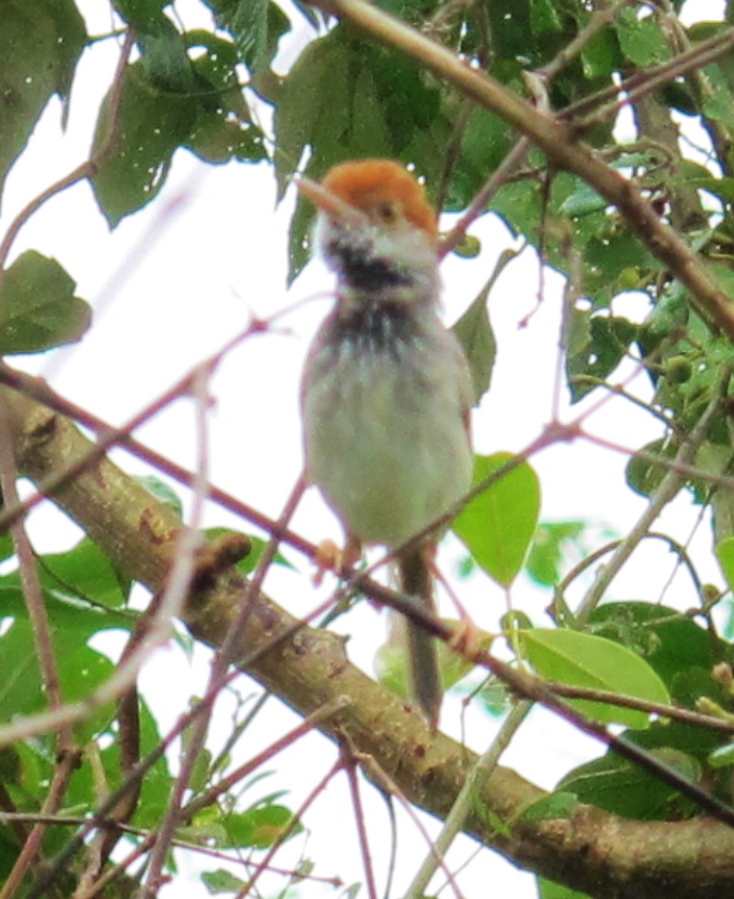
Cambodian Tailorbird, record shot taken with a Canon G12 in poor light and rain, September 16th 2015.Cambodian Tailorbird, record shot taken with a Canon G12 in poor light and rain, September 16th 2015.
Even in densely populated Asia, birds new to science are occasionally discovered – usually as a result of scientific surveys of very remote or previously inaccessible areas. Therefore, more than a few eyebrows were raised in mid 2013 when news was released of a previously undescribed species of Tailorbird. This bird was found living not in some remote forest, but literally under the noses of millions of people in Cambodia’s capital city, Phnom Penh.
The Cambodian Tailorbird somewhat resembles a cross between Ashy Tailorbird and Dark-necked Tailorbird, being mainly grey in color like the former species, but with a large dark patch on its throat reminiscent of the latter. It also has distinctive vocalisations. It has so far been found only in riverine scrub in the flood plain of the Mekong, Tonle Sap and Bassac rivers, meaning its range is extremely small, and its population likely threatened by habitat loss from urban development.
The site I had been given for Cambodian Tailorbird is about 15km north of Phnom Penh. From the city, follow Highway 5 towards Battambang along the west bank of the Tonle Sap river, as far as the Prek Phnov bridge. This crossing is also known as Ly Yongphat street, which is the name my tuk-tuk driver was familiar with. Immediately after crossing this toll bridge, there is a dirt road on the right (heading south). After about 1km, look for an obvious patch of dense scrub on the left, at approximately N 11 39 14.8 E 104 52 40.3. A little call playback here quickly enticed a pair of Cambodian Tailorbirds out into the open. They are probably common in all suitable scrub patches in the area, and certainly seemed extremely responsive to call playback. Unfortunately, it was raining fairly steadily at the time, and a couple of record shots with my Canon G12 were all I could manage in poor light.
So all in all, a successful and rather easy “twitch” of a smart little bird. Coming from central Phnom Penh, allow 2-3 hours for the trip depending on how long you want to spend at the site (the drive itself takes about 45 minutes each way), and reckon on paying your tuk-tuk driver around $15-20 including waiting time.
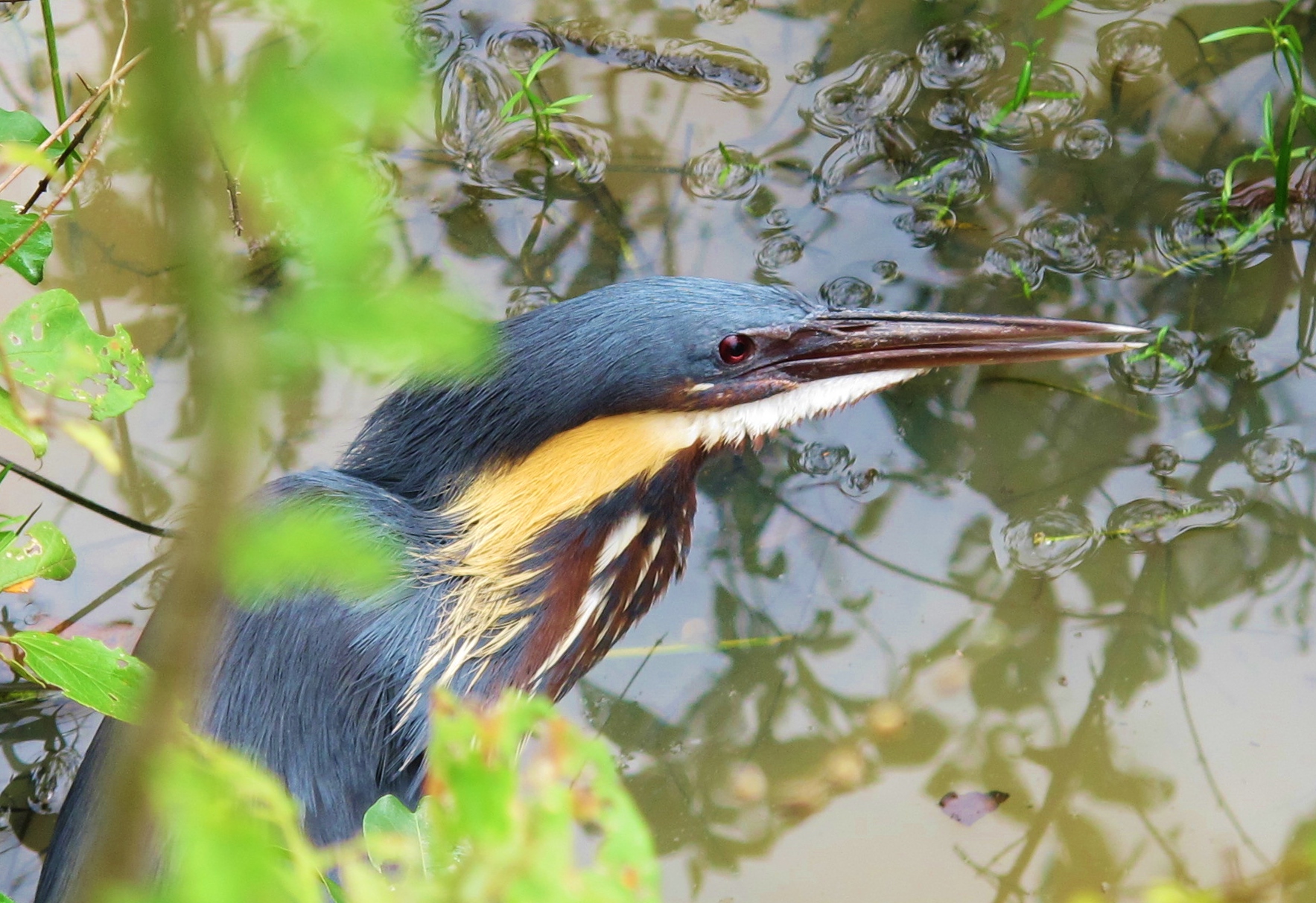
Black Bittern, Phnom Krom rice fields, September 10th 2015.
With a free morning before the obligatory Angkor temples tour tomorrow, I decided to once again visit the rice fields at Phnom Krom – for the second time this year. My main targets were White-browed Crake, Black Bittern and Asian Golden Weaver, the latter two species in particular being potentially easier to find in summer than during my previous visit in February.
In the event, I scored with only one of the three targets, but I did so in some style. Walking alongside a drainage ditch, I noticed a movement below the fringing vegetation almost under my feet, which turned out to be a fine male Black Bittern. Seeing as I was so close, the bird elected to try and hide instead of flying off, so I was able to reel off some fairly decent photos with my point-and-shoot camera. Black Bittern is mainly a summer visitor to south east Asia, and a rather skulking and secretive one at that. It is therefore not seen by many visiting birders, who usually come to the area in winter.
This morning’s supporting cast included two Watercock (only the second time I have seen this species), and several distant Oriental Pratincoles. Also among 34 bird species seen in the area were two Yellow Bitterns, a Cinnamon Bittern, a Lesser Whistling Duck, a pair of Cotton Pygmy Geese, a handful of migrant Wood Sandpipers, a Black-collared Starling, and a most unexpected Rufous Woodpecker.
Lifer: Black Bittern (total 1,987).
2015 Year Ticks: Watercock, Oriental Pratincole (total 898).
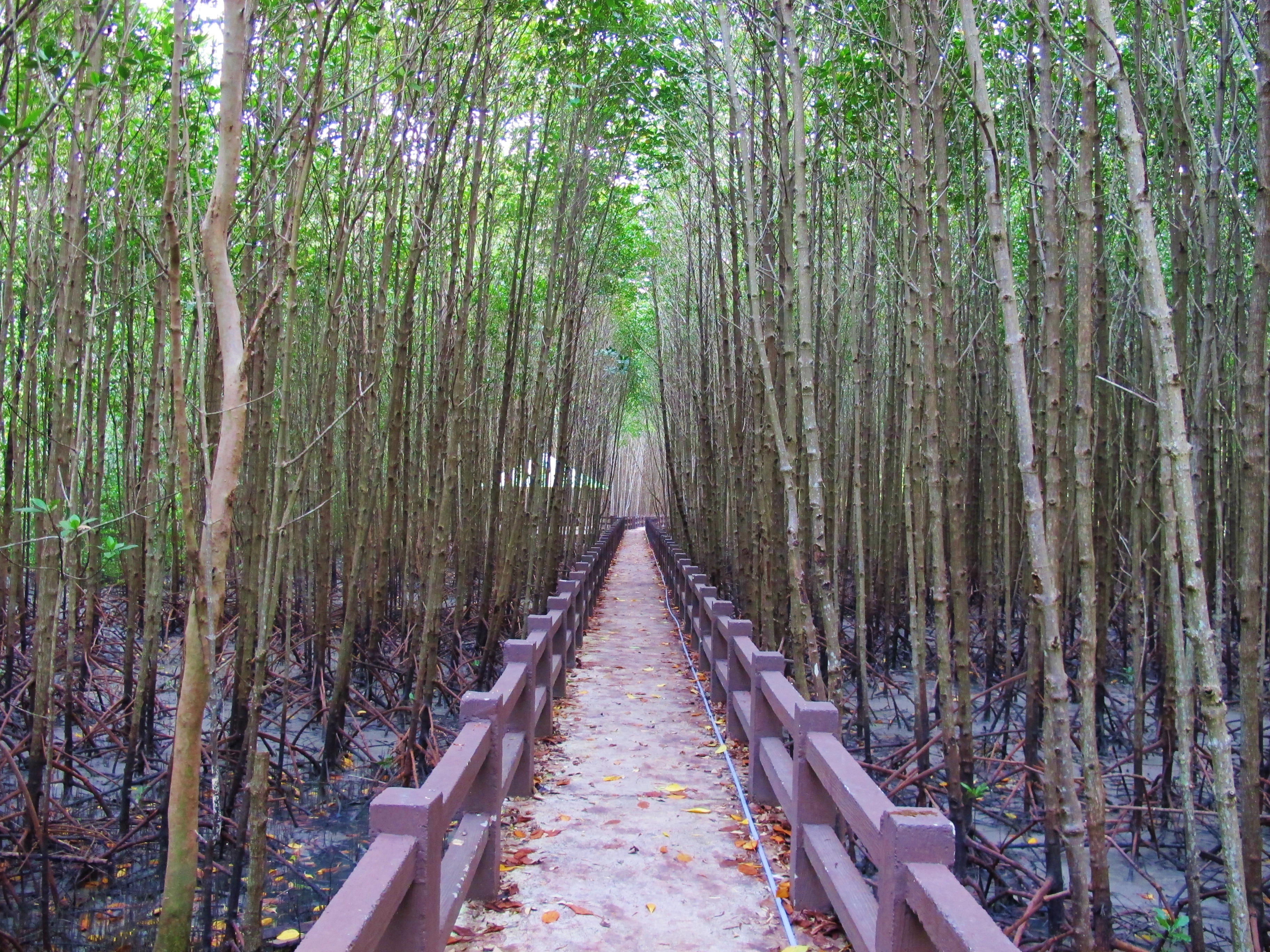
The mangrove boardwalk next to the Tammalang pier, about 10km south of Satun.
On my way back from Hala Bala to Phuket, I took a fairly big detour to overnight in Satun. This was so I could be in position to spend a couple of early morning hours in the mangroves, just to the south of the town. I had two target birds here – Mangrove Whistler and Copper-throated Sunbird. They are both fairly scarce and localised birds in Thailand, but this area is known as one of the best sites to see them.
Mangroves in south Thailand are a frustrating habitat. First of all, not all of the mangrove specialities occur in the same patches of mangrove. You can see Mangrove Pitta in Krabi, but not in Satun. Mangrove Whistler is in Satun, but absent from Krabi. Brown-winged Kingfisher is abundant in some mangroves and seldom seen in others. The rare Mangrove Blue Flycatcher occurs reliably only near Pattani, but not in other areas of seemingly ideal habitat. So you have to visit several areas to add all the birds to your list.
Second, birds never seem to be very numerous in this kind of habitat. It is easy to wander around in mangroves for a few hours and hardly see anything at all. Or sometimes, the very common Golden-bellied Gerygone seems to be the only bird species in there.
My first port of call today was the car park at Tammalang ferry pier, south of Satun, from where ferries to Malaysia depart. Next to the pier, a mangrove boardwalk gives access to some nice habitat. I hadn’t even started on the boardwalk when a bird in a bush next to the car park turned out to be my first target species – a juvenile Mangrove Whistler. It’s very hard to get excited about this bird, as it’s one of the drabbest creatures imaginable – but at least it was safely on my list in record time.
My second target proved a little more difficult, but towards the end of my circuit of the boardwalk I found it – a stunning male Copper-throated Sunbird. This bird is practically the polar opposite of a Mangrove Whistler, being glossy purple, green, black, and blue, with a burnt orange throat. It’s also noticeably long-tailed for a sunbird. Definitely one of the better-looking members of a very colorful bird family.
My final stop was the Mangrove Research Center, where I saw both my target species again, but didn’t score with a secondary target bird, Sunda Pygmy Woodpecker. This is a common species in Malaysia and Indonesia, and its range just extends into southernmost Thailand; in fact the Satun mangroves are the only known site for it in the Kingdom. I’ll probably find myself coming back here for it when my Thai list starts to get into the 700s!
Other birds seen in the area today included Cinereous Tit, Malaysian Pied Fantail, Striated Heron, Whimbrel, a migrant Arctic Warbler, and good numbers of Collared Kingfishers.
Hala Bala research station, with the magnificent Rhinoceros Hornbill as its emblem – a bird that can readily be seen here with a little patience and luck.
Like most birders, I was unsure about whether to make the long journey to the Deep South, due to the ongoing civil war that has claimed more than 6,000 lives since 2004. The British government advises against all but essential travel to the area. Bombings and shootings occur on an almost daily basis, and while tourists are not targeted, the nature of the attacks is indiscriminate and it is possible to end up in the wrong place at the wrong time.
On the other hand, Hala Bala wildlife sanctuary is in a remote area, far from the towns and villages where the majority of the attacks take place. Birders regularly visit in small numbers, and even the occasional commercial birding tour goes there. The long bird list for the sanctuary – including many species found nowhere else in Thailand – is more than tempting.
After reading around as much as I could online – and keeping in mind that the latest news stories may not be reported in the English language media – I decided to chance a visit. My first strategy was to be prepared. Before heading south from Hat Yai, I stocked up on food and water – enough for my 2.5 day stay in the park – and filled the fuel tank of my rental car. I wanted to be able to drive straight to Hala Bala without stopping, and remain within the park boundaries for the duration of my stay.
Directions: Hala Bala is about 280km from Hat Yai, and is relatively easily reached along the main coastal highway through Songkhla, Pattani, and Narathiwat provinces, with a journey time of just under 4 hours. From eastern Songkhla onwards, the region is under martial law. Military checkpoints are frequent, and armored vehicles and machine-gun toting troops are much in evidence. This might be expected to produce a rather menacing atmosphere, but people seem to go about their lives as normal and I never felt in any danger – indeed, the constant presence of troops is actually somewhat reassuring. Of course, the soldiers always raised their eyebrows in surprise as I rolled down the window at the checkpoints, as I suppose very few foreign tourists make their way down here.
The sat nav in my rental car already had “Hala Bala peat swamp research center” programmed in to it, which is inside the sanctuary, so all I had to do was follow the directions. For those without sat nav, the route is easy as far as the border town of Sungai Kolok, from where you should follow road 4057 to Waeng. Even the sat nav was confused in Waeng, but the town is not that big and eventually you should find yourself on the 4057 heading out of town towards the Buketa border checkpoint. Just before the border is a right turn to a village, take this road which becomes the 4062 and heads through several small villages before entering the wildlife sanctuary. It is only for the last few kilometers that Hala Bala wildlife sanctuary is actually signposted.
Orientation: The park HQ is in the first group of buildings you come across, up a steep track on the right (signposted “office” from the main road).
The research center is a few kilometers further ahead, on the left. There is a big sign with a picture of Rhinoceros Hornbills on it, and an entry checkpoint. A few hundred meters further on along the 4062, there is a turning on the left for Sirindhorn Waterfall (it is signposted).
The 4062 then continues through the wildlife sanctuary for about 12km, crossing three bridges along the way, and climbing to a high point before descending to another checkpoint which marks the western end of the Bala reserve.
Shortly after the western checkpoint, a driveway on the left goes through gates to a forest temple with some trails that sometimes produce good birds. A kilometer or so further on, road 4062 enters a village (called Ban Phu Khao Thong), with an intersection next to a playing field. Keep going straight, and there is a general store that sells cold beer on the left (this road eventually ends at the Malaysian border complete with manned gun tower). Take the right turn at the intersection, follow the road around to the left, and continue straight ahead at the next intersection. There is a school on the left, and a noodle soup stand on the right, where I had lunch every day. Ban Phu Khao Thong is very friendly, and I was greeted with great interest by the locals. It is a Thai Buddhist village, hence the availability of beer and “kuaytiaw moo”. As a general rule, the villages to the west of the sanctuary (this one and Ban Toh Moh a little further on) appear to be Buddhist, and the ones to the east along the road to Waeng are all Muslim.
The Toh Moh community forest, mentioned in some site guides, is reached by continuing past the school/noodle soup shop for about 5km, as far as the T-junction in Ban Toh Moh. Turn left here and follow the road to the end, where the trail begins. This forest is outside the protected area of the wildlife sanctuary but still an excellent birding spot.
My extremely basic accommodation in an empty building at Hala Bala wildlife sanctuary HQ.
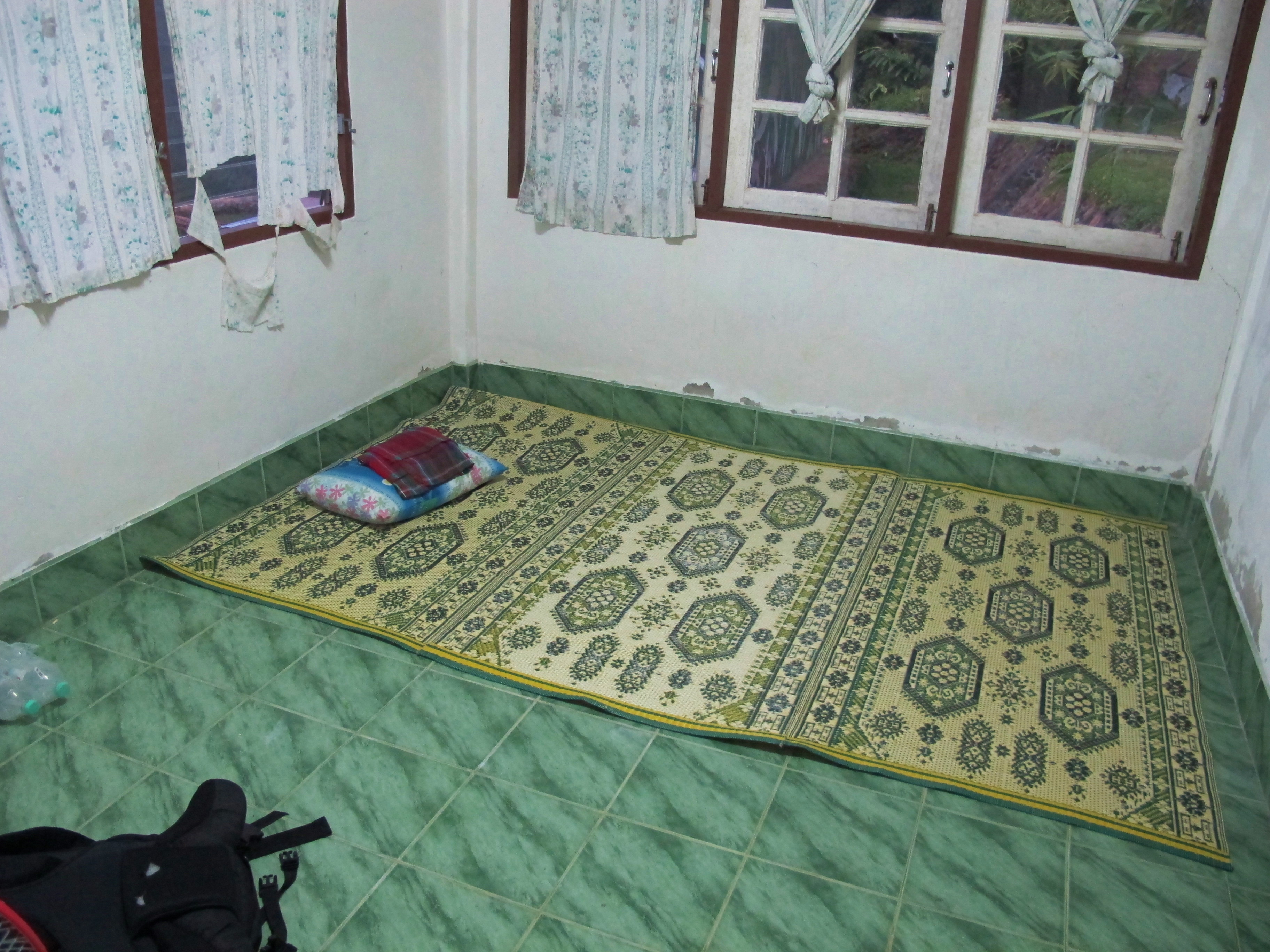
Accommodation and food: I turned up with no advance notice, fully prepared to sleep in the car if necessary. On arrival, I went to the office, where the park director and his staff were very friendly, although communication was difficult as they spoke hardly any English and my Thai is absolutely minimal. I was informed that the usual way to stay at Hala Bala is to send an email a month in advance to their head office in Bangkok. Having not done this, it seemed at first that my chances were low of getting a roof over my head for the night at the sanctuary. However, after a lot of smiling and a little gentle negotiation, I was given permission to stay in an empty building in the park HQ grounds, and provided with a sleeping mat, pillow, blankets and a fan, in exchange for a “donation” of 100 baht per night. It seemed to help my case when I made it clear that I was a birder and not a photographer, I guess they may have had issues in the past with photographers wishing to stake out rare species in the sanctuary.
One of the unexpected rules stipulated by the director was that I was to have a park ranger with me at all times while birding. I didn’t like this rule, but agreed to it anyway. I had two rangers with me throughout the first morning and into the early part of the afternoon, which wasn’t too much of a hardship as they had birding optics and a field guide with them, and they were friendly and interested in birds although not especially knowledgeable. By halfway through the first afternoon, they evidently decided I was OK on my own and left me to my own devices, and they didn’t accompany me again after that.
I had enough food with me to last for the duration of my stay (bread, canned fish, fruit, nuts etc.), but I supplemented my diet at lunchtime with noodle soup from the shop in Ban Phu Khao Thong, as already mentioned. There are also some food options in the Muslim villages to the east of the sanctuary.
Birding: I found some fairly good information online; the main sites I used were Thai Birding, Phuket Birdwatching, and South Thailand Birding. North Thailand birding also had some trip reports with species lists.
The roadside is the main site for birding. Road 4062 runs through the sanctuary from east to west. This road has almost no traffic apart from the occasional park ranger or local on a motorbike (I saw less than one vehicle an hour on average). It is a single track road for most of its length, with vegetation brushing both sides of the car at several points; there are however fairly frequent places to park on the verge. The road is generally in reasonable shape, and while there are one or two rough parts it should still be passable with care in a non-4×4 car.
The two viewpoints mentioned in Thai Birding’s site guide no longer exist, and getting views across the forest canopy is more or less impossible, making it presumably quite a bit trickier to see Hornbills than it used to be. The only place I had a good open view of the forest was along a short section a couple of kilometers west of the research center where the road is banked with concrete; there were almost no opportunities after this, which was particularly frustrating near the high point of the road where I heard Helmeted Hornbill daily but had almost no chance of seeing it.
Bird activity seemed especially high along the ridge just east of the highest point of the road, and on the downhill stretch west of there as far as the third bridge, even in the afternoons when bird waves were commonly encountered.
The high levels of action on the road contrasted with very quiet birding within the forest. I spent some time on the short nature trail in the lower section of the research center, where there were a fair amount of leeches and not a lot of birds. I didn’t wade across the river to the “long” leech trail, I will save this for another visit at a better time of year when forest birds are more active and vocal, and when I have a pair of leech socks with me!
The Toh Moh community forest offers a nice easy trail through good habitat, alongside a stream which should offer the chance of forest kingfishers. Birding was good during my visit here for the first couple of hours of daylight, before suddenly going quiet.
I went out a couple of times at night with my spotlight, just around the park HQ area, and heard no night birds whatsoever. I’m assuming that other times of year would be more productive for this, as Blyth’s/Javan Frogmouth is supposedly abundant in the area and many species of owl occur.
The weather wasn’t bad, with mostly dry and hot days, and some rain in the late afternoons and overnight. Mornings often started gloomy and misty, which hampered birding especially in the closed forest.
My overall feeling was that while the birding was very good, I felt the species diversity was a little lower than I had been expecting, and I couldn’t help but feel that I would have seen and heard more at a different time of the year. But for a first visit it was very good and I will definitely be coming back as soon as the opportunity allows.
The sun burning off the early morning mist, alongside the river at the research center.
Bird highlights by locality:
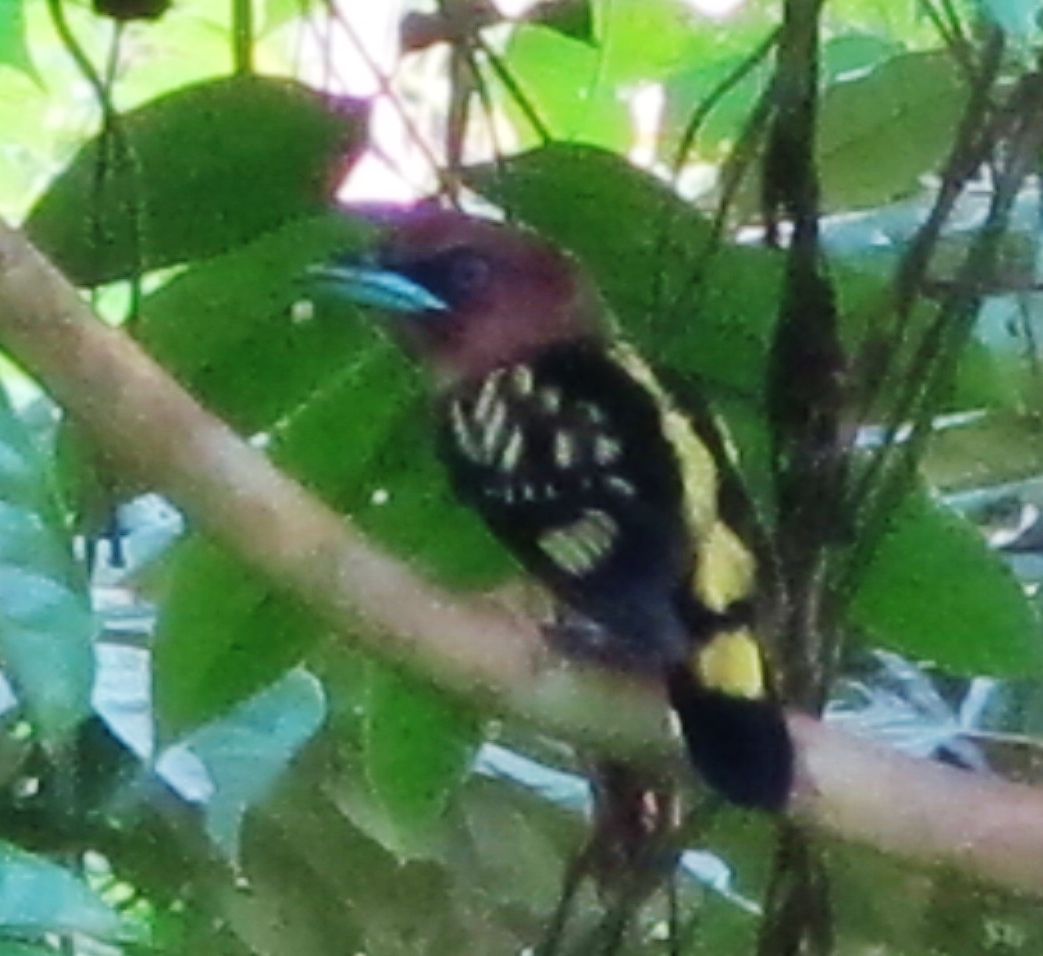
Park HQ: Apart from sleeping here, I spent very little time here but did see a Black-and-yellow Broadbill early one morning.
Research center (lower part): Crested Jay, Black-and-red Broadbill, Sultan Tit.
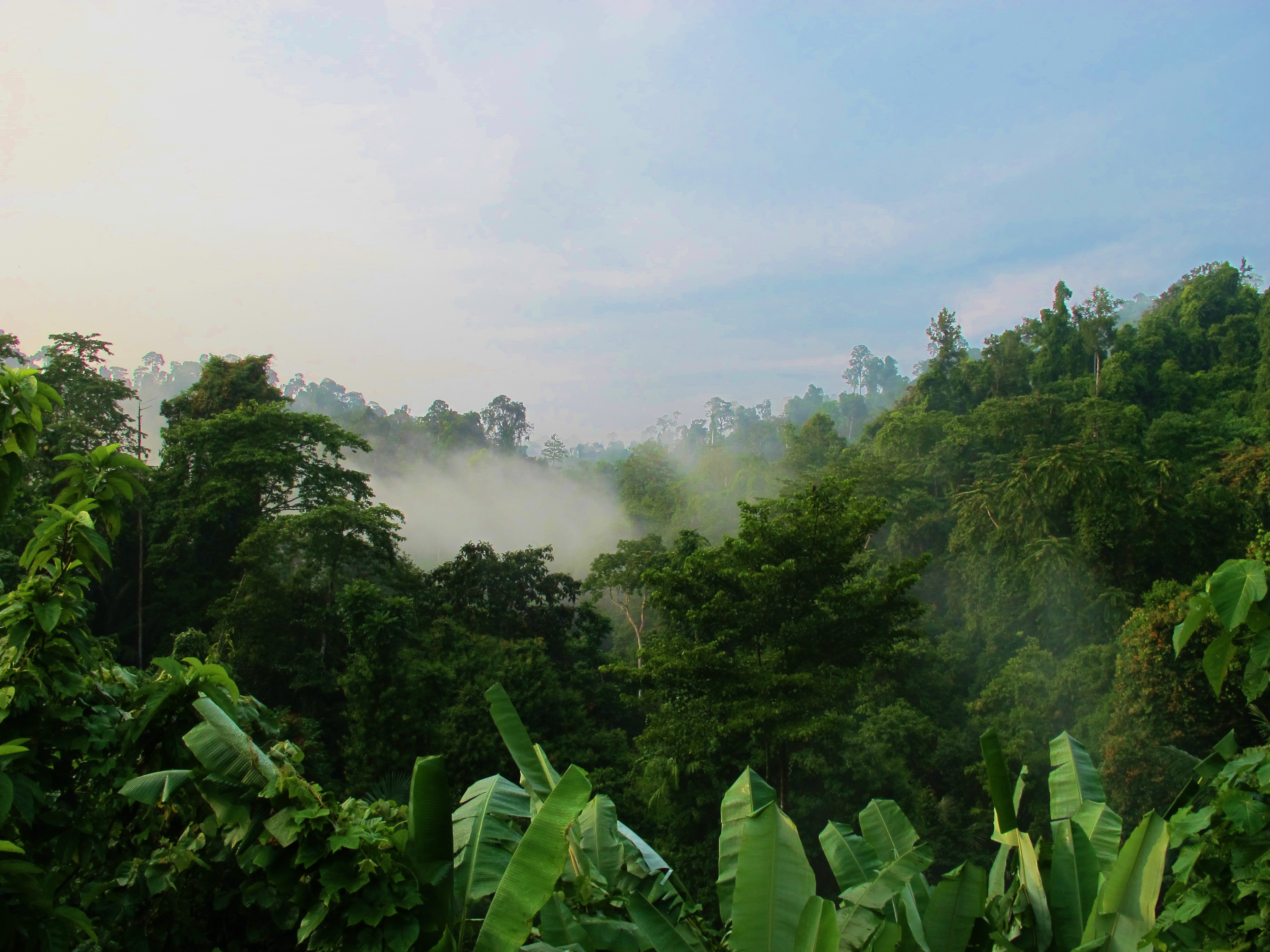
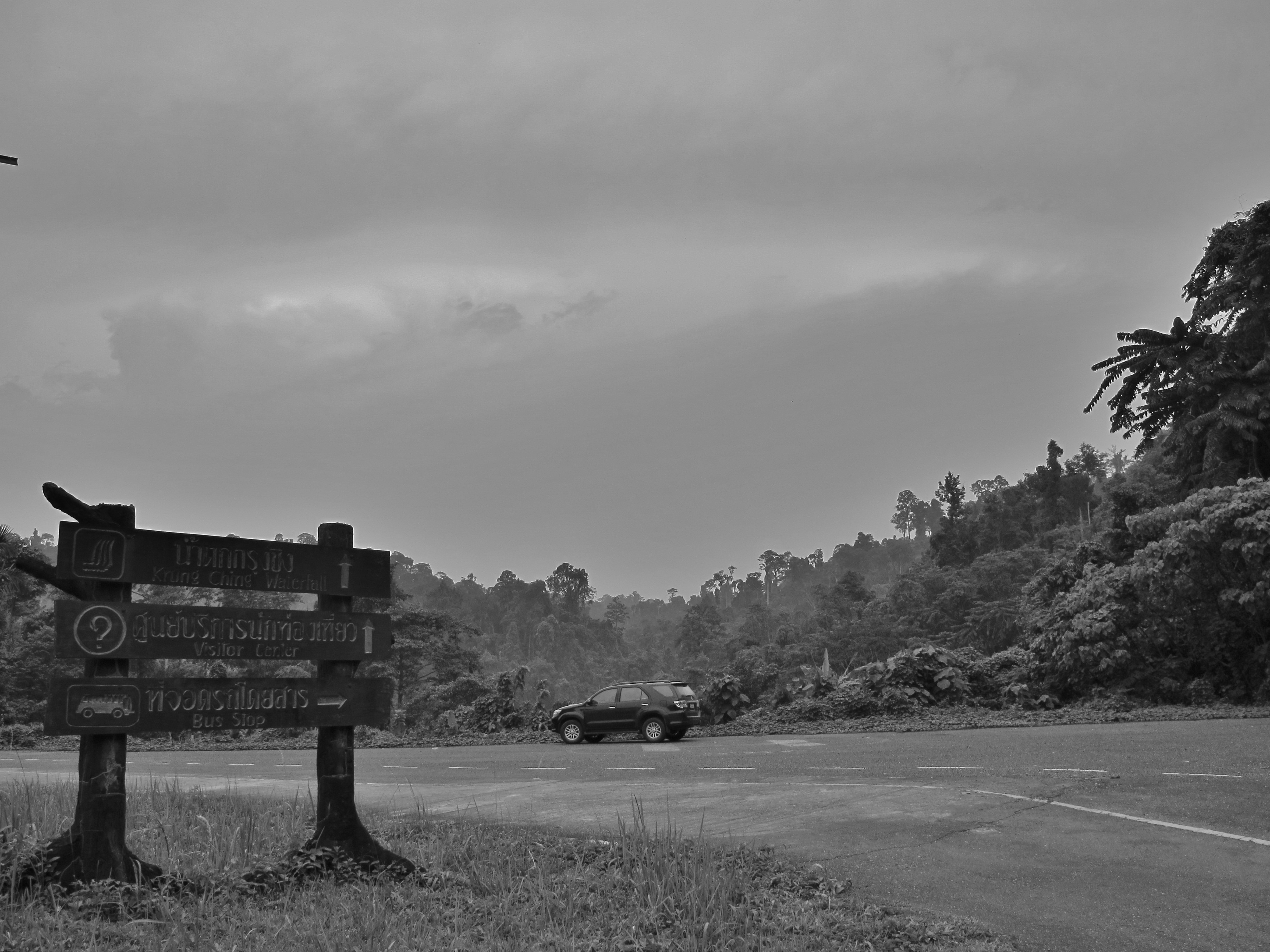
Early morning views across the rainforest canopy at Krung Ching.
I visited Krung Ching for 3.5 days as part of a solo wet season birding tour of southern Thailand. My aim was to have a crack at seeing some of the elusive specialties of the area (Malayan Banded Pitta, Rail-Babbler ….) as well as getting some common southern Thailand forest birds on my Thai list that until now I had only seen in Borneo.
There seems to be little information about birding southern Thailand in the low season, so hopefully this report is of use to those planning to visit the area at this time of year.
Transport: I arrived at Phuket airport on an Air Asia flight from Bangkok. I had reserved a rental car online with Sixt rent-a-car, via the Auto Europe broker website – the low season rate for their cheapest car was less than 600 baht per day with unlimited mileage. Upon arrival, I was upgraded free of charge to a Toyota Fortuner SUV, which turned out to be an excellent vehicle for long drives, and not bad on the gas mileage either.
Driving directions: The jumping-off point to Krung Ching waterfall is the small town of Tha Sala, in Nakhon Si Thammarat province. Tha Sala is about 300km from Phuket airport, on mostly good roads, about a four hour drive via highways 4, 44, and 401.
Entering Tha Sala from the north on highway 401, turn right on road 4140 at a major intersection with a large Tesco Lotus on the left. Continue for 37km (the road becomes the 4186 after 16km), until a small village where a turning on the left is signposted to Krung Ching waterfall. Drive for another 6.3km, then turn left again at a wooden signboard next to a shelter. This is the village of Phitam. There is a very bumpy bridge, follow the road around to the left here, then turn right on a small road opposite a temple. This road winds uphill, passing several a few houses then entering forest, until the park entrance checkpoint after 2km.
Accommodation: Krung Ching is in a remote area and the accommodation situation is limited. The ranger station inside the park has basic bungalows for rent. I didn’t enquire about these as facilities within the park are absolutely minimal and I didn’t feel like staying there. From other trip reports, I understand that the bungalows cost 700 baht per night. You could also camp – the park office has tents available which you may be able to hire if you don’t bring your own.
About 10km from the park is the comfortable Krung Ching Hill Resort, which may be closed in low season (no one was there when I investigated). There are also supposedly some cheap homestays in Phitam village, but there were no signs in English so I couldn’t find them.
On the first night I arrived late, and after a half-hearted trawl around looking for a bed for the night, I parked next to the entrance gate and slept in the car. On subsequent nights, I stayed in Tha Sala at a brand new hotel/coffee shop on the main street called Madison Boutique Hotel. There’s an English sign outside, the owners speak English, and the rooms are stylish and comfortable with hot shower and AC. They offer reasonable value at 690 baht per night.
It takes about 45 minutes in the early morning to drive from Tha Sala to the park, a sacrifice I considered well worthwhile in exchange for nice accommodation, the convenience of 7-11 and Tesco Lotus stores, and a better choice of places to eat in the evenings.
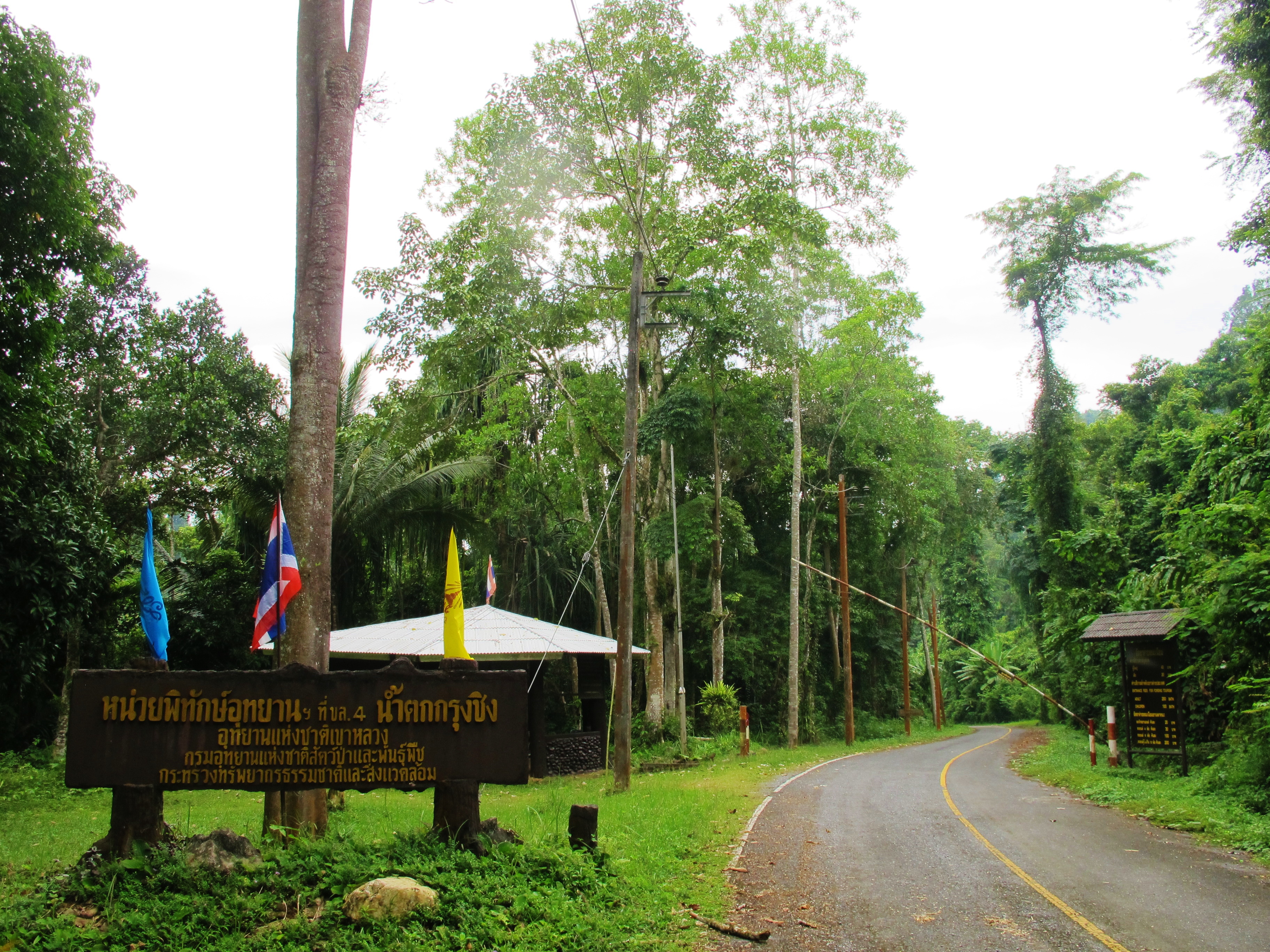
Krung Ching entrance checkpoint, which was unmanned during my visit.
Food: The best bet is to bring all your supplies to Krung Ching. If you are very stuck, there is a small shop at the ranger station, selling the most basic of provisions (and hot water for tea/coffee is available). Opening hours are erratic, depending on whether there are any staff around or not. There is a slightly larger shop in Phitam village, next to the bumpy bridge, which also sells beer. The village also seemed to have a food stall or two but I didn’t check them out.
In Tha Sala, there is a slightly wider – but still limited – range of tourist-friendly food choices. At the far end of the same street as the Madison Boutique Hotel, on the other side of the traffic lights, is a guesthouse/bar/restaurant that has draft beer, a pool table, and a menu in English. Tesco Lotus has a food court which will do at a pinch. There are also some local food stands in the town center outside the main 7-11, and some larger seafood restaurants on the outskirts of town.
Fees: The official entry fee is 200 baht per day, plus 30 baht for a car. However, during my visit the entrance checkpoint was unmanned, so no one checked me as I went in or out. I was approached by a staff member on the second day as I walked past the ranger station, and I had to buy a ticket – but after that I was a familiar face around the place and they didn’t ask me again, so I paid just 230 baht in fees despite visiting on four consecutive days.
Weather: A quick glance at the vegetation is enough to see that it rains a lot here, all year round. Late August is theoretically the dry season in the southern Gulf, so perhaps it rains a little less at this time of the year: stream levels were relatively low, and while leeches were present on the Waterfall Trail, they were manageable with just a handful of bites per day. The days usually started with fog, which quickly burned off to give clear weather for a few hours. Increasing heat brought clouds and threatened showers from lunchtime onwards, but it didn’t usually rain until the late afternoon, and I actually only got rained on once before 4pm during my 3.5 day stay.
Birding: This site fully lived up to its billing as one of the foremost birding locations in southern Thailand. Those birders familiar with difficult sites like Khao Nor Chuchi will find this place to be like a breath of fresh air. The roadside is a hive of avian activity for the first few hours of the day, and while the dark and damp Waterfall Trail is predictably quieter and more difficult, there are still enough birds along here to produce quite a respectable tally over the course of a morning. Afternoons, on the other hand, were typically sultry and near-birdless except for one day when the temperature was a little lower and bird activity correspondingly higher.
Some of the trickier resident birds, for example Broadbills, seemed more vocal and conspicuous than I had been expecting. However, the tougher forest birds weren’t calling – I was lucky to see a male Malayan Banded Pitta, but failed to get a sniff of a Great Argus, didn’t hear any of the rarer kingfishers, and had to be content with a single snatch of song from a distant Malaysian Rail-Babbler. Finally, it was interesting to see a few migrants already appearing in the area, namely Forest Wagtail, Yellow-rumped Flycatcher and Tiger Shrike.
My final total of bird species seen inside the park was 89, in 3.5 days of birding, or just over 30 hours in the field.
Banded Broadbill – the only one I saw during the trip, whereas Black-and-yellow, Dusky, and Green Broadbills were all seen virtually daily.
Birding sites:
A lack of trails means that birding is restricted to just three main areas:
The road from the entrance checkpoint down to the helipad. This 300 meter stretch produced so many good birds in the early morning that it was hard to tear myself away. The afternoons were much quieter but hanging out at the helipad still produced the occasional interesting sighting.
The campsite. A smaller selection of birds than the roadside, but a good place to eat lunch and observe flowerpeckers, leafbirds etc. on fruiting trees.
The Waterfall Trail. The best site for the most elusive forest species. I followed this trail until a few hundred meters past the shelter, focusing on the level section from about Km 0.8 until Km 2.1. The shelter itself was an excellent place to sit and wait for birds to pass through.
Bird list (all birds seen, heard-only birds not included):
Oriental Honey Buzzard – pair seen regularly from helipad.
Crested Serpent Eagle – one seen over campsite, also heard several times along Waterfall Trail.
Wallace’s Hawk Eagle – pair seen once along roadside.
Emerald Dove – occasional singles on roadside and Waterfall Trail.
Banded Bay Cuckoo – two singles seen, at helipad and along roadside, several others heard only.
Plaintive Cuckoo – one seen along roadside, several others heard only.
Violet Cuckoo – one seen overflying helipad, its undulating flight and “kee-vick” call are distinctive once learned.
Asian Drongo Cuckoo – one sunning itself in trees beside the helipad.
Black-bellied Malkoha – singles seen twice near helipad.
Raffle’s Malkoha – seen several times along roadside and Waterfall Trail.
Red-billed Malkoha – pair seen once along roadside.
Chestnut-breasted Malkoha – the commonest Malkoha, regularly seen along roadside and Waterfall Trail.
Glossy Swiftlet – two seen overhead near helipad, a distinctively small, dark swiftlet with bat-like flight.
Germain’s Swiftlet – occasional flocks overhead. Not all swiftlets were positively identified but all those closely scrutinized appeared to be large and pale so most were probably of this species.
Asian Palm Swift – single bird passing over helipad.
Orange-breasted Trogon – two singles along Waterfall Trail.
Great Hornbill – pair seen flying over road.
Wreathed Hornbill – up to 15 birds regularly seen from the helipad, flying overhead each morning presumably on their way from a roosting site.
Common Kingfisher – one at the campsite stream.
Red-bearded Bee-eater – two singles along roadside.
Sooty Barbet – small flocks quite commonly seen and heard in all areas.
Blue-eared Barbet – one seen at campsite, others heard.
Red-throated Barbet – fairly commonly seen and heard.
Gold-whiskered Barbet – two singles seen.
Streak-breasted Woodpecker – singles along roadside and at helipad.
Rufous Woodpecker – one along Waterfall Trail.
Buff-necked Woodpecker – female along Waterfall Trail, 50 meters past the shelter.
Maroon Woodpecker – seen and heard daily along Waterfall Trail.
Grey-and-buff Woodpecker – one near helipad.
Black-thighed Falconet – pair regularly seen in bare treetops on the ridge to the right as you walk down the road towards the helipad.
Vernal Hanging Parrot – one in treetops at the helipad, and another overflying the area.
Green Broadbill – three singles, two on the Waterfall Trail and one at the helipad.
Banded Broadbill – just one, along the roadside.
Black-and-yellow Broadbill – commonly heard singing, seen a few times around the entrance checkpoint and helipad.
Dusky Broadbill – surprisingly common, up to 6 seen every morning along roadside or near helipad.
Malayan Banded Pitta – prolonged views of a male on the Waterfall Trail about 400 meters before the shelter.
Bar-winged Flycatcher-shrike – two along roadside.
Green Iora – one along Waterfall Trail.
Great Iora – distinctive black-backed form seen several times along roadside and Waterfall Trail.
Fiery Minivet – small groups seen daily flying between treetops along the roadside.
Lesser Cuckooshrike – three singles along roadside.
Tiger Shrike – two juveniles along roadside near checkpoint, which although quite skulking were easily located by their loud welcoming committee of seemingly every flowerpecker, sunbird and spiderhunter in the area.
Dark-throated Oriole – fairly commonly seen and heard along roadside.
Bronzed Drongo – occasional singles along roadside.
Greater Racket-tailed Drongo – seen daily along roadside.
Black-naped Monarch – a few seen and heard along both roadside and Waterfall Trail.
Barn Swallow – one flew through the area, seen from the campsite.
Striated Swallow – three passing over the campsite were of this species and not the perhaps more likely Rufous-bellied Swallow.
Velvet-fronted Nuthatch – one along Waterfall Trail.
Black-crested Bulbul – one along Waterfall Trail.
Grey-bellied Bulbul – one along roadside.
Stripe-throated Bulbul – commonly seen around campsite and helipad.
Red-eyed Bulbul – very common.
Hairy-backed Bulbul – fairly common along Waterfall Trail, especially near the shelter.
Ochraceous Bulbul – small groups seen at the edge of the campsite and the helipad.
Yellow-bellied Bulbul – pair along Waterfall Trail.
Yellow-bellied Warbler – several in bamboo along Waterfall Trail.
Common Tailorbird – common at campsite, roadside and helipad.
Dark-necked Tailorbird – common at campsite, roadside and helipad.
Rufous-tailed Tailorbird – one along roadside.
Pin-striped Tit-babbler – common along roadside.
Fluffy-backed Tit-babbler – a pair and a single seen along the Waterfall Trail.
Chestnut-winged Babbler – one of the more numerous babblers, regularly seen along Waterfall Trail.
Moustached Babbler – two along Waterfall Trail.
Scaly-crowned Babbler – two along Waterfall Trail.
Black-capped Babbler – one seen along first 50 meters of Waterfall Trail.
Short-tailed Babbler – several along Waterfall Trail, and one pair along roadside.
Asian Fairy Bluebird – seen several times around campsite.
White-rumped Shama – singles along roadside and Waterfall Trail.
White-crowned Forktail – three seen in damp stream beds along Waterfall Trail, and a further single along the roadside.
Yellow-rumped Flycatcher – male at campsite.
Greater Green Leafbird – one seen daily in fruiting tree at campsite.
Lesser Green Leafbird – common.
Blue-winged Leafbird – common.
Yellow-breasted Flowerpecker – occasional individuals seen, especially along roadside near checkpoint.
Crimson-breasted Flowerpecker – male near the shelter along Waterfall Trail.
Yellow-vented Flowerpecker – one in a fruiting tree at the campsite.
Orange-bellied Flowerpecker – regularly seen at campsite.
Scarlet-backed Flowerpecker – one male at campsite.
Ruby-cheeked Sunbird – seen several times along roadside and Waterfall Trail.
Plain Sunbird – one along roadside.
Red-throated Sunbird – one male at helipad.
Crimson Sunbird – fairly common along roadside, also seen Waterfall Trail.
Long-billed Spiderhunter – one at campsite; other large spiderhunters seen in flight may also have been this species.
Little Spiderhunter – very common.
Yellow-eared Spiderhunter – pair at clearing along the Waterfall Trail about halfway to the shelter.
Grey-breasted Spiderhunter – singles along Waterfall Trail and roadside.
Grey Wagtail – one at the campsite stream.
Forest Wagtail – single migrant on the road.
The “helipad” – an excellent spot especially in the early mornings.
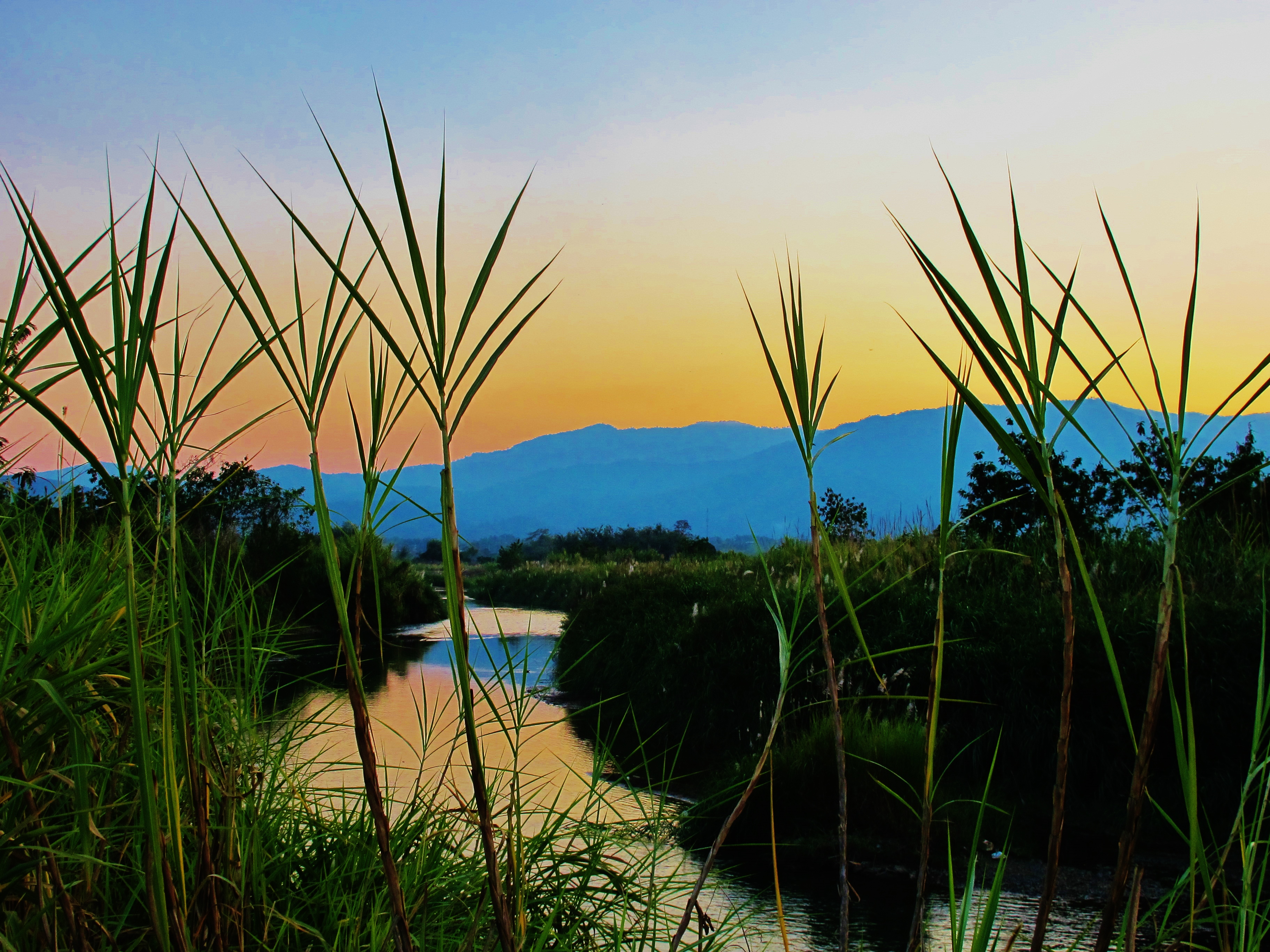
Sunset at the Ping River, south of Chiang Dao (photo taken in February 2015).
I spent 8 days in the area on various dates between August 10th and 22nd, 2015. The weather was quite good, with only one day of constant rain – in fact many of the days were predominantly hot and fairly sunny with an occasional heavy afternoon shower or overnight rain.
The bad ……
The trails are muddy and slippery. The Nature Trail and Fence Trail are very steep on places and in my view basically impassable, even dangerous.
The Summit Trail is not maintained at this time of year, and is officially closed – again it would probably be impassable even for the truly determined.
The Gully Trail near the temple contains water during this season. Rain boots are necessary, and overhanging vegetation is only periodically cleared by the monks. In other words, not ideal birding conditions.
Although I didn’t try going there, I expect the DYK substation area would be impossible to reach unless you have a good 4×4 vehicle and plenty of skill. The approach track is extremely steep in places and would be very slippery and muddy after rain.
Mosquitoes are abundant especially early and late.
Owls and other night birds are not vocal at this time.
…. and the good:
Bird activity is high, and continuous throughout the day.
Very few other people are around, making for relaxing birding.
It doesn’t rain as much as you might expect from the “rainy season” and my birding activities were rarely curtailed by the weather.
Notable bird sightings
I birded for just a few hours each day in the early morning and usually for an hour or two in the late afternoon. I spent almost all of my birding time around the Wat Tham Pha Plong, along the road between there and Chiang Dao Nest 1, and on the Muang Khong road as far as the checkpoint. I tried and failed to get far along the Gully, Fence and Nature trails. On one occasion, I drove beyond the checkpoint as far as the high point of the Muang Khong road (at about Km 16), and I made one afternoon visit to the Chiang Dao rice paddies.
Scaly-breasted Partridge: two at the beginning of the Gully Trail.
Rufous-winged Buzzard: one from Chiang Dao Nest 1.
Besra: one along path to monk’s residences above gully.
Banded Bay Cuckoo: heard only, near start of Summit Trail.
Collared Owlet: heard calling several times near the temple, the only owl species heard.
Crested Treeswift: easy to see at this time of year, viewable daily from Chiang Dao Nest 1.
Orange-breasted Trogon: one in forest along the jeep track on the right, just before the high point of the Muang Khong road.
Oriental Pied Hornbill: up to 4 birds together, seen regularly late afternoon from the temple or checkpoint road.
Blue-bearded Bee-eater: seen opposite Chiang Dao Nest 2 and along checkpoint road.
Grey-headed Woodpecker: a pair about 50 meters before the checkpoint, my personal first record of this species in the area.
Long-tailed Shrike: one near the river south of the rice paddies, a nationally declining species.
Large Cuckooshrike: one near highest point of Muang Khong road.
Streaked Wren-Babbler: one at the temple steps but much less conspicuous here than in the dry season.
Black-throated Laughingthrush: a pair in thick scrub behind Chiang Dao Nest 1 seen twice from my bungalow balcony, and another opposite Chiang Dao Nest 2, not a bird I have seen here in the dry season.
Dark-sided Flycatcher: one near the spirit houses at about Km 13 of the Muang Khong road, presumably an early passage migrant.
White-crowned Forktail: one on the stream 100 meters before the checkpoint.
Thick-billed Flowerpecker: in trees next to the high point of the temple.
Purple-naped Spiderhunter: one next to the temple steps.
Baya Weaver: several breeding colonies beside the river south of the Chiang Dao rice paddies.









 Dom the Birder